
THE Philippines has over 36,000 kilometers of coastline, excellent potential wind resources, and a globally recognized maritime workforce — some of the essentials in developing offshore wind farms.
But are the maritime supply chain and workforce ready for offshore wind (OSW) exploration?
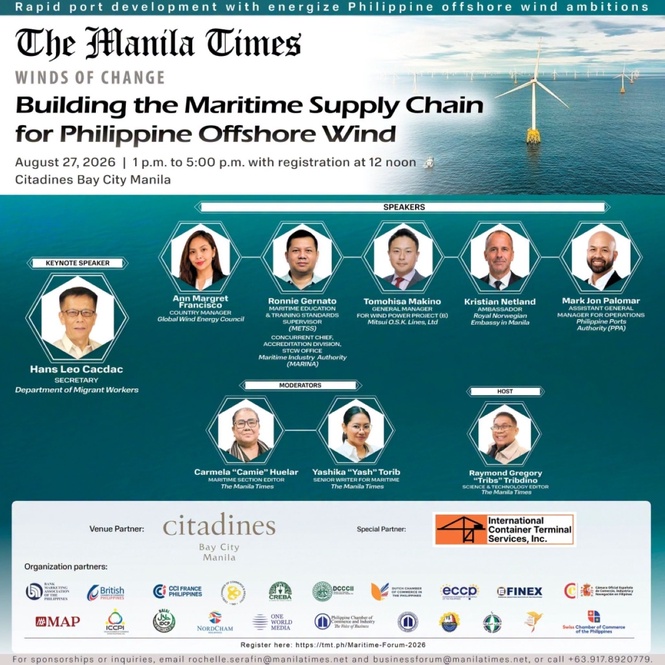
This is the critical question that The Manila Times will address in its Maritime and Offshore Wind Forum on Aug. 27, 2026, at the Citadines Bay City Manila.
The forum, titled “Winds of Change: Building the Maritime Supply Chain for Philippine Offshore Wind,” will explore key issues on OSW.
This includes understanding policies and government frameworks aimed at accelerating OSW permitting and project deployment; port and infrastructure modernization; marshalling yards to handle heavy-lift wind turbines, floating foundations, and specialized vessels; leveraging strengths in shipbuilding, steel fabrication, and cement to build localized supply chains; and job creation and workforce transition for Filipino seafarers, offshore technicians, and maritime workers through green jobs and specialized offshore training.
The forum features industry stakeholders and government leaders such as Migrant Workers Secretary Hans Leo Cacdac, Norwegian Ambassador to the Philippines Kristian Netland, Philippine Ports Authority (PPA) Assistant General Manager Mark Jon Palomar, Maritime Industry Authority (Marina) METSS Supervisor Ronnie Gernato, Mitsui OSK Lines General Manager for Wind Power Project Tomohisa Makino, and Global Wind Energy Council Country Manager Ann Margaret Francisco.
It will be moderated by some of the country’s most seasoned maritime journalists led by Manila Times Maritime Editor Carmela Huelar.
The growing interest on renewable power source, such as offshore wind energy, comes as the country continues to grapple with power supply instability and rising electricity costs.
By generating power through offshore wind, cities may reduce or eliminate grid dependency and subsequently gain protection from rising energy costs.
Offshore wind energy generates electricity through wind farms along inshore water areas such as lakes, sheltered coastal areas, and deeper-water areas.
With a vast technical potential of 178 gigawatts (GW), the country stands on the threshold of a clean energy revolution.
The next challenge, however, is building the maritime backbone that can support large-scale development — from heavy-lift ports and specialized vessels to offshore operations and power transmission. Such development that OSW entails prove that the future of Philippine offshore wind will depend not only on how much wind the country has, but on how ready it is to harness such power.
The Manila Times — the nation’s oldest English daily — invites industry leaders, policymakers, port operators, shipbuilders, and maritime professionals to a critical discussion on how the Philippine maritime sector can build, support, and sustain the offshore wind supply chain.