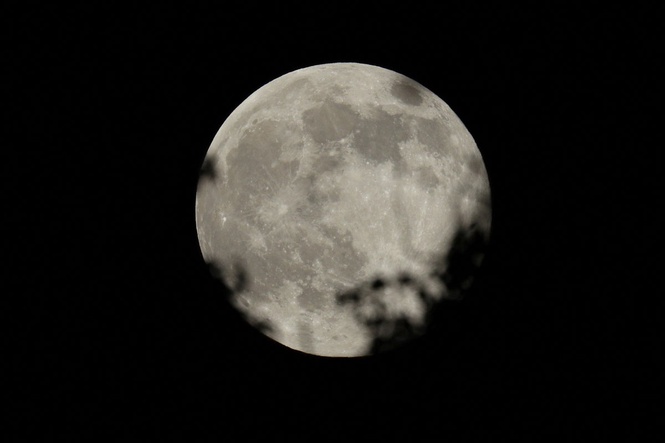
The “Beaver” full moon is currently rising in the night sky, and is looking brighter and bigger than usual.
November’s full moon is notable not only for being the last full Moon of Autumn – but also the first of a run of four “supermoons”. That is the word used for times when the Moon is closer than usual to the Earth, making it appear bigger and brighter than usual.
It could appear up to 30 per cent brighter as well as 14 per cent bigger. The change in apparent size is less clear – though can be seen particularly strongly when the Moon is rising in the sky, and appears even bigger because of its closeness to the buildings on the horizon – but the change in brightness can be striking.
It may be a little covered, however, because of cloud forecast across the UK on Tuesday evening. Unlike many other celestial sights such as meteor showers, however, it is more uncommon for clouds to cover the Moon entirely, and can in fact make the view even more dramatic.
Generally, seeing each month’s full Moon is among the easiest and least complicated ways of keeping an eye on the skies. It requires no particular equipment or timing, and the Moon is easy to locate in the sky.
November’s Moon is sometimes known as the Beaver Moon because it comes at a time when the animals tend to finish building dams ahead of the winter. It is one of a number of names for each month’s full Moon – which tend to claim to historical origins but have become particularly popular in recent years.
More notable, however, is November’s Moon’s place in a run of supermoons. Those events, which have also become more popular in recent years, are seen when the Moon sits particularly close to us.
The Moon orbits around the Earth in an orbit that sees it move closer and further away from the Earth. When the Moon is at its perigee – or its closest point – it is about 30,000 miles nearer than at its apogee, or furthest point.
Supermoons not only effect the view of the Moon in the sky. Because the Moon is closer, its gravitational pull is more powerful – it can bring higher tides than usual, for instance.
Each year brings about three or four supermoons, which arrive in following months because they track the slow movement of the Moon.
Read MoreWe can’t rely on ‘kill switches’ for AI safety, Amazon boss warns
Expert explains why you need to clean your phone – and how to do it safely
Five simple tips to help you protect yourself against scam phone calls