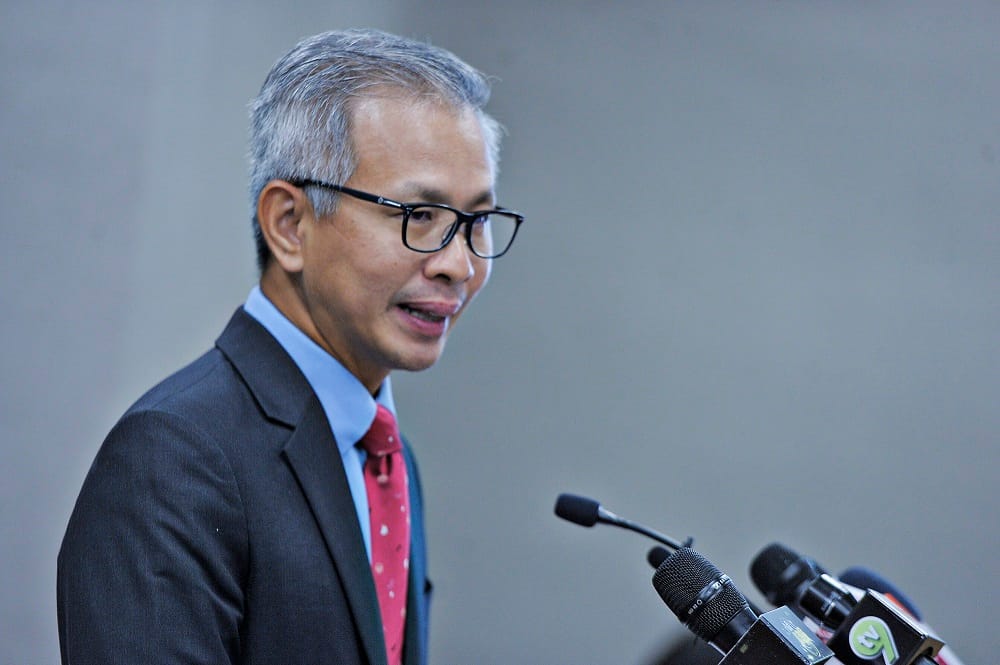
Malaysia has never lacked political controversies. But occasionally, a controversy emerges that raises questions far beyond party politics. It touches the administration of government documents, constitutional institutions, public accountability and the responsibility of those who choose to release sensitive information. The latest controversy surrounding former DAP MP Tony Pua and the Federal Territories Pardons Board minutes concerning Datuk Seri Najib Razak's conditional pardon is one such example. On 18 November 2026, Pua published several pages of what he described as officially declassified minutes from the 64th meeting of the Federal Territories Pardons Board, held at Istana Negara on 18 September 2026. The documents attracted immediate attention because they appeared to record objections from Attorney-General Tan Sri Mohd Dusuki Mokhtar and Federal Territories Minister Hannah Yeoh to the proposed house arrest arrangement for Najib. According to the material shared, the Yang di-Pertuan Agong nevertheless exercised the constitutional power to grant a conditional pardon. But while the political implications of the minutes quickly dominated public discussion, another issue deserves equal scrutiny. Tony Pua is not a member of the Pardons Board. He was not involved in the deliberations, nor was he responsible for the decision concerning Najib's pardon. So, in what capacity did he obtain and publish the minutes? And perhaps even more importantly, why were only five pages shared when the documents appeared to form part of an eight-page record? These are legitimate questions. They deserve clear answers rather than political insults or attempts to silence those asking them.
Tony Pua Was Not a Member of the Pardons Board
First, it is important to understand the constitutional structure involved. Article 42 of the Federal Constitution provides for the exercise of the royal prerogative of pardon. It also establishes the constitutional framework governing the Pardons Board. For the Federal Territories, the constitutional arrangements include the Attorney-General and other appointed members. The Board has a defined institutional role in the consideration of pardon matters. The relevant constitutional provisions can be examined in the “Federal Constitution published through the Attorney-General's Chambers legislation portal”. Tony Pua, a former Damansara Member of Parliament and DAP politician, was not a member of the Board and was not part of the September meeting's decision-making process. That fact, however, does not automatically establish that he had no right to publish information from a document that had lawfully become public. There is an important distinction between having authority to participate in a constitutional decision and having permission to access or reproduce a document after its declassification. A journalist, researcher, former politician or ordinary member of the public does not necessarily need to be a member of a government committee to discuss documents that are legally available for public scrutiny. Therefore, the question should not simply be whether Tony Pua was a member of the Pardons Board.
The more important questions are:
- Who provided him with the minutes?
- Was the document officially declassified before he received it?
- Who authorised the declassification?
- Was the entire document declassified, or only selected portions?
- Was the version published identical to the official record?
These are questions of document governance, not merely political affiliation.
Tony Pua Says He Was Only the Messenger
Following criticism of his disclosure, Pua defended himself. In a report published by “Free Malaysia”. he said he was not responsible for declassifying the minutes and had not participated in the Pardons Board's decision-making. He maintained that he merely referred to minutes that had already been officially declassified and presented the facts contained in them. His position was essentially that critics should not attack the messenger for communicating information that had already been made public. That explanation raises a further question. If the document had indeed been officially declassified, why has the public not received a comprehensive explanation identifying the authority responsible, the date of declassification and the exact scope of the decision? Pua's statement addresses his claimed role in the process. It does not, by itself, answer how the document reached him. There is nothing inherently wrong with a politician discussing an officially released document. Public information should not become the exclusive property of government officials. However, when a document concerns a constitutional institution and a highly sensitive pardon decision, the public deserves to know whether the information was released through a properly authorised process. The issue is not whether Pua is entitled to express a political opinion. It is whether Malaysians have been given the complete and properly contextualised information necessary to understand the document.
Who Actually Declassified the Minutes?
This is arguably the most important question in the entire controversy. On 12 November 2026, Home Minister Datuk Seri Saifuddin Nasution Ismail told Parliament that he would propose bringing the declassification of the minutes to the Cabinet. However, on 18 November, Minister in the Prime Minister's Department (Law and Institutional Reform) Datuk Seri Azalina Othman Said stated that the proposal had not been raised at the Cabinet meeting on 13 November. She subsequently called on the relevant authorities to explain how the minutes had been declassified. Her comments were reported by "The Star" This naturally created confusion. If the Home Minister had indicated that the matter would be brought to Cabinet, but the Cabinet had not discussed it, how did the minutes become available for public circulation?
Five Pages Published. Three Pages Missing. Why?
Now comes the question that has attracted considerable public attention. According to “The Star”, Pua shared five pages numbered 3, 5, 6, 7 and 8. That means pages 1, 2 and 4 were not included in his original social media post. Why? There could be several explanations. The missing pages may have contained administrative information, procedural details, material considered irrelevant to his particular political argument or information that was not authorised for public release. There is also the possibility that Pua simply received an incomplete extract. Without an explanation from the person who published the material or the relevant authorities, none of these possibilities should be presented as established fact. However, the absence of page four became particularly controversial when a copy subsequently circulated on social media. Reports by Malaysian media indicated that the page recorded several views expressed during the Pardons Board meeting, including discussion of Najib's outstanding tax liabilities. The reported contents included the Attorney-General's position that the outstanding tax issue should be considered, while another passage recorded the Yang di-Pertuan Agong's view that the tax matter was not relevant to the consideration before the Board at that meeting. These details were reported in coverage of the circulating page, including “MyNewsHub's report”. But there is a critical distinction: the public circulation of an image does not, by itself, establish that it is an authenticated and complete copy of the official page. That is why the authorities should verify its authenticity and provide the complete context. The question is not whether page four supports one political camp or another. The question is why the original disclosure omitted it and whether the public was given a balanced representation of the meeting. If the objective was transparency, why not publish the complete document that was authorised for public release?
The Government Must Answer, Not Just Political Parties
Thep controversy has already prompted calls for clarification from UMNO and Barisan Nasional representatives. According to “The Star”, BN backbenchers demanded that the authorities verify the documents and clarify their classification status. UMNO also called for an official explanation of the declassification process, as reported by "The Star". But this should not become another political contest between UMNO and DAP. The government has a responsibility to clarify the matter regardless of which political party benefits from the disclosure. If the minutes were lawfully declassified for court proceedings, the government should explain that clearly.If only certain sections were authorised for public release, it should identify those sections. If the documents circulating online are authentic, that should be confirmed through the appropriate channels. And if page four is an authentic part of the same record, the public deserves to know why it was not included in the original disclosure. Transparency cannot mean releasing selected information when politically convenient while leaving the public to guess about everything else.
What Do You Think? I’d Love to Hear Your Opinion in The Comments Section.
The controversy surrounding Tony Pua and the Pardons Board minutes is an opportunity to examine how Malaysia handles sensitive government documents. It should not become an excuse to attack one political party, defend another or turn the constitutional monarchy into a weapon in partisan arguments. Tony Pua is entitled to explain his position. He says he did not declassify the minutes and merely shared information he understood to have been officially released. But that explanation does not eliminate the need for accountability from the authorities responsible for the document.
Equally, the absence of pages 1, 2 and 4 from his original post does not automatically prove that information was deliberately concealed. Nevertheless, the omission raises legitimate questions that deserve an explanation. The government must establish the document's authenticity, clarify the declassification process and explain the scope of what was authorised for public disclosure. Malaysians should not have to depend on political personalities to piece together the contents of a document involving one of the country's most important constitutional institutions. If the minutes can lawfully be disclosed, why not provide the complete authorised version? If page four contains nothing that needs to remain confidential, why should its omission remain unexplained? And if Tony Pua was merely the messenger, who gave him the message in the first place? The public is not asking for political theatre. It is asking for the truth, the complete record and accountability from everyone involved. After all, transparency that only reveals selected pages is not necessarily transparency. It may simply be another form of selective disclosure. And when the document concerns the exercise of constitutional power, Malaysians deserve far better than half a story.
AM World (tameer.work88@gmail.com) is a content creator under the Newswav Creator programme, where you get to express yourself, be a citizen journalist, and at the same time monetize your content & reach millions of users on Newswav. Log in to creator.newswav.com and become a Newswav Creator now!
The User Content (as defined on Newswav Terms of Use) above including the views expressed and media (pictures, videos, citations etc) were submitted & posted by the author. Newswav is solely an aggregation platform that hosts the User Content. If you have any questions about the content, copyright or other issues of the work, please contact creator@newswav.com.