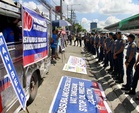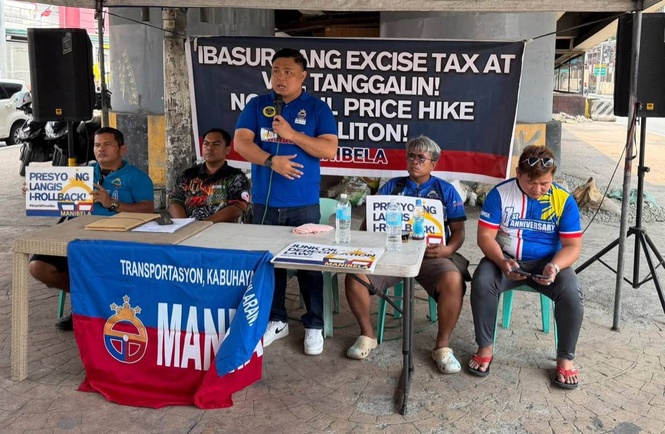
MANILA, Philippines — Transport group Manibela announced on Wednesday a three-day nationwide transport strike from Sept. 28 to 30, 2026 to protest continuous oil price hikes and demand immediate government intervention.
In a media advisory, Manibela Chairman Mar Valbuena criticized the Department of Energy (DOE) for its perceived inaction, stating that escalating fuel prices have severely reduced the daily earnings of jeepney drivers and operators.
"The DOE's inaction is too much, enough is enough," Valbuena said in Filipino.
The upcoming protest follows a two-day nationwide transport strike from Sept. 14 to 15 over similar economic pressures.
Earlier in the day, Transportation Secretary Giovanni Lopez said the government was exploring ways to cushion the impact of sustained increases in fuel prices on public utility vehicles (PUVs) and commuters.
Lopez sought “patience, understanding, and consideration” from the public transport sector and commuters as he assured that the government was implementing various initiatives to help them..
The DOTr chief told them that no less then President Ferdinand Marcos Jr. who has ordered that the needs of transport workers and commuters be addressed amid successive oil price hikes with dispatch.
According to the agency, its initiatives—such as fuel discounts and free tolls on expressways—are being continuously implemented to ease the burden on bus operators and drivers.
Moreover, Lopez said that the Land Transportation Franchising and Regulatory Board (LTFRB) - its attached agency - continues to hear fare hike petitions.
“On fare hikes, this is what I always say: at this point in time, we are still squeezing the government. Whatever initiatives or subsidies we can provide—like our fuel discount, which we know increased from P10 to P12, and which benefits only limited transport modes such as jeepneys and UV (utility vehicle) Express,” he said.
The government has been considering on how to extend it further and include other transport modes, the transport chief added.
Because of high inflation, which also translates into higher prices of goods and services, the top DOTr official said that every decision must be balanced and all factors considered.
“Inflation itself is quite high. Our August inflation was 6.1. If we increase fares, that will surely contribute to inflation,” he explained.
“It will also add to the prices of services and goods. So, what we are trying to say is that the government will absorb this; we will squeeze resources as much as we can—subsidies, various initiatives,” he added.
All DOTr initiatives are ongoing and granting a fare hike would be a last resort, Lopez stressed.