President Donald Trump said on Friday morning that Chinese leader Xi Jinping agrees with him about renaming AI to “super intelligence.”
The president posted on Truth Social the day after he hosted Xi for a state dinner at the White House.
“Very productive meeting with President Xi for both the U.S.A. and China,” the president wrote. “Tremendous things will be happening. Like almost everyone else, he seemed to like calling the poorly and inaccurately named Artificial Intelligence to a far more accurate and important name, SUPER INTELLIGENCE. That would be ‘SUPER!’”
Trump has thus far rebuffed calls for Congress to place new regulations on AI, saying, “The only control or 'guardrails' that AI needs is a STRONG AND SMART (High IQ!) PRESIDENT, and the U.S.A. has that, in spades.”
In response, Trump has attempted to rebrand AI as “super intelligence,” instructing the State Department to rebrand AI under the new banner and that artificial intelligence be referred to as “super intelligence” or SI in all government documents and posts.
During the official visit, Xi seemed to take a more cautious tone to AI than Trump, saying in his initial public address said that the United States and the People’s Republic of China “have the capability and responsibility to develop AI for good, and ensure that AI is always under human control, and serves the well-being of the people.”
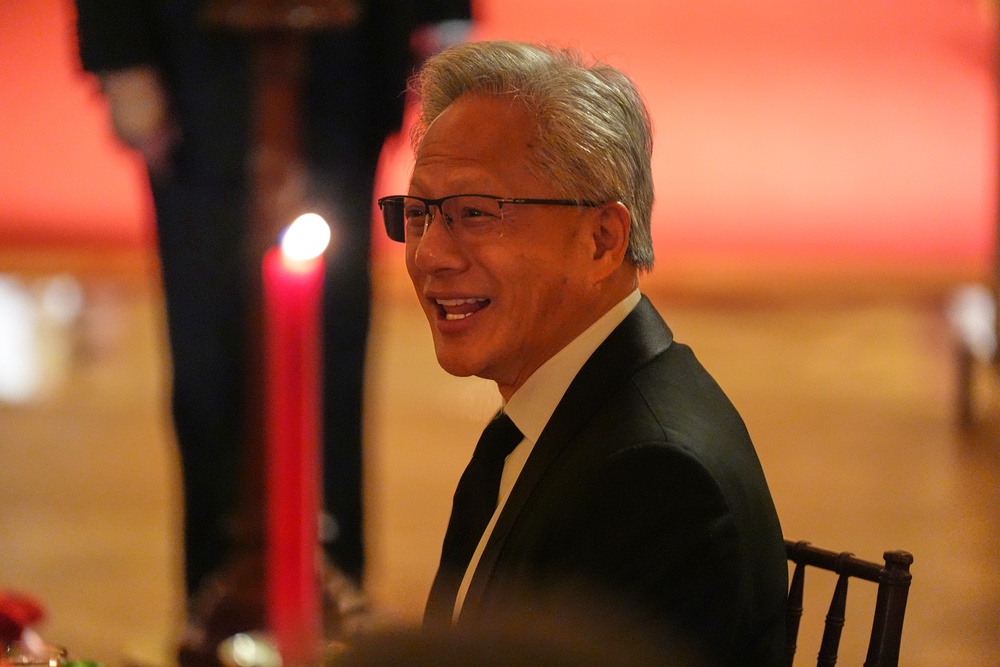
Numerous executives of AI and technology companies attended the state dinner on Thursday evening, including NVIDIA CEO Jensen Huang, OpenAI CEO Sam Altman, OpenAI co-founder Greg Brockman, Tesla CEO Elon Musk and Amazon CEO Jeff Bezos.
The president has taken a relatively lax approach to AI regulation. He enlisted venture capitalist David Sacks to serve as chair of the President’s Council of Advisors on Science and Technology.
Some Republicans expressed concern about the coziness with technology companies.
“Maybe they'd like to come over here and testify while they're here,” Sen. Josh Hawley (R-Mo.), a critic of the technology industry, told reporters before the dinner on Thursday.
But it comes at a time when many Americans and people across the globe have raised the alarm about the risks AI poses. On Thursday, Australian Prime Minister Anthony Albanese revealed that an autonomous artificial agent created by OpenAI hacked a government website that contained the health information of Australians.
Albanese said when the agent sought information from the country’s portfal for Medicare, the nation’s health insurance program, and was refused, “it effectively hacked into that medical portal and got that information anyway.”
In addition, earlier this month, Jacob Coxon, a former AI researcher at Anthropic, raised alarms when he announced his resignation, saying “The people building AI earnestly believe that it could kill us all by the end of the decade.”
The president has responded by saying that such alarms are overblown and said, “This is more of a Hoax than even that of RUSSIA, RUSSIA, RUSSIA, UKRAINE, UKRAINE, UKRAINE, UKRAINE, and Climate Change!”
But some have flagged that “super intelligence” already has a sinister definition meaning AI that could actually surpass human intelligence.
The president and many Republicans argue that the United States should not attempt to restrain AI lest the United States lose the arms race to China.
Still, many Americans, including many of the president’s supporters, fear the risks AI poses and many oppose the construction of data centers that power AI because of the increased electricity costs, the risks to water the noise associated with them.
Read MoreTrump’s pick to lead the FDA won’t say if she thinks birth control is abortion
Trump savaged as ‘un-American’ for his mockery of Biden to communist dictator Xi
A data-sharing clause derailed US-Zimbabwe health talks. Now all funding ends this month
Kennedy Center closure extended despite previous 7-day timeline
Lauren Boebert granted restraining order against the man behind ethics complaint
Board of Peace secretly met with UNRWA despite public disavowal, ex-agency chief says