
Consider the following: After weeks of struggling to escape a quagmire of his own making, US President Trump settled for a vaguely worded interim deal driven by necessity and hammered out by desperation. That is how Trump finally extricated himself from a predicament of his own doing. He was tempted into a war by Israel’s Prime Minister Benjamin Netanyahu. All they have to show is the disruption of the Persian Gulf’s regional order and the havoc wreaked on the global economy. For Trump, reversing the reputational damage to the US and the erosion he has caused to its global standing and military dominance will be a steep climb. The record shows he couldn’t be bothered.
On the other side, Iran’s leadership faced down two far superior military powers, emerging more deeply entrenched and clinching a sweet deal. In the process, it has laid down hard markers against future US-Israeli adventurism. Iran’s neighbours, from West Asia to the Levant, have been put on notice. The current crop has brutally reframed Iran’s deterrence calculus and demolished Israel’s mowing-the-lawn strategy.
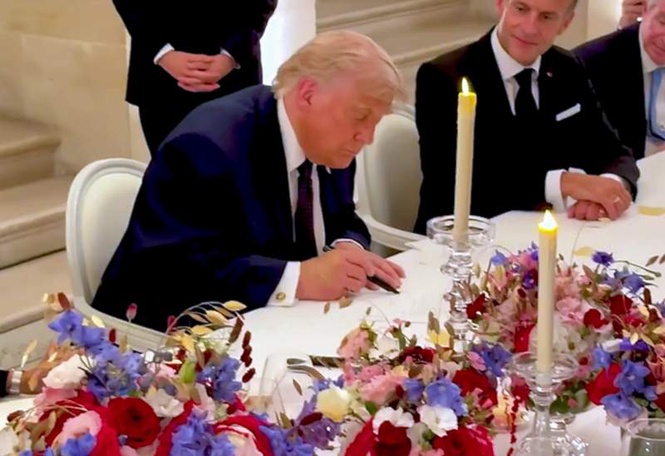
On June 17, Trump and Iranian President Masoud Pezeshkian electronically signed an MoU. Both sides quickly called off a formal signing ceremony scheduled in Switzerland by US Vice-President JD Vance and Speaker of the Majlis, Mohammad Bagher Ghalibaf.
The MoU’s significance cannot be underestimated. It is the first-ever bilateral document between the two adversaries since they cut off diplomatic relations following the Islamic Revolution in 1979 and the US Embassy hostage crisis. Its conclusion follows weeks of negotiations. Trump’s unpredictability was matched only by a new interlocutor on the scene, Qatar, displacing an effete Pakistan overwhelmed by its own self-importance.
Qatar’s persistence, and its clever leveraging of its equities in Iran and the US, is credited for the heavy-lifting needed to get the MoU over the finish line. This is also apparently the same draft the Qataris had conveyed to the Americans over a fortnight ago, but Trump unsuccessfully pressed for more Iranian concessions.
Remarkably, this period also coincided with the outbreak of renewed hostilities: the downing of a US Apache helicopter and Iran’s counter-strikes on US regional bases and Israel. Iran’s messaging was designed to convince Trump that Iran controls the escalation ladder and that he can’t bomb his way out of his own mess.
As finalised, the MoU lays down a “framework” towards a legally binding agreement, to be negotiated over a 60-day period, extendable by mutual consent. This renders the negotiations open-ended. As always, the devil is in the detail. The 14-para MoU can be broadly broken into three main strands.
First, the strategic. Iran has successfully gotten the US to agree to an “immediate and permanent end to the war on all fronts, including Lebanon.” By enshrining its doctrine of unified fronts, Iran has protected its regional proxies, especially the Lebanese Hezbollah. But the US undertaking upends longstanding US-Israeli-GCC demands that Iran stop supporting its Axis of Resistance. Non-interference in internal affairs and a permanent cessation of hostilities are Iran’s other significant gains.
On the critical nuclear issue, Iran “reaffirms that it shall not procure or produce nuclear weapons.” This is not new. But both sides “agreed to resolve the disposition of stockpiled, enriched material pursuant to a mechanism that will be mutually agreed upon.” The vague language should please the Iranians as this punts a core US-Israeli concern well beyond the 60-day window, perhaps indefinitely. Burnt by repeated US betrayals, Iran’s messaging is compliance for compliance.
Second, on economic and financial issues. Iran pockets multiple concessions, including an unprecedented US undertaking “to make fully available for use (Iran’s) frozen or restricted funds and assets” and a sanctions waiver for Iranian sale of oil, gas and petrochemicals. The US has also agreed to help lift all UN, IAEA and other sanctions. There is also a vaguely worded provision on a “plan” for a $300 billion reconstruction and development fund. Unconfirmed reports say the US had consented to the secret release by Qatar and the UAE of nearly $6 billion in frozen Iranian funds.
Finally, of vital importance for net energy importers such as India, the blockade on the Hormuz Strait will be lifted “with no charge for a period of 60 days.” Thereafter, Iran and Oman can “define the future administration and maritime services” in consultation with other Persian Gulf countries. Basically, the US has absolved itself of any further responsibilities for the Hormuz whereas Iran is unlikely to ever give up this leverage, especially given that it has established a “Persian Gulf Strait Authority”. Latest reports are of the resumption of tanker-traffic, especially through the Iranian side.
As is to be expected, the MoU has spawned numerous critics and hardly any supporters. In Iran, the ultraconservative “Paydari (steadfastness) Front”, which has a significant presence in the Majlis, opposed the deal. But once Supreme Leader Ayatollah Mojtaba Khamenei gave his blessing, all factions quietened down. The primary driver is Iran’s desperate economic situation, with its potential to engender post-war anti-establishment demonstrations, as was witnessed this past January.
More importantly, Israeli PM Netanyahu, whom Trump had cold-shouldered, posted a diatribe, making it clear that the MoU is not binding on Israel, which will be guided by its security considerations. Netanyahu faces an election this October and his main opponent Naftali Bennet has vowed to “reset the game”. Backed by the powerful pro-Israeli lobby in the US, Israel can jeopardise the MoU and cripple Trump for the remainder of his presidency. Senator Lindsey Graham, leading the neocon-pro Israel pack, who he desperately needs for his re-election, has made it clear that “any deal with Iran must come to Congress for scrutiny and approval.” Vance helmed the Administration’s defence, declaring: “What we know is this agreement is going to make Israel safer, it’s going to make the entire region safer.”
On the other hand, reactions across the region have been mainly positive. This is no surprise given the war’s enormous collateral damage to the Gulf countries and their economies. New power centres are also coalescing in the region, with a Saudi-Turkey-Egypt-Pakistan (STEP) axis seeking to counterbalance Iran and Israel. The Abraham Accords are destined for a quiet burial, as is the Board of Peace. A chastened UAE is reorienting its strategy and has opened communications with Iran, while Iraq, Kuwait and Qatar, “punished by geography”, will seek to resume their energy exports. Araghchi has briefed his Russian and Chinese counterparts, obtaining their support. An EU statement welcoming the deal was criticised by Ghalibaf, speaker of the Majlis.
No agreement is watertight. The optimistic view is that the Iran-US MoU is poised to form the basis of a new chapter. Given, however, the decades-long mistrust and Trump’s mood swings, the 60-day period, to be extended by mutual consent, offers both sides sufficient leeway. Iran has pocketed much-needed economic concessions upfront in return for undertakings which it has safeguarded with sufficiently vague caveats.
On the other hand, Trump’s calculation is to secure a lifeline for the Republicans ahead of this November’s elections. An interim deal will hopefully limit the war’s economic damage and ease US inflation, thereby limiting a widely expected rout for the Republicans. A Republican loss of the House will surely embroil Trump and his family in multiple legal challenges and will, in all probability, open him to impeachment proceedings. The Iranians would have factored this in, knowing that time is on their side.