
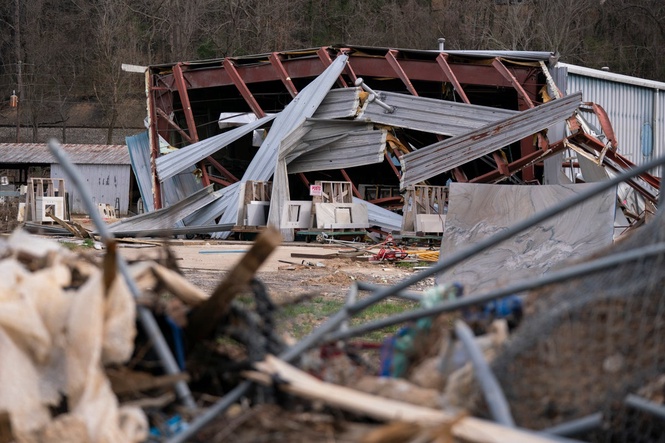
A panel appointed by President Donald Trump recommended sweeping changes to the Federal Emergency Management Agency, the nation’s primary disaster relief organization.
In a 75-page report released Thursday, the FEMA Review Council called for a review of the agency’s staffing levels and a transfer of its core emergency response obligations away from the federal government and to state and local authorities.
“At the end of the day, we know FEMA is broken and it needs to be fundamentally transformed,” former Virginia Governor Glenn Youngkin, who sits on the council, said on Thursday. “What we see here is a need to change, and it has to happen, and it can’t be trimming around the edges.”
Trump established the council shortly after his inauguration last year, following criticism of the federal government’s approach to natural disasters. It is chaired by Defense Secretary Pete Hegseth and Homeland Security Secretary Markwayne Mullin, with 10 additional members serving on the panel.
The council’s recommendations are not legally binding — many would require congressional approval — but they are intended to guide future action.
In the report, the panel proposed conducting a review of staffing levels in response to “a recent surge in headquarters-based personnel” in order “to reduce the agency’s bureaucratic bloat.”
In an earlier draft, the report had recommended slashing “overall staffing by approximately 50%.” That language was removed from the final version.
FEMA currently employs about 20,000 people and has 10 regional offices throughout the country.
The council further suggested shifting the scope of responsibility away from the capital.
“It is time to close the chapter on FEMA. ‘FEMA’ as a brand and as an agency was irreparably damaged by the previous Administration's proclivity to mission creep and endemic program failures,” the report said.
“Therefore, the agency should shift from a District of Columbia-centric bureaucracy and regulatory bottleneck to a new, lean coordination-focused workforce that empowers [State, Local, Tribal, and Territorial] officials to provide relief for their citizens,” it added.
Some stakeholders were not pleased with the panel’s recommendations.
“Americans are facing increasingly frequent and severe weather that’s devastating homes, roads and crops, and the FEMA Review Council’s recommendations don’t meet this reality,” Will McDow, an associate vice president at the non-profit Environmental Defense Fund, told The Washington Post. “The proposed changes would leave communities without the necessary funding, information and access to insurance to stay prepared and safe when disasters strike.”
Trump had suggested cutting FEMA staff by 50 percent – or even getting rid of the agency altogether – in 2025.
This year a number of unions, local governments and other interest groups filed a lawsuite seeking to block reported plans by the Trump administration to cut more than 10,000 roles at FEMA.
The cuts could violate “congressional protections designed to preserve FEMA’s independence and ensure it can carry out its statutory mission,” according to Democracy Forward, a non-profit legal organization representing some of the plaintiffs. The cuts could leave the agency “unable to adequately prepare for or respond to natural disasters and other emergencies, placing lives and property at risk and undermining the very purpose for which Congress created the agency,” Democracy Forward said in a statement.
Established in 1979, the agency has a broad mandate: it delivers individual assistance to people affected by federally declared disasters, provides public grants for debris removal and infrastructure restoration, and funds projects to mitigate future disasters.
FEMA, which is overseen by DHS, spent an average of $12 billion each year on disaster relief between 1991 and 2021, according to the Congressional Budget Office. Its funds are replenished annually by lawmakers, and it generally splits the cost of relief with affected states.
In recent years, the agency has drawn criticism in for sluggish response times, bureaucratic red tape and allegations of political bias.
Since Trump returned to office, communities have experienced the longest delays on record while waiting to see whether the president will approve their requests for federal disaster relief, according to The New York Times.
Editor’s Note: This article has been updated to reflect that the FEMA Review Council’s final report did not recommend a 50 percent cut to staffing levels at the agency. This figure was included in an earlier draft of the report.
Read MoreSadiq Khan accuses Trump of having ‘absurd obsession’ with him
Trump says he will send ‘Election Integrity Army’ into every state for midterms
People are being warned off Trump’s Gold Card immigration plan by attorneys
Iran-US war latest: Trump says Tehran’s response to peace plan ‘totally unacceptable’
Trump wants to check on the gold in Fort Knox because ‘they steal a lot’
Trump’s energy secretary refuses to say gas won’t hit $5 a gallon across US