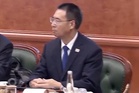
NEW HAVEN, Connecticut — Long on ceremony but short on substance, the eagerly anticipated summit between United States President Donald Trump and Chinese President Xi Jinping was a disappointment. Perhaps not a major disappointment, as expectations were generally low, and as some talk is certainly better than none. But on the major issues of trade, artificial intelligence (AI), Taiwan, and addressing China’s role in two theaters of war, there was little or no progress. Instead, ceremonial flourishes substituted for substance, unmasking the summit as yet another Trump vanity project.
On trade, the two-month extension of the current truce — initially negotiated nearly a year ago in South Korea — was surprisingly short, implying that tariff uncertainty remains high. Pre-summit chatter hinted at an extension of six to 12 months. Moreover, there were expectations of another round of Chinese purchases of US agricultural exports. Instead, the two countries made a joint postsummit announcement to cut tariffs on a total of $60 billion of “nonsensitive” goods, including US imports of electric blankets and magic tricks and Chinese imports of eels and emus.
On AI, the biggest issue facing civilization, there was no meeting of the minds. The two superpowers committed to a loosely structured dialogue and dangled the possibility of an unspecified “hotline” for AI-related national security issues. This bare-minimum achievement is far from the major breakthrough on AI safety many had hoped for, especially in the aftermath of the recent Hugging Face hacking incident and reports of other intrusions that have led some AI insiders to raise human extinction concerns. The disappointing outcome of the summit — which merely paid lip service to such risks — is hardly surprising, considering that Trump has doubled down on his hands-off approach to AI regulation.
On Taiwan, Xi attempted to press the advantage he gained after the Beijing summit in May, when Trump described the pending $14 billion US arms package to Taiwan as a “good negotiating chip.” In view of America’s normally staunch commitment to arming Taiwan, the Chinese side saw this as a major concession, especially given that the deal already had congressional approval. In his opening speech to last week’s summit, Xi urged the US to “adhere to the correct position of opposing Taiwan independence.” But doing so would be a stunning about-face on the “strategic ambiguity” that has long shaped US strategy toward Taiwanese sovereignty.
Finally, China’s role in the wars in Ukraine and Iran escaped scrutiny. As the buyer of some 90 percent of Iran’s oil exports and about 50 percent of Russia’s, China is a major funder of both countries’ military efforts. A new law gives the US president broad authority to address this activity through secondary sanctions and tariffs on those countries, like China, that indirectly support illegal wars. Don’t count on it. Fearful of spoiling the summit’s optics, Trump made no mention of this political hot potato.
Big issues, little effort
By making little effort on the big issues, both in terms of staff preparation and bilateral talks, Trump was painfully transparent about what mattered most to him: impressing Xi and his entourage. Ironically, while the tightly controlled Chinese press delivered enthusiastic messaging back home of Xi’s great successes at the summit, the US broadcast media were muted by Trump’s White House ban on three major news outlets, a shocking crackdown on free speech.
As was the case in Beijing, Trump once again abandoned any semblance of protocol in his cringe-worthy declarations of heartfelt admiration for his “truly great” friend’s leadership skills. The hyperbole was embellished by physical demonstrations of Trump’s affection. The many red carpets would put even China to shame, while the glitzy state dinner with Big Tech “broligarchs” was missing only the grand setting of a Chinese-style ballroom.
Trump attempted to compensate for that by offering Xi a personal tour of his new vanity projects in the White House: the granite helipad, the ballroom construction site, and his rogues’ gallery of annotated presidential portraits. Xi was shown in a rare state of laughter when he came to Trump’s crude and derisive depiction of former US president Joe Biden as an “autopen” — suggesting that the two leaders may share more personality traits than we have been led to believe.
I am hardly the first to bemoan the autocratic symbolism of political leaders’ vanity projects. But there is something considerably more vulgar about Trump’s approach. It consumes him as he approaches the end of his presidency. By slapping his name on monuments, programs and US financial instruments, he routinely violates America’s sense of propriety, which has long held that naming rights are meant to honor and memorialize the deceased. Not so for Trump, who audaciously claimed “I am the code,” when apparently clashing with the ballroom architect over safety issues.
Unfortunately, this has everything to do with Trump’s approach to high-level meetings with America’s most challenging counterpart, China. The heavy lifting of Sino-American engagement has never been needed more to address a host of global challenges. Historically, at critical moments like this, leaders have risen to the occasion. That was not the case on Sept. 24.
There is an important asymmetry in how the two leaders see this moment in time. Xi makes constant references to a world that is “undergoing major changes unseen in a century.” Trump couldn’t care less. His focus on befriending and impressing autocrats — not just Xi but also Russian President Vladimir Putin and North Korean leader Kim Jong Un — and insulting and alienating longstanding allies is part of his twisted sense that the trappings of power are power itself. America’s first-ever vanity summit, while disappointing, sadly comes as no surprise.
Stephen S. Roach is a faculty member at Yale University and former chairman of Morgan Stanley Asia. He is also the author of “Unbalanced: The Codependency of America and China” (Yale University Press, 2014) and “Accidental Conflict: America, China, and the Clash of False Narratives” (Yale University Press, 2022).
Copyright: Project Syndicate, 2026
www.project-syndicate.org
.jpeg?width=1200&auto=webp&trim=0%2C0%2C0%2C0)