
Trump sent in his troops to Venezuela, plucked a duly elected president from his seat, then deposited him in a US jail. Netanyahu and Trump together fired at Iran, claiming that its uranium-enrichment program was an existential threat and that they were exercising the right of “preemptive strike.” The world is still reeling from the fallout of that conflict that Trump apparently does not know how to end. China will not desist in causing mayhem in its border with India even as it persists in its baseless claims in the West Philippine Sea.
What alternative to a rules-based order do we have, really, in the wake of these troubles that have wracked the world. In theory, the binding force of international law comes precisely from the consent of the States that are to be bound by the rules — whether these be embodied in covenants or whether they consist in binding practice, customs taken to be legally obligatory. What global experience has made clear, however, is that power imbalance allows the powerful to choose on the basis of utterly selfish considerations, which rules to abide by and which to ignore. For some time, particularly after the Treaty of Westphalia, it was believed that “balance of power” would serve as a check on any hegemon and compel compliance with the rules. What has perversely happened, however, is strategic equipoise tasked to support mutual lawlessness and the arrant disregard of international law.
And now, we have Trump’s government pummeling the International Criminal Court (ICC) by imposing “sanctions” on its judges and employees and urging allies not to join it. For a very long time, the US pushed against Philippine membership in the Rome Statute. Gloria Macapagal-Arroyo gave in to American finagling. This was the context of the 2005 Pimentel v. Executive Secretary case that sought mandamus to compel the president to transmit to the Senate for its concurrence the Rome Statute. Predictably, the court denied the petition, holding that since it lay with the president to ratify a treaty, her refusal to send it to the Senate for its concurrence constituted her refusal to ratify the treaty. We became parties, though, in the time of President Noynoy Aquino only to withdraw from it when Rodrigo Duterte sensed that there was a very real possibility that he would be a defendant before it.
That the United States has pushed back strongly against the Rome Statute of the ICC is not too difficult to understand. It is the nation that has its uniformed personnel and their officers found on every continent and in many countries, and they fear that the processes of the court may be used to harass and to intimidate their forces. While the rational thing to do would be to bind their contingents all over the world to abide by the rules of international law, American political and economic energy has been directed at crippling the court and causing its demise. That is presumably the reason why, despite calls from enlightened sectors for the Philippines to accede to the Statute once more, our government has made clear its decision not to do so — and this is a pity!
The world should not allow Trump to tell us all what the international order should be. A permanent international tribunal that has jurisdiction over the most egregious crimes that can be committed — crimes against humanity, genocide, war crimes and aggression — should be defended as an abiding, institutional commitment of the peoples of the world against all the atrocities of World War II and the conflicts after that that should have shocked our consciences. The ICC stands for the proposition that it would compromise our humanity to be so habituated to the depths of human depravity to treat these offenses like we do all other crimes on our statute books and to leave them to the vagaries of domestic jurisdiction and processes.
With Anwar Ibrahim declaring without compunction that Taiwan is part of China, yet one more key precept of international law is threatened: the right to the self-determination of peoples. Whatever China may say about history — a recourse it often makes, given the nebulousness of historical claims — the people of Taiwan are a self-governing people, and what they decide about their political future should be determinative. And should the PROC launch a war of aggression to “re-claim” Taiwan, shall the world then let the doleful drama play out — while international law is further eroded and aggression, as a matter of the PROC’s national policy, takes its toll both on human life and our deepest convictions about justice among peoples?
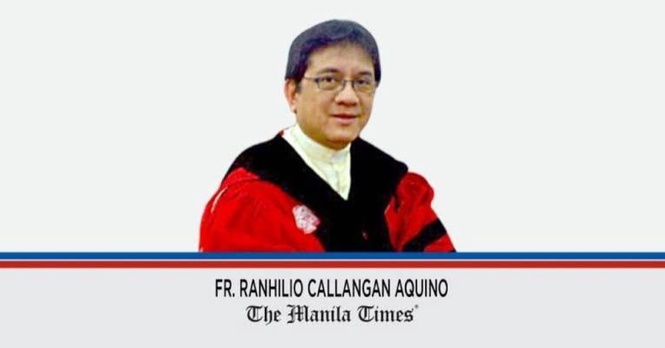
Fr. Rannie Aquino is the dean of the Graduate School of Law, San Beda College-Mendiola.
Trump sent in his troops to Venezuela, plucked a duly elected president from his seat, then deposited him in a US jail. Netanyahu and Trump together fired at Iran, claiming that its uranium-enrichment program was an existential threat and that they were exercising the right of “preemptive strike.” The world is still reeling from the fallout of that conflict that Trump apparently does not know how to end. China will not desist in causing mayhem in its border with India even as it persists in its baseless claims in the West Philippine Sea.
What alternative to a rules-based order do we have, really, in the wake of these troubles that have wracked the world. In theory, the binding force of international law comes precisely from the consent of the States that are to be bound by the rules — whether these be embodied in covenants or whether they consist in binding practice, customs taken to be legally obligatory. What global experience has made clear, however, is that power imbalance allows the powerful to choose on the basis of utterly selfish considerations, which rules to abide by and which to ignore. For some time, particularly after the Treaty of Westphalia, it was believed that “balance of power” would serve as a check on any hegemon and compel compliance with the rules. What has perversely happened, however, is strategic equipoise tasked to support mutual lawlessness and the arrant disregard of international law.
And now, we have Trump’s government pummeling the International Criminal Court (ICC) by imposing “sanctions” on its judges and employees and urging allies not to join it. For a very long time, the US pushed against Philippine membership in the Rome Statute. Gloria Macapagal-Arroyo gave in to American finagling. This was the context of the 2005 Pimentel v. Executive Secretary case that sought mandamus to compel the president to transmit to the Senate for its concurrence the Rome Statute. Predictably, the court denied the petition, holding that since it lay with the president to ratify a treaty, her refusal to send it to the Senate for its concurrence constituted her refusal to ratify the treaty. We became parties, though, in the time of President Noynoy Aquino only to withdraw from it when Rodrigo Duterte sensed that there was a very real possibility that he would be a defendant before it.
That the United States has pushed back strongly against the Rome Statute of the ICC is not too difficult to understand. It is the nation that has its uniformed personnel and their officers found on every continent and in many countries, and they fear that the processes of the court may be used to harass and to intimidate their forces. While the rational thing to do would be to bind their contingents all over the world to abide by the rules of international law, American political and economic energy has been directed at crippling the court and causing its demise. That is presumably the reason why, despite calls from enlightened sectors for the Philippines to accede to the Statute once more, our government has made clear its decision not to do so — and this is a pity!
The world should not allow Trump to tell us all what the international order should be. A permanent international tribunal that has jurisdiction over the most egregious crimes that can be committed — crimes against humanity, genocide, war crimes and aggression — should be defended as an abiding, institutional commitment of the peoples of the world against all the atrocities of World War II and the conflicts after that that should have shocked our consciences. The ICC stands for the proposition that it would compromise our humanity to be so habituated to the depths of human depravity to treat these offenses like we do all other crimes on our statute books and to leave them to the vagaries of domestic jurisdiction and processes.
With Anwar Ibrahim declaring without compunction that Taiwan is part of China, yet one more key precept of international law is threatened: the right to the self-determination of peoples. Whatever China may say about history — a recourse it often makes, given the nebulousness of historical claims — the people of Taiwan are a self-governing people, and what they decide about their political future should be determinative. And should the PROC launch a war of aggression to “re-claim” Taiwan, shall the world then let the doleful drama play out — while international law is further eroded and aggression, as a matter of the PROC’s national policy, takes its toll both on human life and our deepest convictions about justice among peoples?
Fr. Rannie Aquino is the dean of the Graduate School of Law, San Beda College-Mendiola.
rannie_aquino@sanbeda.edu.ph
rannie_aquino@csu.edu.ph