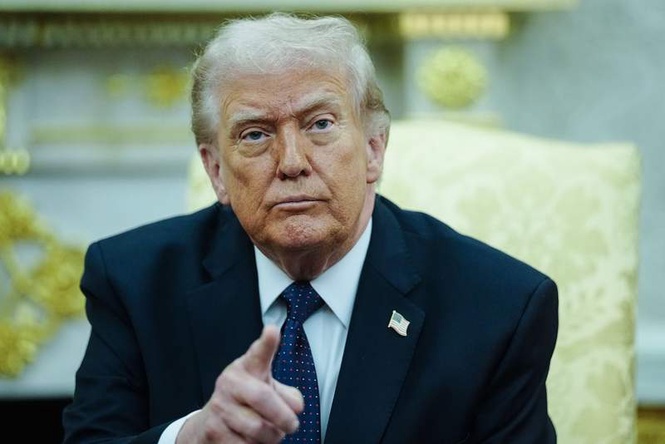
An agreement to end the fighting between Iran and the US is scheduled to be signed on Sunday, after which the Strait of Hormuz is to be reopened, President Donald Trump said on Saturday.
He made the claim without providing details on the timing, location or signatories.
There was initially no confirmation from Tehran, but also no denial.
In a post on his social media platform Truth Social, Trump wrote: "The Deal is scheduled to get signed tomorrow, and immediately after it is signed, the Hormuz Strait is OPEN TO ALL."
The Strait of Hormuz is a key shipping route linking The Gulf to the Arabian Sea, through which a large share of global oil passes.
The war triggered by joint US-Israeli strikes on Iran in late February has sharply disrupted traffic through the strait and driven global oil prices higher.
Earlier on Saturday, mediator Pakistan also signalled that a signing was planned for Sunday, which would also coincide with Trump’s 80th birthday.
Prime Minister Shehbaz Sharif wrote on X that finalization was expected "within the next 24 hours" and preparations were under way for an electronic signing ceremony.
Sharif added that technical-level talks were expected to follow next week. Pakistan’s Foreign Ministry also indicated a signing was planned for Sunday.
Talks have been ongoing since a ceasefire in the conflict took effect in April, but there have been repeated mutual attacks, and an escalation in the fighting in recent days.
The framework deal is intended to serve as a starting point for in-depth talks between Washington and Tehran.
In addition to reopening the Strait of Hormuz, reports indicate that it would extend the ceasefire by 60 days and serve as the starting point for negotiations on Iran’s nuclear programme.
Iran: Closer than ever to a deal
Iran said on Saturday that a deal is closer than ever to being reached for an initial framework agreement with the United States aimed at de-escalating their conflict.
Foreign Ministry spokesman Esmaeil Baghaei said a memorandum of understanding could be finalized "in the coming days," calling such an outcome “very likely,” according to the Iranian news agency IRNA.
As recently as Thursday, the US president had spoken at the White House of a likely signing that might take place as early as this weekend in Europe.
However, Baghaei dismissed reports of an upcoming trip by Iranian officials to Geneva or Islamabad. “No trip is planned for the next one to two days,” he added.
On Friday, Foreign Minister Abbas Araghchi also said a framework deal was within reach. Referring to the so-called Islamabad memorandum, he wrote in a post on X that an agreement "has never been closer."
What's in the deal?
The proposed framework would also include lifting the naval blockade on Iranian ports and reducing Iran’s nuclear programme, news portal Axios reported, citing a senior US official.
Enriched material would be removed or destroyed, though the technical details remain subject to further negotiations expected within 60 days.
Frozen Iranian assets abroad could be released only in exchange for reciprocal steps, and sanctions relief would depend on Iranian compliance. The agreement would also bar Tehran from financing militant groups, according to US reports.
Trump described the prospective deal as more comprehensive than the 2015 nuclear agreement reached under former president Barack Obama, from which he later unilaterally withdrew the United States.
He also warned that, if diplomacy fails, an unspecified “alternative” remains on the table.