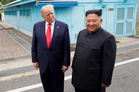
KOTA KINABALU — Last week, United States President Donald Trump appeared once again to be extending an olive branch to North Korea, signaling his willingness to engage its leader Kim Jong Un while calling for a reduction in the scale of joint US-South Korean military exercises. To some observers, this may look like Washington is softening its stance toward Pyongyang. Yet viewed from another angle, it is very much in keeping with Trump’s preferred negotiating style, which is to maintain strength and deterrence, but deliberately lower unnecessary tensions in order to create room for diplomacy.
Trump has never been a conventional practitioner of diplomacy. He believes strongly in the maxim that peace comes through strength, but he is equally comfortable sitting down with adversaries when he believes direct engagement can produce results. His three meetings with Kim during his first term demonstrated this unusual approach, even if they ultimately failed to produce a lasting agreement on North Korea’s nuclear program.
The lesson Trump appears to have drawn is that pressure alone has its limits. If years of sanctions, military exercises and diplomatic isolation have failed to persuade North Korea to surrender its nuclear arsenal, Washington may reasonably ask whether a somewhat different approach could yield better results. Reducing the scale of certain military exercises, therefore, need not mean abandoning deterrence. It could simply be an attempt to reduce the temperature sufficiently to reopen a channel of communication.
This is particularly understandable, given the number of strategic challenges currently confronting Washington. The US is dealing simultaneously with security concerns in Europe, continuing instability in the Middle East and intensifying strategic competition in the Indo-Pacific. American military resources, although unmatched globally, are not unlimited. A more selective deployment of those resources is therefore a matter of strategic prioritization rather than an indication of retreat.
For South Korea, however, the development understandably warrants close attention. Military exercises are not merely symbolic demonstrations. They provide American and South Korean forces with opportunities to maintain interoperability, rehearse joint operations and prepare for a range of contingencies. Any reduction therefore needs to be calibrated carefully so that diplomatic flexibility does not come at the expense of military readiness.
Still, it would be premature to conclude that the US-South Korean alliance is being weakened. Quite the opposite. America remains Seoul’s most important security partner, while the strength of the alliance provides Trump with the confidence to engage Pyongyang from a position of considerable strength.
Indeed, the real danger is not that Washington talks to North Korea. The greater danger would be the absence of dialogue altogether. North Korea is a nuclear-armed state with missiles capable of threatening South Korea, Japan and, potentially, American territory. Communication between Washington and Pyongyang, however imperfect, is therefore preferable to a situation in which military maneuvering becomes the only form of interaction.
There is also an important lesson here for Southeast Asia, particularly amid the broader strategic rivalry between Washington and Beijing.
First, America’s presence in Asia should not be viewed purely through the prism of military deployments. For decades, the US has contributed to regional security while simultaneously becoming an important economic, technological, educational and diplomatic partner for Southeast Asia. American companies, universities and technology firms have helped shape the region’s development just as American military power has contributed to the broader strategic equilibrium.
Consequently, an adjustment in American military deployments does not automatically amount to American abandonment of Asia. Washington may periodically recalibrate its military posture according to changing global circumstances, but that is different from withdrawing from the Indo-Pacific altogether.
Second, Southeast Asia should make better use of America’s continuing strategic commitment to the region. Southeast Asia does not need another Cold War-style bloc confrontation. What it needs is a regional order in which no single major power can dictate the terms to everyone else.
The continued engagement of many partners gives the region more strategic choices. Such diversity is valuable because it reduces the temptation — or pressure — for Southeast Asian countries to choose sides between Washington and Beijing.
This is especially important for smaller- and middle-sized states. Strategic autonomy does not mean equidistance from every major power, nor does it mean pretending that all powers have identical interests or capabilities. It means having sufficient diplomatic and economic options to avoid excessive dependence on any single external actor.
Third, Southeast Asian countries should strengthen their own defense and maritime law-enforcement capabilities. This does not mean embarking on an arms race. Rather, credible national capabilities provide the foundation upon which diplomacy can operate effectively. The sensible formula is therefore not military power versus diplomacy, but military preparedness alongside diplomacy. In simple terms, countries need both a shield and friends.
Trump’s latest overture to North Korea should therefore not automatically be interpreted as a sign of American weakness or withdrawal. It may instead demonstrate Washington’s desire to protect American interests through a more flexible and cost-effective strategy, combining deterrence with diplomacy.
For Southeast Asia, the message is equally straightforward. Regional countries should not panic whenever Washington adjusts its military posture, nor should they assume that American engagement will remain unchanged forever. Instead, they should make constructive use of America’s considerable economic, technological and security influence while simultaneously building greater resilience of their own.
Ultimately, the stability of the Indo-Pacific will depend not on American power alone, but on how that power interacts with capable regional states and responsible diplomacy. Trump’s approach to North Korea may yet succeed or fail. Either way, Southeast Asia should pay attention — not because America is leaving, but because Washington is demonstrating that even a superpower will constantly reassess how, where and at what cost it exercises its power.