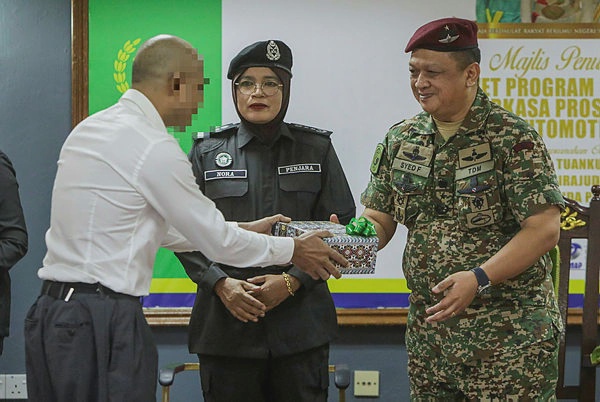
The TVET Re-Drive programme provides Perlis Correctional Centre inmates with practical automotive skills and job placements to build sustainable lives after release.
ARAU: The Technical and Vocational Education and Training (TVET) Re-Drive programme, ‘Empowering Prospects with New Millennium Automotive Skills’, provides prospects (inmates) with an opportunity to build a new life, through skills which can be utilised after their release from prison.
Deputy Commissioner General of Prisons (Community) Hafidz Othman, performing the duties of the Commissioner General of Prisons, said that the programme offered the prospects a second chance to improve themselves through new skills, while building a brighter future.
Hafidz said the high-impact programme, which began last year, was the brainchild of the Raja Muda of Perlis, Tuanku Syed Faizuddin Putra Jamalullail, with a proposal for strategic collaboration between Universiti Malaysia Perlis (UniMAP) and the Prisons Department.
“It opens a new chapter by bringing together academia and correctional rehabilitation, for a brighter future for prospects (prisoners). The programme not only provides a second chance, but also equips them with high-level technical skills which are relevant to the modern automotive industry of the new millennium,” he said.
He said this in his speech at the closing ceremony of the Re-Drive programme, at the Perlis Correctional Centre (Malaysian Prison Department), here, yesterday. His speech was read out by Prisons Headquarters Corrective Division director, Prison Commissioner, Nora Musa.
Tuanku Syed Faizuddin Putra graced the closing ceremony.
Hafidz said a total of 20 prospects from the Perlis Correctional Centre participated in the programme, which covered basic motorcycle maintenance and diagnostics, basic tyre replacement and alignment, and basic painting skills.
The programme’s advantage was that the theoretical and practical training was conducted at the university, while the prospects were also offered employment opportunities by companies in the automotive industry, upon completing their training.
“This support and the opportunities provided are important, to help them become self-reliant, build a stable new life and reintegrate into society with dignity. The programme will be continued in the future, to provide more prospects with opportunities to acquire skills which can be utilised after serving their sentences,” he said.
Meanwhile, one of the prospects, Hafiz (not his real name), who participated in the programme and was released yesterday under the Licensed Prisoner Release (PBSL), said his experience undergoing training through the TVET programme had given him an opportunity to learn automotive skills in a more professional manner.
Hafiz, 30, who was serving a prison sentence for a drug abuse offence, said that previously he had only limited knowledge of automotive skills, which he learned informally in his village.
“I feel fortunate to have been given an opportunity like this, and I hope I can use these skills outside, after I am released,” he said.
Sharing a similar view, another prospect who was also released under the PBSL yesterday, 44-year-old Fazli (not his real name), said the programme had helped him understand various motorcycle components, including methods of detecting faults and determining whether a motorcycle was still safe to use.
“I plan to open a small workshop or provide mobile automotive services after I am released. This programme can really help prospects like us, and I am grateful to the Prisons Department and everyone involved in making this programme a success,” said Fazli, who was serving a prison sentence for a drug abuse offence.