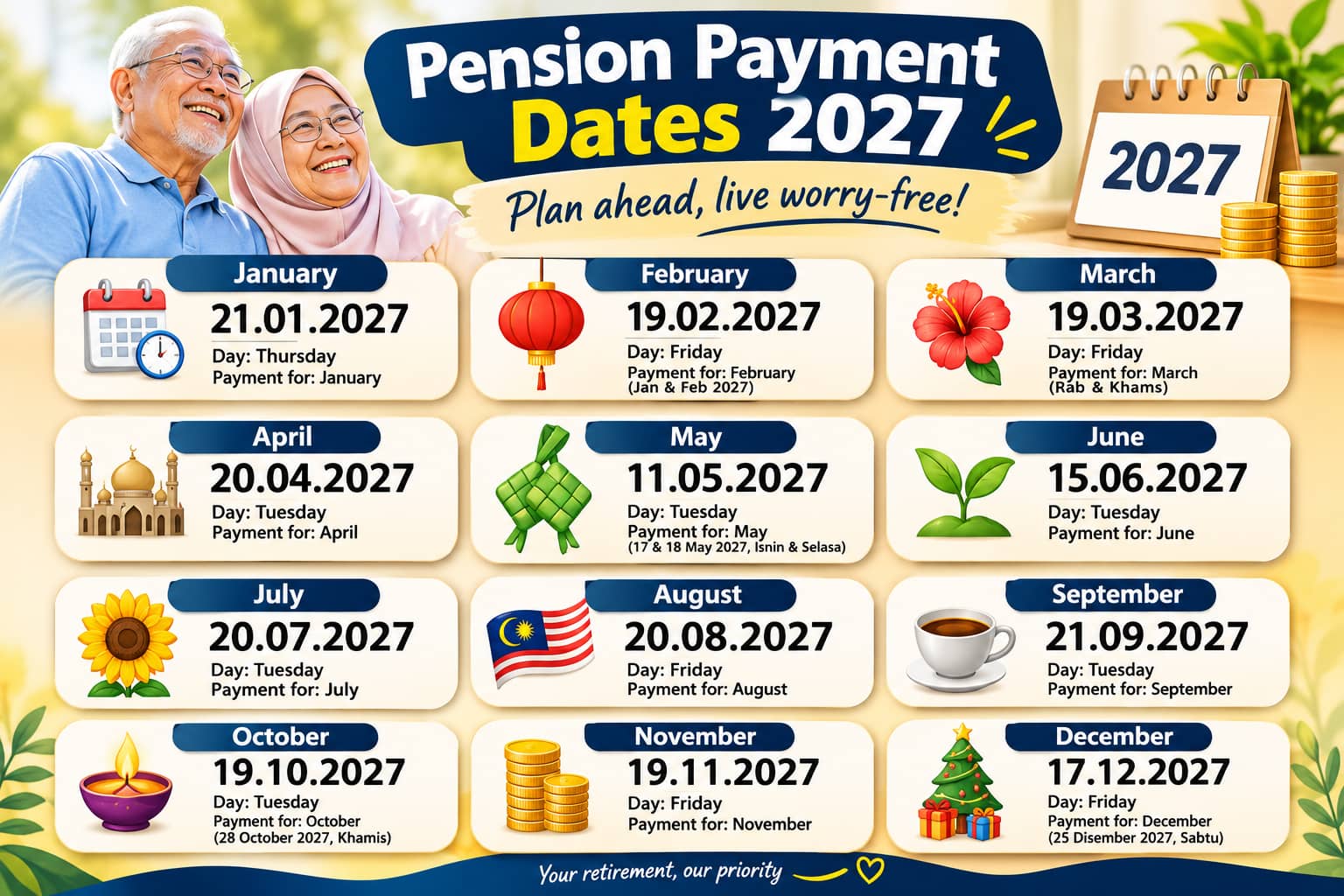
Every year, as soon as the government releases its annual pension payment calendar, millions of copies are quietly screenshot, printed, and pinned onto refrigerator doors or saved in family WhatsApp chats across Malaysia. On the surface, the newly published 2027 schedule from the Public Service Department’s Pension Division looks like a straightforward administrative list: twelve monthly dates stretching from Thursday, January 21, to Friday, December 17, with Tuesday, May 11 standing out as the earliest payout of the year. Yet, for hundreds of thousands of retired civil servants, armed forces veterans, and derivative pension recipients, those twelve dates are the heartbeat of household survival. Behind every calendar entry lies a quiet ritual of budgeting for blood pressure medication, utility bills, grandchildren’s school expenses, and festive preparations. Beneath the cheerful emojis circulating online lies a deeper social and economic truth: when inflation squeezes fixed incomes, the spacing between payout dates matters almost as much as the ringgit amount itself. Recent official disclosures on the 2027 timetable highlight a pressing household reality, showing how festive adjustments such as bringing May’s payment forward ahead of Hari Raya Haji while keeping February and March after major holidays create both welcome relief and unusually long stretches between paydays. This annual release challenges us to look past a simple list of dates and examine how retirement security actually functions on the ground. To push the conversation forward, we must deconstruct the comforting illusion that fixed monthly deposits automatically shield retirees from modern cost-of-living shocks. Instead, we need to examine how the 2027 calendar shapes monthly cash flow, how digital platforms and payment reforms are changing access, and why supporting Malaysia’s aging public-sector alumni demands wider financial resilience in twenty-first-century Malaysia.
Reading Between the Dates: Festive Shifts and the 35-Day Stretch
A closer look at the official calendar published by the Public Service Department’s Pension Division reveals a careful balancing act between administrative routine and Malaysia’s festive rhythm. Most payments fall steadily between the 15th and 21st of each month starting on Thursday, January 21, followed by Friday, February 19; Friday, March 19; Tuesday, April 20; Tuesday, May 11; Tuesday, June 15; Tuesday, July 20; Friday, August 20; Tuesday, September 21; Tuesday, October 19; Friday, November 19; and concluding on Friday, December 17. As noted in an analysis by Rise Malaysia, May 11 arrives roughly a week ahead of Hari Raya Haji on May 17 and 18, while October 19 and December 17 similarly precede Deepavali and Christmas. Conversely, because Chinese New Year in early February and Hari Raya Aidilfitri in mid-March fall earlier in the calendar, those monthly payouts land after the celebrations. The practical consequence for household budgeting is striking: while retirees enjoy a brief 21-day gap between April 20 and May 11, they then face back-to-back 35-day stretches from May 11 to June 15 and from June 15 to July 20. For households managing fixed expenses, spotting those five-week gaps early is essential to avoiding mid-year cash crunches.
Digital Gateways, Scheme Transitions, and Protecting Elderly Recipients
Receiving a pension on time depends not only on treasury calendars, but also on how smoothly payment infrastructure reaches retirees across urban centers and rural villages alike. According to guidance compiled by eCentral, retirees and derivative recipients can verify monthly statements and payment records digitally through the KWAP MyPesara Portal, reducing the need to wait for physical paper slips or queue at bank branches. At the same time, institutional transitions require careful communication so vulnerable pensioners are never caught off guard. As highlighted in reporting on pension administration updates by Rise Malaysia, the Public Service Department has also issued notices regarding transitioning remaining recipients from Scheme B which requires periodic physical verification or representative claims toward direct bank crediting under Scheme A, alongside parallel schedules maintained for armed forces retirees by the Department of Veterans Affairs (JHEV). Modernizing these channels improves convenience and reduces administrative friction, yet it also requires families and community networks to help older retirees navigate digital logins safely and stay vigilant against phone scams that routinely spike around announced payout dates.
Beyond the Calendar: Fixed Pensions in an Era of Rising Living Costs
While knowing exact payout dates brings predictability, predictability alone cannot erase the structural pressure facing retirees living on fixed incomes. Over the past several years, rising food prices, private medical charges, and everyday household overheads have steadily tested the purchasing power of older Malaysians especially those who retired decades ago under lower salary scales. As summarized in overviews of retirement benefits and fiscal measures by eCentral, policy discussions under Budget 2027 including proposed adjustments to minimum pension floors and targeted special financial assistance reflect growing recognition that calendar certainty must be paired with adequate income protection. For many multi-generational households, a parent’s government pension still serves as a stabilizing anchor that supports not just one individual, but extended family resilience. Ensuring that retirement benefits remain meaningful requires continuous institutional attention to healthcare affordability, elderly care support, and transparent pension adjustments.
Cultivating Everyday Financial Discipline Around the 2027 Cycle
Publishing the 2027 timetable months ahead of the new year offers a valuable planning window for retirees and their families to turn passive waiting into proactive financial stewardship. Financial planners routinely encourage fixed-income households to map recurring commitments such as chronic medication refills, insurance premiums, utility autopays, and festive spending against both standard 30-day cycles and longer 35-day intervals like May-to-June and June-to-July. As noted in practical breakdowns by Hi-Edu, staggering pension disbursements around the 15th to 21st of each month separate from active civil service paydays also helps ease congestion at bank counters and ATMs nationwide. When families sit down together to review the calendar, set aside small buffers during shorter payout intervals, and verify official channels before sharing viral messages, those twelve dates become a tool for peace of mind rather than monthly anxiety.
What Do You Think? I’d Love to Hear Your Opinion in The Comments Section.
Ultimately, the release of Malaysia’s 2027 government pension schedule is far more than a routine administrative notice; it is a quiet acknowledgment of the millions of working years built into the nation’s public institutions. We stand at a point where honoring the service of retired civil servants and veterans means ensuring both punctual payments and broader economic dignity in their golden years. True national gratitude is measured not only by how reliably funds arrive on scheduled Tuesdays and Fridays, but by how thoughtfully society safeguards the health, security, and financial peace of those who spent decades serving the country. Navigating retirement in a changing economy requires foresight, family solidarity, and steady institutional care. As households bookmark these twelve dates for 2027, let us remember that behind every pension deposit is a lifetime of public service deserving lasting respect.
AM World (tameer.work88@gmail.com) is a content creator under the Newswav Creator programme, where you get to express yourself, be a citizen journalist, and at the same time monetize your content & reach millions of users on Newswav. Log in to creator.newswav.com and become a Newswav Creator now!
The User Content (as defined on Newswav Terms of Use) above including the views expressed and media (pictures, videos, citations etc) were submitted & posted by the author. Newswav is solely an aggregation platform that hosts the User Content. If you have any questions about the content, copyright or other issues of the work, please contact creator@newswav.com.