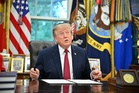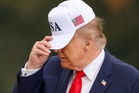
FEW American presidents have been punished by their own voters as thoroughly as Donald Trump was on Tuesday. Democrats took both the House of Representatives and the Senate — only the fifth time since the Second World War that a party has flipped both chambers of Congress in midterm elections. They flipped seven Senate seats, including Texas, Kansas and South Carolina. Voters were angry about rising prices and the war on Iran, and Trump himself conceded to Fox News that "a part" of the reason of his Republican Party’s defeat “was Iran." From Jan. 3, Hakeem Jeffries will be House speaker, and he has listed ending the war among his four priorities.
More telling still was the verdict from inside the White House. In a post on X the day after the vote, Vice President JD Vance wrote that "the reason we lost is the war," and cited a pollster's list of what voters now want: end the war, focus on the cost of living, put America First, and "change our relationship [with] Israel." He then challenged the war's defenders directly: "If you'd like to argue it was worth it, that losing the Senate for the next 6 years was worth it, then do so."
For a vice president long regarded as Trump's heir apparent, this was not a passing complaint. It was the clearest sign yet that the Republican Party's next leadership sees the Iran war — and the closeness to Israel that came with it — as a liability rather than a cause.
A week earlier, Trump's closest partner in the war suffered a setback of his own. Benjamin Netanyahu's bloc finished Israel's legislative elections on Oct. 27 with 53 seats, eight short of a majority, with his Likud party winning only six seats ahead of Gadi Eisenkot's new party. Netanyahu now governs as a caretaker while President Isaac Herzog consults party leaders. Eisenkot, a former army chief, had already said Netanyahu was not fit "to carry out another operation." Yair Golan, another opposition leader, warned after the American midterms that keeping Netanyahu in power could bring sanctions, isolation and a confrontation with Washington, while Yair Lapid has ruled out a unity government under him.
The two men who launched the war on Iran in February are, therefore, weaker today than at any point since it began. The comfortable conclusion is that weakened leaders become cautious ones. It seems the opposite is more likely.
The most effective brake on a renewed war this fall was not any mediator, but the electoral calendar. According to CNN, citing a report from Israel Hayom, Netanyahu was "very eager" for fresh strikes in October and tried to persuade Trump to act before the elections. But Trump declined, having promised on his Truth Social platform that the United States would "not be attacking Iran at any time prior to the Midterm Elections," a pledge that made sense only if attacking afterward remained on the table. Both elections are now over. The brake has gone with them.
What replaces it is a window of roughly nine weeks in which both men have the most freedom and the least to lose. In Washington, the outgoing Republican majority controls Congress until Jan. 3, and the war-powers resolutions that failed all year will keep failing. The Wall Street Journal reported that Trump told Gulf allies to prepare for a brief, high-intensity campaign after the elections, and American officials told CNN that US forces could launch large-scale strikes within 96 hours of an order, against a target list that includes Iran's energy infrastructure. In Israel, experts at the Israel Democracy Institute and the Tachlith Institute told Asharq Al-Awsat that a caretaker prime minister can legally take the country to war. For a leader whose political survival has long rested on his role as Israel's defender against Iran, a fresh confrontation is also the obvious route to the wartime unity government his rivals now refuse him. Vance's post sharpens that calculation. If Trump's heir apparent now treats the relationship with Israel as a reason for defeat, Netanyahu has every reason to conclude that unconditional American backing is running out in both parties at once, and that whatever he wants from Washington, he must get before it does.
For the Gulf, the consequences of an escalation in this window would be immediate. Iran's military keeps reporting tankers burning after striking mines near the Strait of Hormuz, and Brent crude traded above $104 a barrel the morning after the US vote. Last month, Houthi attacks on Riyadh's international airport and an Aramco refinery led Saudi Arabia, Türkiye and Pakistan to invoke their Mecca defense pact for the first time. A renewed American and Israeli campaign against Iran's energy facilities would invite retaliation against exactly those Gulf targets, and Iran's parliament speaker Mohammad Bagher Ghalibaf has already warned that Iran's "NO comes with a Nightmare."
Yet the same weakness also opens a path to settlement, and this is where the story moves to Islamabad. Trump's aides spent election night promising voters lower fuel prices once the Iran conflict is resolved, which is another way of saying that his political recovery now depends on a deal. With his own vice president openly questioning whether the war was worth the Senate, Trump has more reason than at any time since February to listen to those offering him a way out. The question is who can deliver it.
For most of this war, the answer has been Pakistan. Islamabad brokered the ceasefire of April 8, hosted the highest-level direct engagement between American and Iranian officials since 1979 a few days later, and produced the 14-point Islamabad memorandum in June. The memorandum lapsed in August, but Pakistan's Foreign Office says the points now under discussion are fully aligned with it.
At the center of this effort stands Field Marshal Asim Munir. His visit to Tehran on Oct. 20 was his fifth since the ceasefire and one of two he made that month. He is one of very few figures who has sat across a lunch table from Trump at the White House and a negotiating table from Iranian officials in Tehran, and that dual access is the real asset in Pakistan's mediation. Military spokesman Lt. Gen. Ahmed Sharif Chaudhry told Reuters on the eve of the midterms that Munir had played a "critical role" in helping both sides recognize that continued destruction benefits no one, and that Pakistan was "cautiously optimistic," while warning that "powerful spoilers" still want the conflict to continue. Iran's Foreign Minister Abbas Araghchi, confirmed on Oct. 31 that Qatari and Pakistani mediators were still "continuing consultations regarding our conditions."
Pakistan's position is unusual in another respect. Through the Mecca pact, it has pledged to help defend Saudi Arabia, which gives Islamabad standing in Riyadh and Tehran at once, but a wider Gulf war would place it between a neighbor it mediates for and an ally it has promised to protect.
The next nine weeks are, therefore, the most important test of Munir's mediation so far. Islamabad's task is to turn the Islamabad framework into a signed interim text before Jan. 3, working with Doha and Muscat and building on Qatar's phased package, which includes a visit by United Nations inspectors to the bombed facilities. It should also open a channel to the incoming Democratic leadership, which wants the war ended and will need a ready-made framework when it takes office.
The test is simple. If Jan. 3 arrives, a new Congress is sworn in and the Islamabad framework is still on the table without a renewed campaign against Iran, Pakistan's mediation will have carried the region through its most dangerous stretch. If not, the war will have resumed in the one window when the two men who started it had the least to lose.