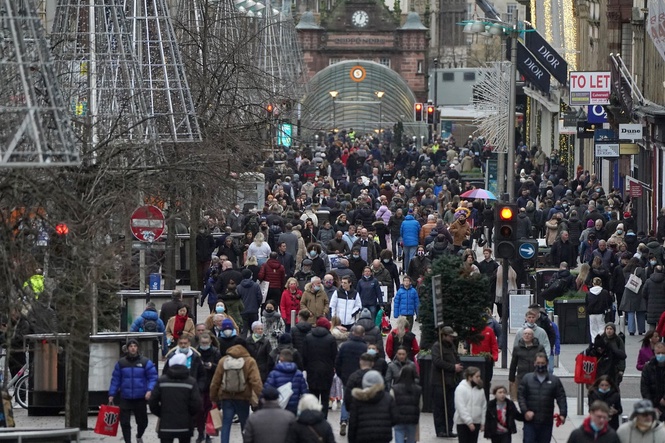
Population growth in the UK has slowed down to its lowest non-pandemic level since 1998, official figures show.
This sharp deceleration is largely driven by an ongoing reduction in net migration, which has fallen steeply after reaching record highs in 2023.
While live births continue to slightly outnumber deaths across the UK, the margin between the two has narrowed.
Disparate trends are visible across the UK's four nations, with Wales recording its first population decline in a decade. Scotland and Northern Ireland experienced virtually no growth, whereas England was the only country to report a minor rise.
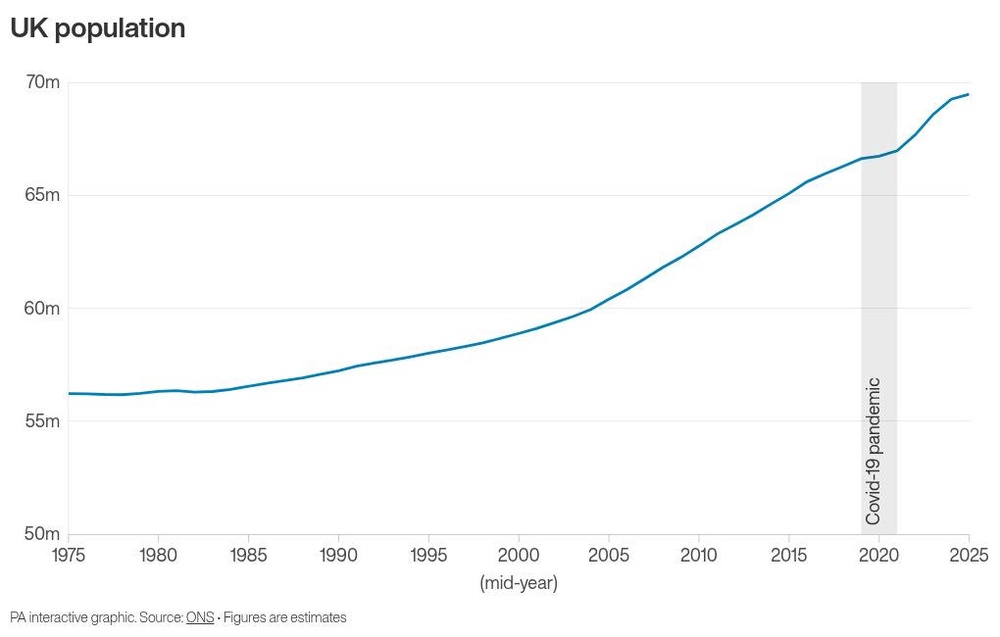
The overall population of the UK was estimated at 69.5 million people in mid-2025, an increase of 227,665 compared with the previous 12 months, according to the Office for National Statistics (ONS).
This 0.33 per cent increase marks the lowest annual growth rate recorded since 1998, with the exception of the pandemic-affected year of 2020.
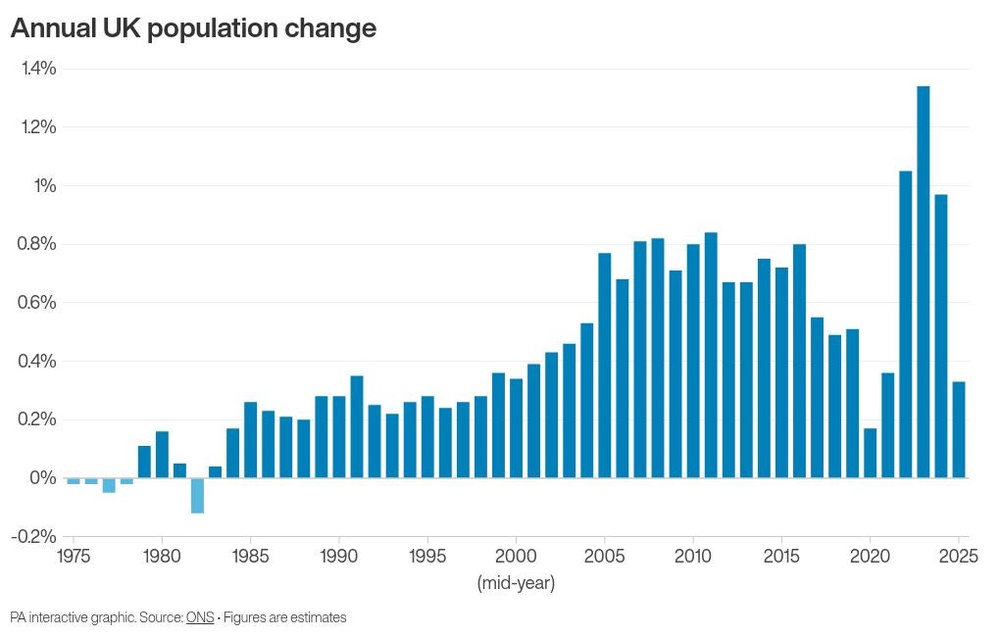
It comes after a sequence of much larger jumps in population of 1.05 per cent in 2022, 1.34 per cent in 2023 and 0.97 per cent in 2024.
These were caused by a spike in net international migration to UK, which is the difference between the number of people moving long-term into the country and those emigrating abroad.
Net migration in the year to mid-2025 is estimated to be 222,900, down steeply from 651,700 in the previous 12 months.
Some 652,400 births took place in the year to mid-2025, the lowest for more than four decades, the ONS said.
There were 647,500 deaths over the same period, meaning natural change – the difference between births and deaths – contributed an increase to the UK population of only 4,900.
This is lower than the previous year, when natural change stood at 16,200.
But it is higher than the 12 months to mid-2023, when there were more deaths than births in the UK, resulting in negative net change of minus 16,300.
Projections published earlier this year by the ONS suggested deaths could outnumber births each year in the UK from 2026 onwards.
They also showed population growth continuing to slow and then come to a halt, with the size of the UK population starting to fall in the mid-2050s.
The ONS projections were based on current and past trends, particularly the recent fall in net migration and lower fertility rates.
This means they are not forecasts or predictions, and do not take into account what may or may not happen in the future.
A number of factors are likely to have caused the recent drop in net migration.
There has been a decline in people from outside the European Union coming to the UK for work-related reasons.
This follows policy changes introduced by the previous Conservative government and continued by the current Labour administration, which have tightened the rules for coming to the country for employment.
There have also been fewer arrivals in the UK through official humanitarian resettlement schemes, as well as an increase in people moving out of the country.
While England saw its population grow by an estimated 0.39 per cent in the year to June 2025, Scotland and Northern Ireland both saw almost no annual growth, at 0.04 per cent and 0.03 per cent respectively.
The estimated population of Wales fell by 0.09 per cent: the first year on year drop since 2015.
There were more deaths than births in both Wales and Scotland.
This is because the population of both countries is older on average than in England or Northern Ireland, leading to a slightly higher rate of deaths and lower rate of births, the ONS said.
“The average number of children that are born to women in Wales and Scotland is also lower than the rest of the UK, which contributes to fewer births,” the agency added.
Net international migration contributed to population growth in all four countries, but this was more than offset in Wales by the level of negative natural change – more deaths than births – which is why the overall population here is estimated to have fallen.
Read MoreReleased prisoners thank PM as 700 let out early: ‘Don’t get me back here again bro’
Naomi Campbell's 5-year ban on serving as a charity trustee in England and Wales is overturned
Travelodge ‘fundamentally failed’ woman sexually assaulted in hotel
New driving licence changes start today. Here's what they could mean for you
Regeneration bid for historic Dambusters airbase rejected by Home Office
Burnham’s pension changes ‘completely unacceptable’, says Swinney