The Met Office has issued thunderstorm warnings across parts of the UK, warning there is a “small risk of flooding and disruption” after a record-breaking summer.
Yellow storm warnings will come into force for the West and East Midlands, as well as the North West, South East, South West and east of England, and parts of Wales.
An alert will be in place from 3am until 10pm on Wednesday, and from 6am until 10pm on Thursday.
It comes after back-to-back heatwaves left the ground hard and dry, with 70 per cent of England and Wales in drought.
Provisional Met Office data shows that the UK’s mean temperature for meteorological summer so far is currently at 16.48C – that is 1.88C above the 1991 to 2020 average temperature. England has recorded a mean summer temperature of 18.19C so far, 2.46C above average.
The remainder of August would need to be 1.41C below the summer average for England to equal its current warmest summer on record, also set in 2025.

But will there be another dry and sunny spell?
What does the long range forecast say?
Looking ahead, the Met Office’s long range weather forecast predicts that “an unsettled period is likely” heading into September, with the amount of rainfall likely to “be above average for the time year”.
However, the forecaster notes that “some drier and more settled interludes could develop at times”, and while “temperatures are likely to be near average... some short-lived warm or very warm spells are possible, especially in the south.”
Moving further into the month, the forecaster predicts that “drier weather may become more prevalent, especially in the south and southeast, with any more unsettled conditions tending to become more likely further north and northwest”.
It adds: “Temperatures will probably be near normal at first but may become warmer later, with the possibility of some hot spells in the south.”
What records have been broken this summer?
The Met Office said earlier this month that temperatures had reached 37.6C at Charlwood in Surrey, while at Wisley temperatures had hit 37.2C, and Kew Gardens in London had recorded a temperature of 38.1C – the highest temperature recorded in the UK this year.
A further 10 weather stations were at or above 36C, the provisional figures from the Met Office showed.
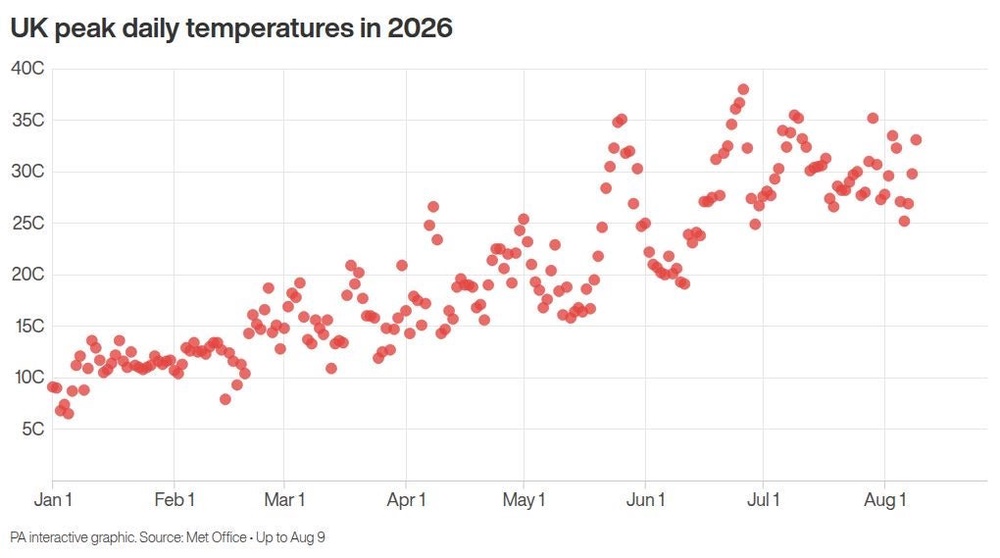
It makes 2026 the first year on record to see three separate days where temperatures reached the 37C threshold.
Before 2026, the UK had recorded 37C or higher on only six occasions.
It also extends 2026’s record-breaking run of days above 35C.
For four months in a row temperatures hit 35C in the UK on at least one day in May, June, July and now August.
July was also the driest month since records began in 1836 in both England and Wales, southern England alone had its driest calendar month ever on record.
By 15 July this year the UK had already recorded more days above 30C than in the whole of 1976, which was known for its long-lasting heatwave.
Why is the UK experiencing more heatwaves?
Climate change is making extremes such as heat and drought more intense and more likely.
The UK's weather is becoming warmer and wetter, and adverse weather events - heatwaves, flooding, extreme cold - are growing more frequent and intense. The last decade has been warmer than any previous decade on record, and summers we once considered exceptional are becoming the norm.
The Met Office explains that the UK is experiencing higher maximum temperatures and longer warm spells in recent years. Warm spells have seen their average length more than double – increasing from 5.3 days in 1961-90 to over 13 days in the decade 2008-2017.
But the outlook could get worse. A study by the Met Office Hadley Centre suggests the current chance of seeing days reaching 40C or more is extremely low. However, by 2100 under a high emissions scenario the UK could see 40 C days every three to four years.
Read More‘Intense’ thunderstorms could cause travel disruption, Met Office warns
Met Office thunderstorm warning issued across large parts of UK
Tornado of ‘rare intensity’ tears through French villages as over 300 homes damaged
Man dies and woman critically injured in crash after police chase
High Court quashes Parades Commission Drumcree determination
Jason Arday’s family ‘deeply moved’ by support as fundraiser reaches £224,000