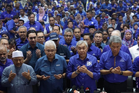
BARISAN Nasional’s (BN) victory in Melaka has demonstrated the electoral value of working with Perikatan Nasional (PN), but the success also sets up a more difficult question for Umno and PAS: how long can two parties competing for the same Malay electorate remain on the same side?
The two coalitions secured 24 of the 28 seats in Saturday’s state election, with BN winning 21 and PN taking three. Pakatan Harapan (PH) was reduced to four seats.
For Umno and PAS, the result offers further evidence that avoiding direct contests can improve their chances of winning Malay-majority constituencies.
But the arrangement has yet to answer how the two parties intend to divide political influence when they move beyond state-level cooperation.
That question will become increasingly important as preparations for the 16th general election gather pace.
The most telling result came in Bukit Katil, where PAS candidate Muhammad Ridzuan Mohd Sarif defeated former Melaka chief minister Adly Zahari by 6,607 votes.
The constituency had been contested by PH in previous elections, but this time BN backed the PN candidate under their electoral understanding.
The outcome was significant not only for PAS, but also as an indication that support could be transferred between the two sides.
Observers have said that the result demonstrated that the BN-PN arrangement was a workable electoral partnership, although it had not significantly expanded BN’s electoral dominance.
Political commentators have also stressed that the transfer of support between BN and PAS voters seen in Negeri Sembilan had been repeated in Melaka.
The results, however, should not be mistaken for a resolution of the political rivalry between Umno and PAS.
Both parties have spent years competing for influence among Malay voters, with PAS making considerable electoral gains while Umno struggles to reclaim ground lost since the 2018 general election.
For Umno president Datuk Seri Ahmad Zahid Hamidi, the Melaka outcome strengthens his argument that cooperation with PN can deliver results.
It also gives him greater room to pursue a broader political understanding with the opposition coalition.
But the arrangement comes with its own complications.
PAS is no longer simply a smaller political partner whose support Umno can take for granted.
Its electoral strength and parliamentary representation give it considerable bargaining power, particularly when negotiations turn to the allocation of seats and positions in a future government.
The question of who should lead that government could prove even more contentious.
If PAS enters GE16 with a stronger parliamentary position than Umno, it would be difficult for the Islamist party to accept a subordinate role without seeking a greater share of power.
Umno, meanwhile, is unlikely to willingly surrender the leadership position it has historically regarded as its own.
The stakes are therefore considerably higher than those in Melaka, where the two sides could agree on which constituencies to contest and which candidates to support.
At the national level, they will have to negotiate not only electoral boundaries but also competing ambitions over the premiership and the direction of a future administration.
Their common opposition to PH, particularly DAP’s influence in the federal government, provides a basis for cooperation.
But a shared political adversary does not necessarily translate into a shared vision of power.
Fathi Aris Omar, a veteran journalist, raised a similar concern in a post on Facebook following the Melaka polls, describing the next phase as another round of competition between Umno and PAS for the Malay vote.
He questioned whether PAS would eventually overtake Umno or whether Umno, having regained some political strength, would find a way to sideline its current partner.
The observation points to a contradiction at the heart of the alliance: both parties need each other electorally, but neither is likely to be comfortable allowing the other to emerge as the dominant force in Malay politics.
Melaka has shown that cooperation can deliver seats. GE16 will test whether it can deliver a lasting political partnership.
For now, Umno and PAS have a common reason to stay together.
Whether that remains the case when the question of who gets to lead the country comes into play may be the defining test of their alliance. – November 15, 2026