
Malaysia is on the brink of a major digital policy shift, with the government planning to enforce a ban on social media access for users under the age of 16 as early as June.
Framed as a bold move to protect young Malaysians from the darker corners of the online world, the proposal has quickly evolved into a national debate: one that pits child safety against privacy, practicality, and fundamental rights.
Communications Minister Datuk Fahmi Fadzil confirmed that the initiative is currently undergoing final review, with the Malaysian Communications and Multimedia Commission (MCMC) leading a regulatory sandbox involving major social media platforms. The goal is to establish a unified and enforceable framework, moving beyond simple “age assurance” toward stricter “age verification,” potentially using official identification such as MyKad.
The move reflects a growing global push to tighten social media rules for minors, with countries like Australia taking the lead by banning users under 16 last year due to concerns over harmful effects on young people.
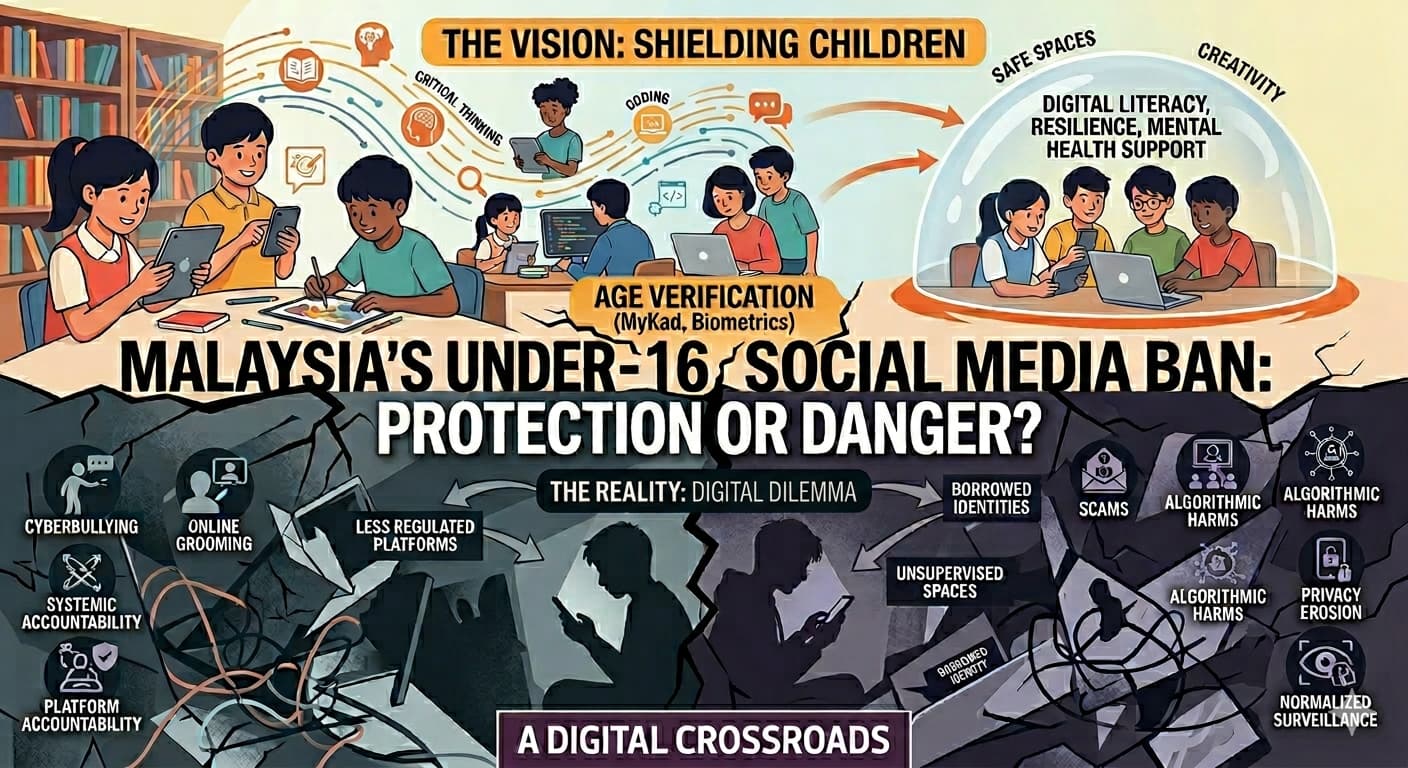
On paper, the intent is reasonable and widely supported: to protect children from cyberbullying, online grooming, scams, and harmful algorithm-driven content. In reality, however, the road to implementation is riddled with complex challenges.
Civil society organisations have already sounded the alarm. In a joint letter addressed to Prime Minister Dato' Seri Anwar Ibrahim, they argue that a blanket ban is not only disproportionate but potentially dangerous. Their concern is that enforcing age verification through identity-based systems could erode privacy, expose sensitive personal data, and normalise surveillance-like practices in everyday digital access.
Critics also question whether such a ban would even work. Teenagers, after all, are notoriously adept at bypassing restrictions. If official accounts become inaccessible, underage users may simply turn to borrowed identities, shared accounts, or migrate to less regulated platforms - ironically exposing themselves to even greater risks. In this scenario, the policy may succeed in reducing visible underage accounts while failing to address the underlying harms.
The issue of definition further complicates matters. What exactly qualifies as “social media” in 2026? While platforms like TikTok and Instagram are obvious targets, the digital ecosystem now includes messaging apps, livestream services, gaming communities, and hybrid platforms that blur traditional boundaries. Without clear definitions, enforcement risks becoming inconsistent and confusing, undermining public trust.
There is also a broader question of whether age restrictions alone can tackle the root of online harm. Many of the most serious risks - harassment, exploitation, misinformation - are driven not by age, but by platform design and business models that prioritise engagement over safety. Simply raising the age limit does little to dismantle these systemic issues.
Proponents of a more balanced approach argue that Malaysia should focus on building resilience rather than imposing outright bans. This includes investing in digital literacy, critical thinking skills, and accessible mental health support for young users. Empowering children to navigate the digital world safely, they say, may prove more sustainable than restricting access altogether.
At the same time, the government’s push to hold platforms more accountable is gaining traction. By requiring major platforms to take “reasonable steps” to prevent underage access and enforce stricter safety measures, Malaysia signals a shift toward shared responsibility - where tech companies, not just users, bear the burden of protection.
Ultimately, the success of this policy will not be measured by headlines or compliance statistics, but by real-world outcomes. Are children genuinely safer? Are online harms reduced? Or has the problem simply been pushed into less visible, harder-to-regulate spaces?
Malaysia now stands at a digital crossroads. Get it right, and the country could set a regional benchmark for child online safety that respects both protection and privacy. Get it wrong, and it risks creating a system that collects more data, fuels more distrust, and leaves the very people it aims to protect navigating an even more dangerous digital landscape.
Because in the end, banning access is easy. Building a safer internet: that’s the real challenge.
By: Kpost
Information Source:
Nst , SoyaCincau , TechPolicyPress
Kpost (ckhorsk@gmail.com) is a content creator under the Newswav Creator programme, where you get to express yourself, be a citizen journalist, and at the same time monetize your content & reach millions of users on Newswav. Log in to creator.newswav.com and become a Newswav Creator now!
The User Content (as defined on Newswav Terms of Use) above including the views expressed and media (pictures, videos, citations etc) were submitted & posted by the author. Newswav is solely an aggregation platform that hosts the User Content. If you have any questions about the content, copyright or other issues of the work, please contact creator@newswav.com.


