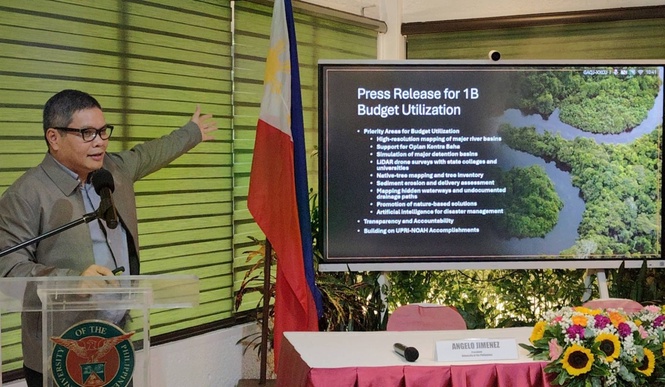
MANILA, Philippines — The University of the Philippines Resilience Institute - NOAH (Nationwide Operational Assessment of Hazards) Center said it would utilize the P1 billion funding it received from the national government to generate, manage, communicate, and apply scientific information for disaster risk reduction, flood management, environmental protection, and climate resilience.
The funding was part of the 2026 General Appropriations Act.
During a press briefing on Thursday at the University of the Philippines Executive House in Quezon City, UP President Angelo Jimenez said that the budget release was an "investment in something that UP has always believed in: the power of research and innovation to serve the nation."
"At UP, we do not conduct research simply to add another paper to an academic journal, or another dataset to a repository, or another technology to a laboratory. We do research because knowledge matters. And knowledge matters most when it can help us make better decisions, solve real problems, and improve the lives of our people," Jimenez said.
The funding will be used for high resolution mapping of major river basins using geospatial technologies that will produce high-resolution hazard maps.
It will also collaborate with the Department of Public Works and Highways (DPWH), the Metropolitan Manila Development Authority (MMDA), local government units (LGUs) and the private sector to integrate watershed science, flood modeling, terrain, infrastructure, and local knowledge to identify appropriate structural and non-structural solutions.
Dr. Alfredo Lagmay, UP Resilience Institute executive director, said the high resolutuon mapping and simulations would test flood interventions before spending money on flood infrastrucutre.
"You cannot find a solution if you do not understand the problem. Once you understand the problem with better science with better technologies, you can find the appropriate solutions," Lagmay said.