
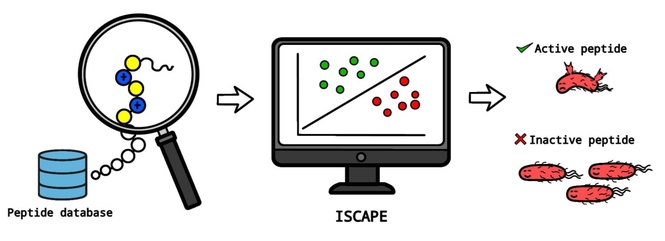
RESEARCHERS from the University of the Philippines Diliman College of Science have developed an artificial intelligence (AI) tool that can help scientists identify antibacterial peptides that may work against drug-resistant bacteria.
Called ISCAPE, or Interpretable Support Vector Classifier of Antibacterial Activity of Peptides against Escherichia coli, the system predicts whether a peptide can kill or inhibit the growth of E. coli bacteria.
The tool was developed by Remmer Salas, Dr. Portia Mahal Sabido and Dr. Ricky Nellas of the Institute of Chemistry.
According to the researchers, ISCAPE requires only a Simplified Molecular-Input Line-Entry System (SMILES) string as input, allowing scientists to evaluate candidate molecules more quickly.
Salas said conventional methods of discovering antibacterial peptides involve synthesizing and testing large numbers of candidates individually, making the process time-consuming.
“We used AI to learn from existing data and identify patterns that distinguish active peptides from inactive ones,” he said.
The researchers said ISCAPE can also identify molecular features linked to antibacterial activity, helping scientists reduce trial-and-error experiments and improve peptide design.
“ISCAPE helps address antimicrobial resistance by accelerating early-stage screening through data-driven peptide design,” Salas said. “It doesn’t replace laboratory experiments, but it makes discovery more efficient and helps researchers focus on the most promising candidates.”
The team said the model can be adapted for bacteria other than E. coli if retrained using datasets specific to other bacterial strains. Researchers also noted that the same approach may be used to study other bioactive peptides.
The study, titled “Interpretable support vector classifier for reliable prediction of antibacterial activity of modified peptides against Escherichia coli,” was published in the Journal of Molecular Graphics and Modelling.
ISCAPE is publicly accessible through Hugging Face Spaces, while its training data and code are available on GitHub.