
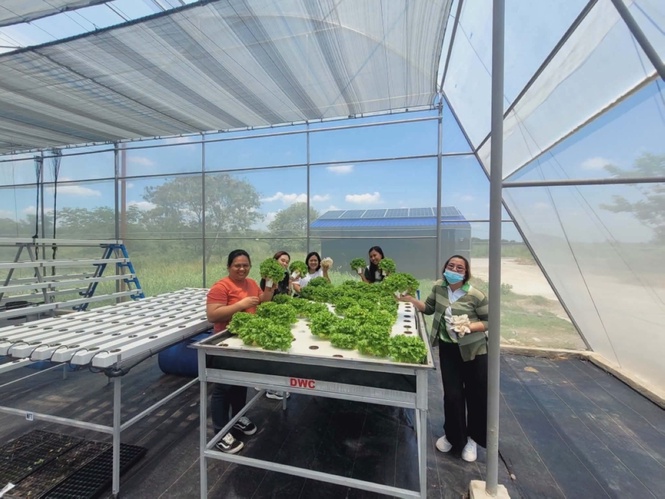
INSIDE a hospital compound in Tumauini, Isabela, lettuce grows under solar-powered hydroponics and mushrooms fruit in a climate-controlled house — a shift that shows how health care facilities are becoming new frontlines for food security.
Saint Matthias Medical Center of Isabela Inc. has integrated food production into its operations through the National Urban and Peri-Urban Agriculture Program (Nupap) of the Department of Agriculture Regional Field Office 2 (DA-RFO2). Under its Fiscal Year 2025 assistance, the center received P2.91 million in interventions.
The package, according to DA-RFO2, includes a greenhouse equipped with a solar-powered hydroponics system, a mushroom house complete with fruiting bags and a range of production inputs.
The inputs cover vegetable seeds, strawberry cuttings, calamansi seedlings, organic fertilizers, potting media, seedling trays, stackable pots, crates, drums, wheelbarrows, plastic mulch, a multi-cultivator, a soil auger and 100 Sweet Abulug Pomelo seedlings intended for an edible landscaping component.
For agriculture planners, the project illustrates a pivot in Nupap strategy: moving urban agriculture beyond households and schools into institutional settings where food demand is constant and nutrition is critical.
The hospital is now harvesting lettuce, mushrooms, fruits and vegetables from the facilities. The produce goes directly into the institution’s food system, shortening the supply chain from farm to ward.
What DA describes as turning “food miles into food steps” is applied literally — crops grown meters away from where patients and personnel eat.
The agriculture lens is significant. Hydroponics allows year-round leafy vegetable production with less water and without dependence on arable land, a key consideration for urban facilities.
Mushroom production provides a high-protein, short-cycle crop that can be grown in limited spaces. The inclusion of Sweet Abulug Pomelo, a locally developed variety from Cagayan, also links institutional farming to regional commodity promotion.
Implementation relies on internal labor organization. DA-RFO2 said the facilities are managed through the hospital’s Nupap coordination led by Willyn Amurao Uy, with day-to-day maintenance by designated staff.
Participation in recent harvest activities included medical personnel — among them oncologist Dr. Angelita Bariuad and a hemodialysis nurse — indicating integration of farming into hospital routine rather than as an add-on activity.
For DA-RFO2, the Tumauini model reflects Nupap’s three core objectives: strengthen food availability in urban and peri-urban areas; promote sustainable production systems; and localize food sourcing.
If replicated, the approach positions hospitals not only as consumers of food but as producers — reducing procurement costs, ensuring freshness and providing therapeutic green spaces.