
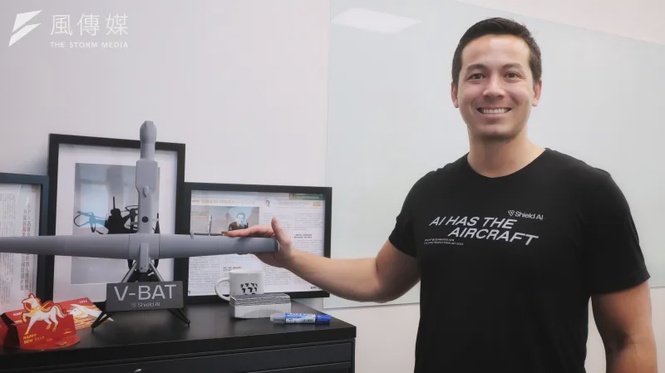
Two of America's best known defense technology startups, Anduril and Shield AI, are buying a rising share of their drone hardware from Taiwanese suppliers and have opened offices on the island. Executives and analysts say the draw is a manufacturing base that offers quality, cost and ease of collaboration, paired with Taiwan's own large appetite for military drones.
Interest in Taiwan's drone sector has surged over the past two years. Delegations from the United States, the Czech Republic, Denmark and Germany visited in the first half of 2026 alone. In early July, the American Institute in Taiwan (AIT), Washington's de facto embassy, joined the Taichung city government to host a forum on drone and unmanned vehicle business opportunities.
Taiwanese Components Now Make Up 16% Of Shield AI Products
Shield AI co-founder Brandon Tseng (曾國光) offered a glimpse of why the company is spending money to be in Taiwan. Speaking on a Storm Media video program, he said the firm's supply chain director, who previously ran supply chain operations for SpaceX's Starlink, brought eight team members to Taipei for the September 2025 aerospace exhibition, an expensive trip from the United States. When he asked her why she needed so many people, he recalled her answer:
"Taiwan has the best suppliers in the world. We came here to find the best ones, work with them and bring them into our ecosystem, because Taiwan's supply chain is better than other countries' in quality, cost and ease of cooperation."
Tseng said Taiwanese parts accounted for less than 1% of Shield AI's product content two years ago. The share has climbed to 16% this year, and the company hopes to raise it to 25%.
Anduril Added 15 Local Suppliers In 15 Months
Anduril reports a similar trend. Alexander Chang (張良治), the company's managing director for East Asia, told the annual forum of the Research Center for Technology, Democracy and Society (DSET), a think tank of Taiwan's National Science and Technology Council, that Anduril had added 15 Taiwanese suppliers in the previous 15 months. Its direct purchasing in Taiwan grew 15-fold over the same period, and it hired eight local employees.
The company's Altius-600M anti-armor drone, sold to Taiwan through the US Foreign Military Sales (FMS) program, went from contract signing to delivery in 13 months. It was Anduril's first overseas FMS case.
Chang said Anduril buys motors, printed circuit boards, precision machined parts and injection-molded plastic components from Taiwan. He said many suppliers come from consumer electronics and are now moving into defense work, which has given them deep experience in making small batches of varied prototypes.
"This has been a great experience. The skills of Taiwan's local industry, and its willingness to cooperate, are excellent," he said.
Chang added that Anduril is running many commercial projects with Taiwan's military research institute beyond the Altius.
Contracts With The Military Institute Preceded The Supply Deals
The groundwork was laid in August 2025, when Anduril co-founder Palmer Luckey delivered a lecture at National Taiwan University, organized by Taiwan AI Academy. He said Taiwan stands at the crest of a defense technology industrial revival that builds on the island's existing consumer and industrial electronics base.
A month later, at the Taipei Aerospace & Defense Technology Exhibition, the National Chung-Shan Institute of Science and Technology (NCSIST), the military's main weapons research body, signed a procurement contract with Anduril and Canada's AirShare. It also signed memorandums of understanding with AeroVironment and several other American and European companies covering unmanned vehicles, counter-drone systems, missile integration and unmanned vessels.
Shield AI displayed a full-size V-BAT reconnaissance drone at the same show and opened its Taiwan office in Taipei 101 that week. In February 2026, it signed a contract with NCSIST to integrate its Hivemind AI platform into Taiwan-developed unmanned systems, a step intended to move Taiwanese drones from autopilot toward autonomous decision-making.
Analyst Sees US Software Pairing With Taiwanese Hardware
Fang Yi-jan (方怡然), a national security policy analyst at DSET, said foreign drone makers are drawn by government tenders, Taiwan's supply chain and the prospect of combining software with hardware.
"Why are foreign companies interested in the Taiwan market? Because we have issued a tender, which is a very clear demand signal. Naturally, companies want orders to come in," she said.
Taiwan's strengths lie in manufacturing and mass production, Fang said, while software is a gap. She pointed to Anduril's Lattice command system and Shield AI's Hivemind autonomy platform as examples of what Taiwan lacks.
"Taiwan certainly has engineers who want to design this kind of AI software, but we have less combat experience. American companies think that since Taiwan lacks it, perhaps they can come in and cooperate. They see Taiwan's supply chain has strong hardware, and they will fill in the software," she said.
Fang added that as AI and drones shift toward edge computing, which processes data on the device itself rather than in a distant data center, foreign firms will need Taiwan's chips even more. That, she said, would open a different level of cooperation.
With heavy domestic demand for military drones, a deep manufacturing base and semiconductor strength, Taiwan now has major foreign backers. How far that will carry it toward becoming a global drone power remains to be seen.
This report is based on Storm Media's Chinese-language "Drone Myths" investigative series.
Social Media Links & Editor Tag - Penny