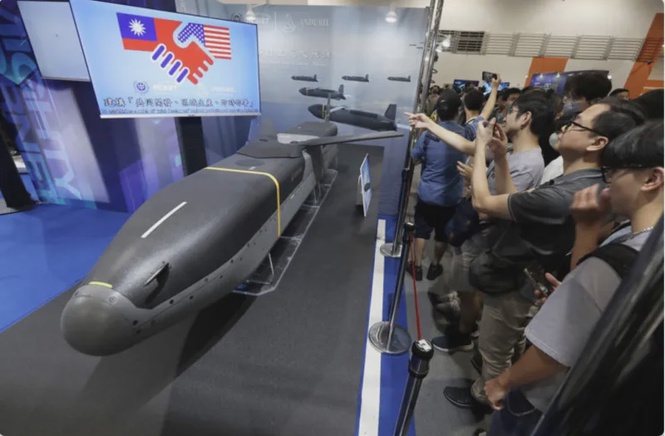
Taiwan has lost its chance to buy Anduril Industries' Barracuda-500 low-cost cruise missile through a commercial deal after the US military adopted the weapon, but the island's state-run weapons developer still aims to field a cheap air-launched cruise missile within 18 months using a substitute from another supplier, military and political sources told Storm Media.
The setback undoes a plan unveiled in September 2025, when the National Chung-Shan Institute of Science and Technology (NCSIST), the Taiwanese military's main research and development arm, shared a booth with the California-based defense unicorn at the Taipei Aerospace and Defense Technology Exhibition. The Barracuda-500, an air-launched cruise missile designed to be produced cheaply and in large numbers, was meant to be built in Taiwan through a local supply chain.
That changed after war broke out between the United States and Iran and the US military moved several low-cost weapons, the Barracuda-500 among them, into its own inventory, according to the sources.
US Export Rules Close The Commercial Route
Under US rules, once a weapon becomes standard equipment for American forces, any export of it is subject to review and control by the US State Department. That leaves Taiwan with only one path to the Barracuda-500: a government-to-government arms sale, a process that would inevitably stretch out how long the island waits for delivery.
The same logic explains the limits placed on Anduril's Dive-LD, a large autonomous underwater vehicle, the sources said. Because the Dive-LD is already in service with the US military and has carried out missions in the Middle East, it can only be offered for commercial use.
NCSIST Keeps Its 18 Month Missile Target
Despite the setback, the sources stressed that NCSIST's target of producing a low-cost cruise missile within 18 months has not changed. The institute has shifted how it works, they said, and is now actively courting promising startups around the world. A product from another company has in effect already been lined up to replace the Barracuda-500, although the sources did not name it.
The sources gave two reasons for the turn toward startups. First, young companies tend to think differently from traditional defense primes and can come up with disruptive solutions suited to a battlefield that is changing quickly. Second, startups looking to grow their revenue are less selective about who they work with. That openness gives Taiwan, which has formal diplomatic ties with only a handful of countries and faces heavy limits in the international arena, an opening it rarely gets from established arms makers.
Covenant's Anthem Emerges As A Possible Option
Under this flexible approach, which the sources described with a Chinese idiom meaning "changing the broth but not the medicine," Taiwan may even be able to bring in Anthem, a long-range precision strike weapon made by US defense startup Covenant. The weapon has already won an order from the Danish government, the sources said. Danish officials announced in October 2026 that they plan to buy Anthem alongside Kongsberg's Joint Strike Missile to give the country its first long-range strike capability, Defense News reported.
Custom Versions Built For Taiwan's Battlefield
The US military is now buying up many of the low-cost weapons on the market to rebuild its stockpiles, the sources said. To avoid getting caught in the same trap again, NCSIST plans to develop a customized version of any weapon it brings in from a foreign partner, tailored to conditions on a Taiwan battlefield and deliberately different from the version sold to US forces. Keeping the two apart is meant to keep Taiwan's version out of the reach of US export control reviews on equipment and technology.
The sources pointed to a recent example. Coretronic Intelligent Robotics Corp. (CIRC) has partnered with AEVEX Aerospace, the US maker of the combat-proven Phoenix Ghost drone, to bring the American firm's drones to Taiwan, and the internal components of those aircraft differ from the US versions.
For Taiwan, the episode is a reminder that American weapons in high demand at home can quickly become harder to buy abroad, and that the island's search for affordable firepower may increasingly run through startups rather than the biggest names in the US defense industry.
You've read it. Now join the conversation — follow us on X, Facebook and IG. Editor: Penny Wang