CITING years of “manufactured” water shortages, financial drain and alleged environmental sabotage, a consumer advocacy group and whistleblowers on Wednesday filed a complaint before the Office of the Ombudsman against San Jose del Monte (Bulacan) Water District (SJDMWD) officials and top executives of PrimeWater Infrastructure Corp.
Named in the 928-page complaint, a copy of which was obtained by The Manila Times, were SJDMWD Aurelio Jose Jr., board chairman; Armando de Los Reyes, vice chairman; Jovita Vizmonte-Mateo, secretary; Leo Brigino, member; and Loreto Limcolioc, general manager, who were facing administrative charges of grave misconduct, gross neglect of duty and conduct prejudicial to the best interest of the service.
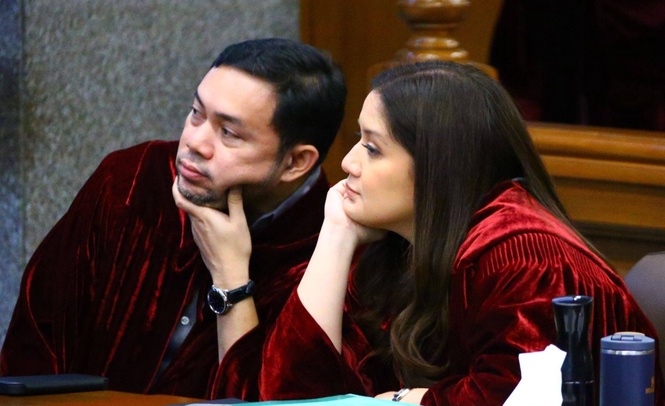
Private respondents include PrimeWater owners, namely ex-senator Manuel Villar Jr., and wife and ex-senator Cynthia Villar, and children Paolo Villar, Sen. Mark Villar and Sen. Camille Villar, along with corporate executives Fe Rabancos, Lester Santos and Victor Canita.
The consumer advocacy group Ugnayan ng mga Higit na Apektado sa Water Access and concerned SJDMWD employees as well as its former workers accused the SJDMWD and PrimeWater management of orchestrating a “sweetheart” joint venture agreement (JVA) that transformed the state utility into a private corporate “automated teller machine” (ATM), citing manifest partiality and gross inexcusable negligence.
At the heart of the case is SJDMWD leadership’s “stubborn refusal” to heed six years of scathing Commission on Audit (COA) reports, the complainants said.
From 2018 to 2024, COA repeatedly flagged crippling financial losses, missing asset records and widespread contractual violations. Yet water district officials failed to take corrective action, consistently siding with PrimeWater over the public interest, they said.
Audit reports noted that before the joint venture, SJDMWD was a thriving state utility with net income of P187.56 million in 2016 and P126.48 million in 2017.
“Immediately after PrimeWater assumed operations in May 2018, net income plummeted 58 percent to P53.6 million, plunged 98 percent to P2.27 million in 2019 and hit an official net loss of P5.35 million in 2020,” the complainants said.
They said that COA had also repeatedly cited SJDMWD for failing to establish a contractually required Rewards and Penalties Framework (RPF), as explicitly mandated under a JVA provision.
“Without the RPF, SJDMWD stripped itself of the legal authority to fine PrimeWater for daily service failures — allowing the delay to stretch for six consecutive years (2018–2024) and effectively shielding the firm from financial penalties,” the complaint read.
The complainants cited the state auditors who repeatedly called out the local water board for allowing PrimeWater to accumulate tens of millions of pesos in unpaid inventory and receivables.
They said SJDMWD failed to enforce leakage control programs against PrimeWater, resulting in over P247 million in wasted revenue annually.
“Instead of holding PrimeWater accountable, the water district management turned the public treasury into PrimeWater’s personal “ATM,” the complainants said.
“SJDMWD officials routinely advanced public funds — totaling P69. 64 million as of Dec. 31, 2023, and P59. 98 million as of Dec. 31, 2024 — to cover bulk water supply, ongoing projects, emergency booster pumps and supplies that were exclusively PrimeWater’s financial obligation under the JVA,” they added.
The complaint-affidavit also outlined a pattern of SJDMWD protecting PrimeWater at every turn. PrimeWater pledged P6.771 billion over 25 years, yet after seven years, only P748 million — roughly 11 percent — had actually been invested, the complainants said.
In another instance, when PrimeWater failed to process over 1,400 pending water connection applications in 2024, the complaint said SJDMWD spent government funds and labor to complete the installations while still permitting PrimeWater to collect the P1,915 application fee per consumer.
Seeking a preventive suspension without pay against the SJDMWD officials, the complainant said that they “demonstrated gross inexcusable negligence by abandoning their regulatory duty to protect consumers.”
“The resulting water crisis paralyzed local commerce, forced school class suspensions and disrupted the daily lives of hundreds of thousands of residents,” the complainants said.