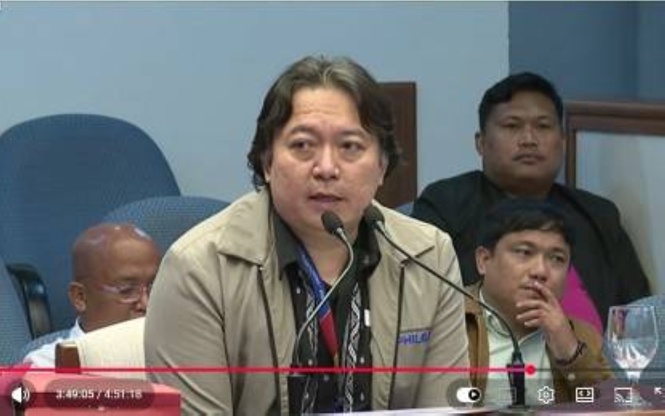
ELEVEN of 15 contracts awarded by the Davao City government under Mayor Sebastian Duterte to GenCorp Industries Inc., a company linked to Vice President Sara Duterte, did not undergo public bidding, a Philippine Government Electronic Procurement System (PhilGEPS) official testified before the Senate impeachment court on Monday.
Philippine Government Electronic Procurement System Division Chief Rendell Sopeña made the disclosure when Senator-Judge Risa Hontiveros questioned him about procurement transactions involving GenCorp, which the vice president has declared as a business interest in her statement of assets, liabilities and net worth (SALN).
“Of the contracts awarded by the Davao City LGU to GenCorp, how many did not undergo public bidding?” Hontiveros asked.
“If I remember correctly, there were 15, minus four that underwent public bidding. Eleven,” Sopeña testified.
He said the 15 contracts had a combined value of P34.216 million, with four awarded through public bidding and 11 through negotiated small-value procurement.
Sopeña cited several of the smaller contracts processed through negotiated procurement, with amounts including P501,600, P414,000, P249,000, P49,800, P498,000, P805,500, P381,500, P508,000, P254,000 and P554,000.
“Roughly, this would be around P8 million or P7 million,” he said.
Sopeña earlier told the impeachment court that GenCorp had secured 49 government contracts worth a combined P35.9 million from various government offices, including the Davao City government, Philippine Health Insurance Corp. Region XI and the Overseas Workers Welfare Administration Region XI.
Senator-Judge Erwin Tulfo later questioned why PhilGEPS does not routinely review procurement records for possible violations.
Sopeña said his office is not directly involved in government bidding processes and primarily serves as a repository of procurement data submitted by government agencies.
Asked whether PhilGEPS personnel had detected problems while the contracts under scrutiny were being processed, Sopeña said they were not “visible or personally knowledgeable” during the bidding process.
Asked when he became aware that there could be problems with the contracts, Sopeña replied: “when we received the subpoena.” Tulfo asked whether PhilGEPS could intervene if it encountered “glaring” violations of procurement laws during a bidding process, such as questioning a transaction or alerting supervisors.
Sopeña said his office’s role was limited.
“Your honor, we are merely the repository of the data,” he said.
He also said procurement compliance oversight was not part of PhilGEPS’ mandate.
Tulfo asked whether PhilGEPS could review past government contracts and projects — not only those involving Davao City — to determine whether similar issues existed elsewhere.
Sopeña said such reviews were not part of his division’s mandate, although his office regularly receives procurement-related requests from various government agencies.
Tulfo questioned whether PhilGEPS could take the initiative to examine its procurement records, citing graft and corruption cases involving government projects, including flood-control projects.
“Why can’t your department take the initiative? Even if you are only the repository, you can look into the records. Can you do that?” Tulfo asked.
Sopeña said other government agencies had the proper mandate to address such concerns.
Tulfo pressed further, asking whether PhilGEPS could at least examine the records in its possession rather than simply storing them until another agency requests them.
Sopeña clarified that the records are stored electronically in a database rather than as physical files.
Asked again whether PhilGEPS personnel could review the electronic records, Sopeña said this was not part of his division’s functions.
Senator-Judge Joel Villanueva also questioned whether the Davao City government may have split contracts involving similar supplies in a way that avoided public bidding.
Sopeña confirmed that some of the contracts involved identical goods, including “food and catering services,” although their publication and award dates differed.
He was also asked by Senator-Judge Sherwin Gatchalian whether the system shows bidding results, including the number of participating bidders and the prices they submitted.
Sopeña said PhilGEPS only reflects the procurement modality and does not show the number of participating bidders or their respective bid prices unless such information is uploaded by the procuring entity.
The system, he said, can reflect the approved budget for the contract and the contract awarded amount, depending on the information entered by the procuring entity.
Gatchalian then asked whether PhilGEPS checks if a winning bid is reasonable or falls within the usual price range for similar purchases.
Sopeña said such an assessment is not part of his division’s mandate.
The testimony prompted questions from senator-judges about a potential conflict of interest, given that the Davao City mayor and the vice president are siblings and that Vice President Duterte has declared GenCorp as a business interest.
“Was GenCorp allowed to participate in public bidding in Davao knowing that VP Sara is an owner, one of the owners of GenCorp, and that Davao is her bailiwick? Isn’t there a conflict of interest there?” Senator-Judge Raffy Tulfo asked.
“Shouldn’t PhilGEPS have immediately flagged it and said, ‘Wait a minute, there appears to be a conflict of interest here?’” he added.
House lead prosecutor Gerville Luistro argued that the transactions could run afoul of constitutional restrictions if Duterte maintained an ownership stake in GenCorp.
“GenCorp should not be participating in the bidding of the City of Davao, which is headed by no less than the brother of the respondent vice president,” Luistro said.
“It is my humble submission that this is the conflict of interest contemplated under Article VII, Section 13 of the Constitution,” she added.
Raffy Tulfo echoed the prosecution’s position, saying that if Duterte is indeed a part-owner of GenCorp, such ownership would be contrary to the constitutional provision.
“For me, the fact remains that the vice president is a part-owner of GenCorp, and under Article VII, Section 13, the vice president should not own or participate in any business company for that matter,” he said.
Senate Presiding Officer Francis Escudero, however, pointed to a discrepancy between Duterte’s disclosures and GenCorp’s corporate records.
Escudero said documents GenCorp submitted to the Securities and Exchange Commission do not identify Duterte as a shareholder or stockholder.
“So that is one difference that still has to be reconciled at some point,” Escudero said.
Duterte, however, declared GenCorp Industries Inc. as one of her business interests in her 2024 and 2025 SALNs.
Duterte became vice president in 2022.
As Sopeña was excused from the witness stand, Luistro made a manifestation citing mandatory disclosure requirements under procurement laws and argued that the vice president could face three separate ethical issues.
“Owning business, operating business, and conflict of interest, Your Honor. In fact, it’s like the card game tong-its. That’s three hits,” Luistro said.