VICE President Sara Duterte’s defense team will begin presenting evidence to counter allegations of unexplained wealth on Monday, opening a crucial phase of her impeachment trial with corporate, property and financial records, and 22 witnesses already served with subpoenas.
The defense will open its case with a corporate lawyer who will testify on company records covering 2022 to 2025, followed by property assessors, an accountant, a barangay official and bank representatives in hearings that could run almost daily in the coming weeks.
“We will hit the ground running on Monday and in the weeks ahead,” Senate impeachment court spokesman Reginald Tongol said in a radio interview on Saturday.
Tongol said the court had largely cleared administrative matters ahead of the resumption, allowing the defense to proceed with its evidence on the remaining article of impeachment concerning Duterte’s alleged unexplained wealth.
The defense is expected to call Suzette Balucanag-Punay, corporate counsel of GenCorp Industries and Metro City Chow Foods Corporation, as its first witness.
She is expected to testify on the companies’ general information sheets and audited financial statements covering 2022 to 2025.
After Balucanag-Punay, Tongol said the defense is expected to call next representatives from the city assessor’s offices of Davao City and the Island Garden City of Samal, an accountant from Davao City, and the barangay chairman of Matina Crossing in succeeding hearings.
Tongol said the impeachment court had served subpoenas on 22 of the 24 witnesses for the defense.
Former law school dean Rene Sarmiento was not issued a subpoena after the defense removed his name from its witness list.
Tongol said the court acted on the defense’s formal manifestation, not Sarmiento’s earlier public statements declining the offer to testify.
The impeachment court is preparing for an intensive hearing schedule, with proceedings potentially running almost daily from 10 a.m. until around 6 p.m., depending on developments.
Tongol said Monday’s proceedings will continue despite an afternoon break for the Senate’s legislative session.
The Nov. 11 schedule may also be affected by the plenary session, while hearings on Nov. 12 and 13 are expected to run for the entire day.
He expressed confidence that the defense could accommodate all its proposed witnesses within the scheduled hearing days, citing the relatively brief testimonies of bank representatives during the prosecution’s presentation.
The court is aiming for a December conclusion, consistent with the timeline previously identified by Senate Presiding Officer Francis Escudero.
But Tongol said that the target is not fixed and would depend on how the defense presentation unfolds.
“This is not set in stone. It is a moving target,” he said. “If additional hearing days are needed to ensure the respondent’s due process and allow the defense to fully present its case-in-chief, then more days will be scheduled.”
Conversely, proceedings could end earlier if the defense drops witnesses or completes its presentation ahead of schedule.
Tongol described the defense presentation as a crucial stage of the impeachment proceedings, as it will give senator-judges and the public a chance to hear Duterte’s response to the prosecution’s allegations.
“What we saw during the prosecution’s presentation was simply its effort to build its case. We have seen only one side so far. We have yet to hear the answer,” he said.
With the defense preparing to present its own documentary and testimonial evidence, Tongol said the senator-judges and the public would begin to get a clearer picture of Duterte’s position.
Tongol also said the defense has yet to inform the court whether Duterte will take the witness stand.
“It is entirely the defense’s prerogative whether to put the respondent on the witness stand,” Tongol said.
If the court requires Duterte to testify, Tongol said, it could trigger a major legal debate over the constitutional right against self-incrimination.
He outlined two opposing legal interpretations. One is that impeachment proceedings are not criminal proceedings and that the right against self-incrimination may be invoked on a question-by-question basis.
Under this interpretation, Duterte could be called to testify but could refuse to answer questions that might incriminate her.
The other view treats impeachment as akin to a criminal proceeding because of its potentially severe consequences, including removal from office and perpetual disqualification from holding public office.
Under this interpretation, the right against self-incrimination could be invoked more broadly to prevent the respondent from being compelled to testify against herself.
Tongol also defended the court’s decision to admit financial records involving Duterte and her husband, including documents obtained from the Bureau of Internal Revenue (BIR), the Anti-Money Laundering Council (AMLC), banks, and other institutions.
The defense had objected to the documents, arguing that they were not attached to the articles of impeachment and that their submission amounted to a fishing expedition by the prosecution.
Tongol said the court rejected the objection because articles of impeachment need only state the general or ultimate facts underlying the allegations, not every specific evidentiary detail.
He said Escudero and his legal team have been conducting scenario planning and mock trials in preparation for the resumption of proceedings.
“For every possible scenario, there are skeletal rulings prepared,” Tongol said, adding that Escudero has three to four draft rulings ready.
If the arguments raised during a hearing match a scenario already anticipated by the legal team, the presiding officer may read the prepared ruling.
If new issues arise, the legal team incorporates additional instructions before the ruling is issued.
Tongol said this explains the short breaks sometimes taken by the court before announcing decisions.
He also explained the court’s decision to restore the sub judice restriction on Articles 1, 3 and 4, which had been dropped by the House prosecution panel.
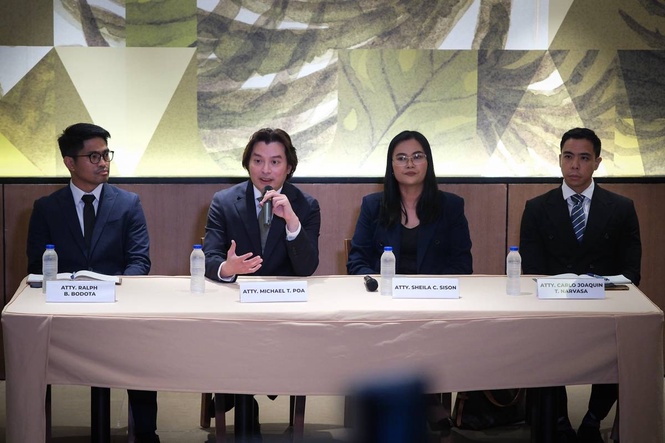
Escudero initially lifted the restriction on Oct. 13. However, defense lead counsel Sheila Sison told the court that lifting it would serve little purpose for the defense, particularly regarding Article 4, which involves grave-threat allegations and is also the subject of a pending case before the Metropolitan Trial Court of Quezon City.
Senator-judge Francis Pangilinan sought reconsideration of Escudero’s ruling, with Senator-judge Bam Aquino seconding the appeal.
The defense was given an opportunity to consult Duterte on whether she wanted the restriction lifted. After the defense did not pursue the lifting, Escudero restored the restriction.
Another senator-judge, Risa Hontiveros, on Sunday said the case against Duterte must be decided on the strength of the evidence, not public opinion or speculation about how many senator-judges are prepared to convict or acquit her.
Hontiveros cautioned against prematurely counting votes, stressing that the impeachment court must hear the defense’s side and consider the entire case before reaching a verdict.
“It is premature for me or anyone to say that there are already numbers for conviction or acquittal,” Hontiveros said in an interview with DZBB radio.
“We have only heard half of the sides. The defense presentation will begin tomorrow. We are obligated to listen to everything,” she said.
Hontiveros said the actual vote count would only be known on the day of the decision.
She also rejected speculation that senators have already made their decision, describing their deliberations as an ongoing process.
“All of the senator-judges are involved, not just the majority. In an impeachment trial, there are no majority or minority blocs,” Hontiveros said.
She acknowledged that the personalities involved naturally attract public attention because they are frequently seen in the news, but stressed that popularity is not the issue before the impeachment court.
Hontiveros stressed that senator-judges would not be voting based on popularity.
“For us, that is outside the issue of the impeachment trial because we will not be voting on popularity. We will look at accountability,” she said.
“That is what we will weigh — all the witnesses and evidence that we have studied for our final decision or vote,” she said.
Asked if she expected Duterte to personally appear before the Senate impeachment court, Hontiveros said it was the defense’s call.
“If the vice president is included, I will listen and ask clarificatory questions,” Hontiveros said.
She said she expected Duterte to attend the Senate deliberations on the Office of the Vice President’s (OVP) proposed 2027 budget.
Hontiveros recalled that Senate President Sherwin Gatchalian had emphasized during the committee hearing that the head of the agency was expected to attend.
Asked what would happen if Duterte again failed to attend, Hontiveros said senators would take notice “because that is not proper conduct for any head of an agency, even if that official is the vice president.”