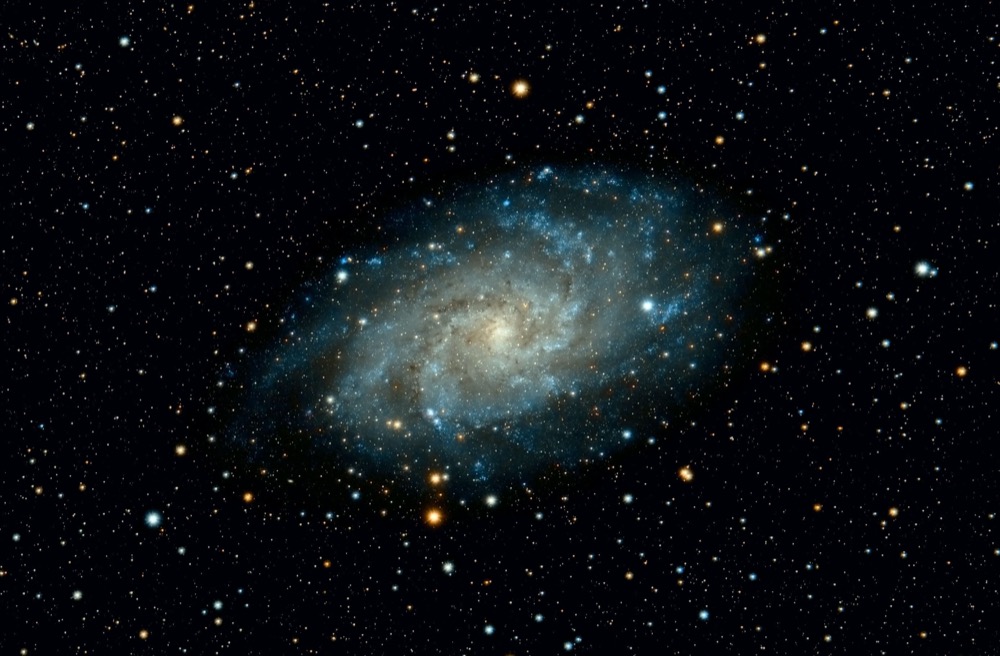
Scientists using the James Webb Space Telescope have observed one of the earliest galaxies ever seen, dating back 13 billion years, just 800 million years after the Big Bang. This groundbreaking discovery, reported in Nature, offers a rare window into the universe’s first stars and chemically primitive galaxies, revealing clues about the very origins of cosmic structure.
A Window Into The Dawn Of Galaxies
The galaxy, dubbed LAP1-B, is incredibly faint and small, making it nearly impossible to detect under normal circumstances. Its discovery was made possible by gravitational lensing, a natural cosmic magnifying effect where a massive cluster of galaxies in the foreground amplifies the light from distant objects. In the case of LAP1-B, this magnification boosted its light by a factor of 100, allowing astronomers to study it in unprecedented detail.
Using advanced spectroscopic techniques, the research team analyzed the light from the galaxy’s glowing gas clouds rather than its stars. By splitting this light into a spectrum, they were able to detect emission lines that revealed the galaxy’s chemical composition. The results showed extremely low levels of heavy elements, with an oxygen abundance 240 times lower than the sun’s, marking LAP1-B as one of the most primitive star-forming galaxies ever observed.
Evidence Of The First Stars
The emission lines also indicated intense ionizing radiation, a hallmark of the universe’s first generation of stars, known as Population III stars. These stars are theorized to have ignited the cosmic landscape, producing the first chemical elements heavier than hydrogen and helium. The team detected an unusually high carbon-to-oxygen ratio, consistent with models of early supernovae from these first stars.
This discovery is not only a chemical fingerprint of the first stars but also a glimpse into how early galaxies assembled, shedding light on the processes that transformed the cosmos from a nearly uniform sea of hydrogen and helium into the richly structured universe we see today.
Dark Matter’s Hidden Grip
In addition to the chemical findings, astronomers studied the motions of the gas within LAP1-B. Their measurements suggest that the galaxy is held together by a massive halo ofdark matter, invisible yet dominant in shaping its structure. This reinforces the notion that dark matter played a crucial role in the formation of the earliest galaxies, acting as the scaffolding around which ordinary matter could accumulate.
The combination of chemical primitiveness, Population III signatures, and dark matter presence makes LAP1-B a rare “fossil in the making,” a direct link to the ultra-faint dwarf galaxies we observe in the local universe today. By examining objects like LAP1-B, scientists are beginning to unravel the earliest chapters of cosmic history.
Observing The Universe’s First Light
The James Webb Space Telescope, launched in 2021 at a cost of $10 billion, is designed to peer deeper into the universe than any previous observatory. Its infrared capabilities allow it to detect light that has traveled for billions of years, giving astronomers a time machine to study the first galaxies and stars. According to the study published in Nature, LAP1-B represents one of the earliest stages of galaxy formation ever witnessed, offering unprecedented insights into how the universe transitioned from darkness to light.
Enjoyed this article? Subscribe to our free newsletter for engaging stories, exclusive content, and the latest news.