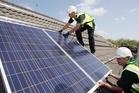
With energy prices still prone to sudden swings, more UK households are looking at solar as a way to cut bills and rely less on the grid. But once you start comparing the best solar panels, the next question is surprisingly practical: what type should you actually choose?
For most UK rooftop installations, that means comparing monocrystalline, polycrystalline and thin-film solar panels. These technologies all turn sunlight into electricity, but they differ in efficiency, lifespan, cost and the amount of roof space they need to deliver a useful output.
Now there is another option entering the conversation. In March 2026, the UK government said plug-in solar panels would be available in shops “within months”, giving renters, flat owners and households without suitable roof space a potential route into small-scale solar generation. Plug-in systems are not a replacement for the output power of a full rooftop array, but they do change how households might think about the different types of solar panels available.
What are the main types of solar panels?
When people talk about the different types of solar panels, they are often referring to two slightly different things: the technology used inside the panel and the way the solar system is installed.
Solar panel technologies include monocrystalline, polycrystalline and thin-film panels. These terms describe the materials and manufacturing methods used in the photovoltaic cells, which affect their efficiency, cost and typical uses.
Solar system types, meanwhile, describe how solar is fitted or used around the home. This includes conventional rooftop solar panels, plug-in solar panels, solar tiles, flexible solar panels and building-integrated photovoltaics. A plug-in solar system, for example, may still use conventional PV technology, but it is designed for a very different purpose from a full rooftop installation.
Below, we’ll break down the different types of solar panel technology and then the different types of systems you can install.
Types of solar panel technologies
Monocrystalline solar panels
Monocrystalline panels are now the default choice for most UK homes. They are made from a single, pure silicon crystal, allowing electricity to flow more efficiently through the panel. Visually, they are usually black with a uniform finish.
Modern monocrystalline panels typically achieve efficiency ratings of around 19-23 per cent, meaning they produce more electricity per square metre than other panel types. This makes them particularly well-suited to UK housing, where roof space is often limited and typical systems are sized at around 3-4kWp.
Installers generally point out that while monocrystalline panels cost more upfront, the gap has narrowed in recent years. In practice, the higher output often means fewer panels are needed, which can offset the initial price difference. Lifespans are long, with performance warranties commonly lasting 25 years or more.
As one installer we spoke to explained, efficiency tends to matter more than panel price in the UK, because most homes are restricted by roof space rather than budget.
Best for
- Most UK households
- Smaller or shaded roofs
- Homeowners focused on long-term performance
Polycrystalline solar panels
Polycrystalline panels are made by melting together multiple silicon crystals. This process is simpler, but it results in slightly lower efficiency. These panels usually have a blue, speckled appearance.
Typical efficiency ratings for polycrystalline panels sit at around 15 to 18 per cent. As a result, more panels and more roof space are needed to achieve the same output as a monocrystalline solar panel system. For homes with larger roofs, this may not be an issue, but it can be a limiting factor for many UK properties.
Polycrystalline panels were once popular because they were noticeably cheaper, but installers say that price differences have narrowed to the point where many households now opt for monocrystalline instead. Lifespans are still strong, with warranties often covering 20 to 25 years, but lower output means long-term returns can be reduced.
Best for
- Homes with larger roof areas
- Installations prioritising lower upfront cost
- Situations where panel availability is limited
Thin-film solar panels
Thin-film solar panels are produced by applying thin layers of photovoltaic material to surfaces such as glass or metal. They are lighter and more flexible than silicon panels and can be used on curved or non-standard roofs.
However, thin-film panels typically achieve efficiency ratings of just 10-13 per cent, making them far less suitable for UK homes. In a climate where sunlight is limited and roof space is at a premium, this low efficiency means significantly more surface area is required to generate useful amounts of electricity.
Thin-film panels also tend to have shorter lifespans, with warranties often ranging from 10 to 20 years. While the panels themselves can be cheaper, installers note that the cost per unit of electricity generated is usually higher.
For these reasons, thin-film panels are rarely recommended for domestic rooftops in the UK and are more commonly used in commercial or specialist applications.
Best for
- Commercial buildings
- Large, unobstructed roofs
- Non-standard or lightweight structures
Types of solar panel technologies compared
Use our comparison tool: Get free solar panel quotes
Panel type | Typical efficiency | Lifespan | Key advantage | Main drawback |
Monocrystalline | 19–23% | 25+ years | High output per m² | Higher upfront cost |
Polycrystalline | 15–18% | 20–25 years | Lower initial cost | Needs more roof space |
Thin-film | 10–13% | 10–20 years | Lightweight, flexible | Low efficiency |
Types of solar panel systems
As well as choosing a panel technology, homeowners may also come across different solar system types. These are not always separate technologies; in many cases, they describe how the panels are installed, connected or integrated into the property.
For most UK homeowners, a standard rooftop solar PV system remains the most common option. However, plug-in solar panels, solar tiles and flexible solar panels may suit households with different priorities, budgets or property constraints.
Rooftop solar panels
Rooftop solar panels are the most common form of domestic solar installation in the UK. Panels are mounted on the roof and connected to an inverter, which converts the electricity they produce into power the home can use.
A rooftop solar system will usually cost more upfront than a small plug-in kit, but it can generate significantly more electricity and deliver greater long-term savings. For homeowners with a suitable roof, this is still likely to be the main option to consider.
Best for
- Homeowners with suitable roof space
- Households with higher electricity use
- People looking for the largest bill savings from solar.
Plug-in solar panels
Plug-in solar panels are small solar PV systems designed to connect to a home through a standard socket rather than being wired in as part of a full rooftop installation. A typical kit includes one or two panels, a microinverter and mounting equipment.
The appeal is accessibility. Plug-in solar could give renters, flat owners and households without suitable roof space a lower-cost way to generate some of their own electricity. However, these systems are much smaller than rooftop arrays, so they should be seen as a way to offset some daytime electricity use rather than power a whole home.
Best for
- Renters or flat owners who cannot install rooftop solar
- Homes with balconies, patios, gardens or small outdoor spaces
- Households that use electricity during daylight hours
- People who want a lower-cost entry point into solar generation
Plug-in solar may be less suitable if you have no safe outdoor space, heavy shading, limited daytime electricity use, or if you expect it to deliver the savings of a full rooftop system.
Solar tiles and building-integrated photovoltaics
Solar tiles, sometimes called solar roof tiles, are designed to replace conventional roof tiles rather than sit on top of them. Building-integrated photovoltaics, or BIPV, work on a similar principle, integrating solar generation into the fabric of a building.
These systems can look neater than conventional rooftop panels and may appeal to homeowners who are replacing a roof or working on a new-build project. However, they are usually more expensive and may be less efficient than standard solar panels.
Best for
- New builds, roof replacements
- Listed or design-sensitive properties where appearance is a major consideration
Flexible solar panels
Flexible solar panels are lightweight panels that can bend slightly, making them useful for curved or weight-sensitive surfaces. They are more commonly used on caravans, boats, sheds and outbuildings than on standard domestic roofs.
Their main advantage is versatility, but they are typically less efficient and may not last as long as rigid framed solar panels.
Best for
- Caravans, boats, sheds, outbuildings and lightweight structures where rigid panels are not practical
Solar panel system types compared
Solar product/system | Typical use | Key advantage | Main drawback |
Rooftop solar panels | Most UK homes with suitable roof space | Highest generation and savings potential | Higher upfront cost and professional installation |
Plug-in solar panels | Balconies, gardens, patios, renters and flats | Lower cost, portable and easier to install | Much lower output than rooftop solar |
Solar tiles/BIPV | Homes where appearance is a priority | Blends into or replaces roof covering | Usually more expensive and complex |
Flexible solar panels | Caravans, boats, sheds and lightweight structures | Lightweight and adaptable | Lower efficiency and durability than rigid panels |
Which type of solar panel is best for UK homes?
For most UK homeowners with a suitable roof, monocrystalline rooftop solar panels remain the best all-round choice. They offer higher efficiency, strong output from limited roof space and the greatest potential for long-term electricity bill savings. They also tend to perform more consistently in low-light conditions than older panel technologies.
However, the “best” option depends on the property. Plug-in solar panels may be more practical for renters, flat owners or households without suitable roof space. Solar tiles may suit homeowners who prioritise appearance or are already replacing a roof. Flexible solar panels are better suited to caravans, boats, sheds and specialist structures than standard homes.
In other words, the right choice depends on whether you are comparing panel technology or system type. Monocrystalline panels may be the best technology for most rooftop installations, while plug-in solar may be the most accessible system type for households that cannot install a conventional array.
Other solar panel “types” you’ll see (and what they actually mean)
Beyond monocrystalline, polycrystalline and thin-film technologies, you’ll often see extra labels in installer quotes and product spec sheets. These don’t usually describe a completely different type of solar panel. Instead, they’re typically a thin-film material, a panel design feature, or a cell technology used inside a monocrystalline panel.
Thin-film subtypes: different materials, same category
Thin-film panels are sometimes broken down by the material used, such as amorphous silicon (a-Si), cadmium telluride (CdTe), or CIGS. These can affect efficiency and cost, but they’re still all “thin-film,” and thin-film remains a niche choice for most UK homes compared with monocrystalline solar panels.
“Bifacial” panels: a design feature, not a new panel type
Bifacial panels can generate electricity from both the front and the rear, with the idea being that any light being reflected off the roof underneath the panel can also be converted into electricity. In the right setup (for example, mounted above a light-coloured surface that reflects sunlight), they can produce more energy than a standard solar panel. The key point is that bifacial is usually an add-on design to monocrystalline panels, not a separate technology category.
Half-cut, shingled and “black frame”: build and aesthetics
You may see solar panels described as half-cut or shingled. These refer to how the cells are arranged and wired, which can improve performance in partial shade and reduce electrical losses. Likewise, “all-black” or “black frame” is mainly an appearance choice. Again, these are typically variations of monocrystalline panels, not distinct solar panel types.
PERC, TOPCon, HJT, IBC: cell technology labels
These acronyms describe how the solar cells are engineered. They can affect real-world performance (especially in lower light), but they’re best thought of as generations of monocrystalline tech, rather than a fourth or fifth solar panel type. If you’re comparing quotes, they’re useful as a sign that you’re looking at newer designs, but efficiency, warranty, and cost-per-watt still matter more than the acronym alone.
Solar tiles and BIPV: solar that replaces your roof covering
Some solar products are designed to sit flush with the roof and, in some cases, replace part of the roof covering. You’ll see these described as solar tiles or building-integrated photovoltaics (BIPV). They can be a neat solution where appearance is a priority, but they’re typically more expensive and more involved to install than standard roof-mounted panels.
Solar thermal: not the same as solar PV
Finally, it’s worth separating solar PV (which generates electricity) from solar thermal systems, which use roof-mounted collectors to heat water. Solar thermal is useful in the right home, but it isn’t a type of electricity-generating solar panel.
Read MoreWhat are flexible solar panels: how they work and how much they cost
Are solar panels worth it in the UK? An expert guide on how they work for your home
How much do solar panels cost? UK 2026 prices guide
How long solar panels actually last on a typical UK home as fuel prices soar
Soly solar panels: what they offer and is it worth it?
DMEGC Infinity solar panel review: best overall for long-term value
Sunsave solar review: best installer for solar subscriptions