‘Missing’ is not dead: 55 Malaysian families in Nepal left waiting for answers
WE know how to mourn the dead. But what do we do with the missing? I have been thinking about that question since I saw the number 55.
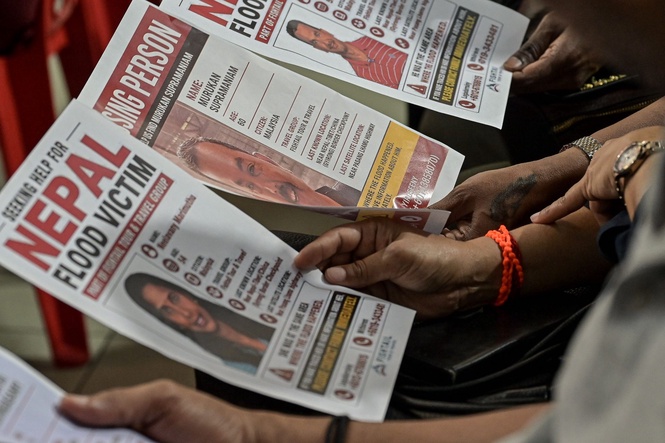
Fifty-five Malaysians are still missing in Nepal. Not 55 cases, not 55 names on a list – fifty-five people. And behind every one of those names is a family sitting with the cruelest word in the English language: missing.
Because missing is not dead. And that is exactly why it hurts so much. If someone dies, as unbearable as it is, there is a finality to it. There is a body to bring home, a funeral to arrange, relatives to call, food to cook, people to hug and prayers to offer.
You cry, you mourn and eventually, painfully, you begin to learn how to live with the empty chair. But what if there is no chair? What if you don’t even know whether the person who normally sits in it is coming home?
That is where these families are. Three weeks have passed since the floods hit Nepal’s Rasuwa district. Three weeks of checking phones. Three weeks of waiting for updates. Three weeks of asking questions that nobody can properly answer. Three weeks of hoping that the next knock on the door, the next phone call or the next WhatsApp message will somehow bring good news.
I cannot imagine what that does to a family. And perhaps that is the problem with the word “missing”. It sounds temporary: My keys are missing. My phone is missing. My pen is missing.
But no, those are not the same thing. When a loved one is missing, your entire life gets stuck between two possibilities: They survived or they didn’t.
And you are not allowed to fully embrace either one. You cannot properly celebrate because you feel guilty. You cannot properly grieve because you don’t know. You cannot pack away their belongings because what if they come home? You cannot stop looking at your phone because what if the next message is the one you have been waiting for?
Even sleep must feel like a negotiation. And while these families are living inside that terrible uncertainty, the rest of us carry on. We complain about traffic. We rush to work. We argue about what to eat for dinner. We send silly TikToks to friends. We get annoyed because someone took our parking spot.
Life, rather rudely, continues. And that is normal. It has to. Perhaps every now and then, we need to stop and remember that while our lives have moved on to the next headline, someone else’s life is still standing in Nepal. Fifty-five families are still waiting for an answer.
That number also struck me because it is bigger than the Malaysian numbers we remember from some of our most painful tragedies.
MH17 claimed 43 Malaysian lives. MH370 had 50 Malaysians on board. And now we have 55 Malaysians unaccounted for in one disaster.
But numbers don’t really explain grief. Numbers are neat, families are not. A number can fit into a headline but a mother waiting for her son cannot, a husband waiting for his wife cannot, a child waiting for a parent cannot.
And perhaps this is what I want us to remember when we talk about the 55. They are not simply 55 missing Malaysians; they are 55 unfinished stories.
Their birthdays may be approaching, their clothes still hanging in wardrobes, their photographs that nobody wants to take down and there are probably messages in phones that families cannot bring themselves to delete.
These are ordinary things that suddenly become unbearably precious – a favourite cup, a pair of slippers, a voice note or a last “Take care”. That is the part of tragedy we don’t see on television.
We see rescue teams. We see helicopters. We see maps. We see numbers. But we don’t see what happens when everyone goes home and a family is left staring at an empty room.
I think that is why this story deserves our attention even when there is no dramatic new development. Because sometimes the story is the waiting. Sometimes the story is that there is still no answer. And sometimes the story is simply that 55 families cannot move forward because they don’t know which direction to move in.
I don’t know what the final answer will be. Neither do these families. And perhaps that is the hardest part. For now, all they can do is wait. Hope can be a beautiful thing. But when you are waiting for someone who may never come home, hope can also be exhausting.
Still, I suspect they will hold on to it because what else can a family do?
So today, while most of us go about our lives, somewhere a phone will be kept close. Someone will check it again. And again. Just in case. Because for 55 families, the waiting has not ended. And until they know what happened to the people they love, neither has the grief.
Hashini Kavishtri Kannan is the news editor at theSun.
Comments: letters@thesundaily.com.my