Cebu, Philippines – The Visayas economy is booming, with Western Visayas posting the fastest year-on-year growth rate at 6.4% in 2025, followed by the Negros Island Region at 5.7% and Central Visayas at 3.7%, according to latest data from the Philippine Statistics Authority. The Department of Energy points out that this economic expansion comes alongside surging energy demand, as evidenced by recent red and yellow grid alerts reported by the National Grid Corporation of the Philippines, underscoring the growing pressure on the region’s power system.
How then can its cities support this economic boom without compromising safety, resilience and sustainability? Schneider Electric, a global energy technology leader with 190 years of innovation expertise, outlined a solution centered on three areas: making energy systems smarter, integrating diverse energy resources, and connecting infrastructure through responsive digital systems that help industries and communities adapt.
Manage demand: make energy systems smart
As local economies grow, more offices, commercial spaces, industrial facilities and public buildings are added to the urban landscape—each pulling more power from an already strained grid, particularly for cooling and other operations that consume significant amounts of electricity.
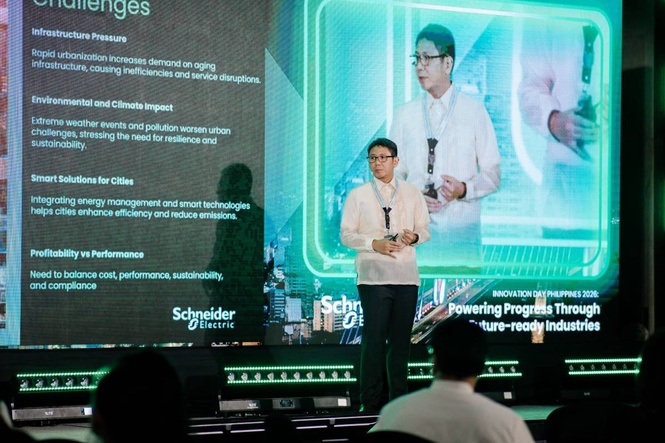
For Harold Lim, Country Solutions Head of Schneider Electric Philippines, the fastest way to ease that pressure is not necessarily new construction, but smarter energy management within the buildings and industries already there. “Intelligent energy systems can give operators greater visibility into how energy is being consumed, allowing them to identify inefficiencies and optimize systems such as cooling, lighting and ventilation,” he said.
That intelligence is especially relevant to buildings already existing. In Cebu, for instance, 31% of available office inventory is more than 10 years old, which creates an opportunity to modernize energy systems through retrofits such as upgraded controls, sensors and metering that can identify energy waste and optimize performance without the cost and disruption of a complete overhaul.
Strengthen supply: integrate diverse energy resources
With rapid economic growth driving continuous urban expansion, the region’s energy mix becomes more diverse, with renewable generation, distributed energy resources and electrification changing how power is produced and consumed.
For Schneider Electric, the opportunity lies in using digital energy management technologies to connect, monitor and coordinate these diverse energy resources as supply and demand change. This means giving businesses and operators greater visibility and control over when energy is generated, stored and consumed.
Schneider Electric’s smart energy solutions provide the digital and control infrastructure to make this possible — from smart grids that enable real-time monitoring, to digital grid platforms that automate distribution control, to microgrids that coordinate localized renewable generation and battery storage.
Build safer, smarter, and connected cities
Smarter demand management and a stronger, more flexible supply are two halves of the same equation. What turns them into a single, responsive system is EcoStruxure, Schneider Electric’s architecture for connecting, monitoring and optimizing energy and infrastructure systems.
Its architecture brings together three-layers. Onboard forms the foundation, connecting intelligent, AI-enabled devices such as sensors, circuit breakers and meters to the physical and digital worlds, providing the information needed to achieve operational goals. Operate brings that information into real-time control, helping operators orchestrate connected devices and adapt operations for greater efficiency, reliability and performance. Optimize brings data from across the enterprise, including Schneider Electric and other sources, together to turn it into strategic insights that support efficiency, collaboration and continuous improvement.Together, these allow local economies to support sustainable urban growth by managing growing demand, using resources more efficiently, and keeping essential services running.
In a region where yellow and red alerts already signal how quickly supply can fall short of demand, that visibility can change how fast a city responds. Instead of discovering a problem after the lights go out, operators can see strain building, whether at a substation nearing capacity or an overloaded transformer, and act before it becomes an outage.
“When essential services can see and respond to disruptions more quickly, cities are better equipped to maintain continuity and protect people during emergencies,” shared Lim.
For Schneider Electric, the outcome is a Visayas where cities are “safe, efficient, sustainable and livable,” with infrastructure that can adapt to growing demand and support the communities and economies that depend on it.