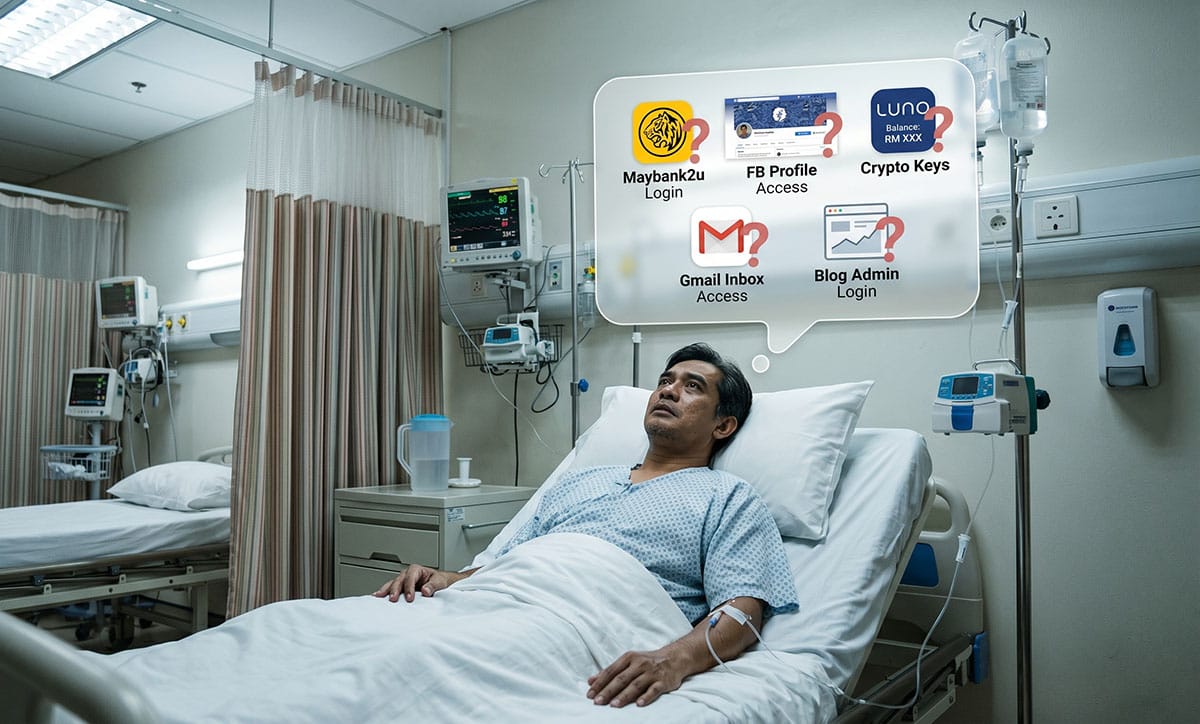
Nobody likes to talk about this. But someone has to bring it up. Here are some tips.
Your Facebook account has been active since 2008. Your Gmail contains eighteen years of correspondence. Your Maybank, CIMB, Versa and Luno accounts hold real money. Your TikTok and Instagram have thousands of followers. Your blog has been generating income for twenty years.
If you disappeared tomorrow, what happens to all of it?
For most Malaysians, the honest answer is: nobody knows. Because nobody planned for it.
Malaysia Already Has a RM90 Billion Problem
Before we even get to the digital layer, Malaysia has a staggering physical estate planning problem.
Frozen inheritance assets in Malaysia have reached RM90 billion, with 85% of Malaysians having no formal estate plan whatsoever. Properties, bank accounts, investments and business assets sit locked in legal limbo because their owners died without leaving clear instructions, and their families are now entangled in a process that can take years to resolve.
And that is just the physical assets. Nobody has started counting the digital ones.
Malaysia's digital economy is valued at over USD 35 billion and growing. Malaysians have money in digital banks, investment platforms, cryptocurrency wallets, e-wallets, and online businesses. They have years of memories in cloud storage. They have income-generating blogs and social media channels. All of it lives in accounts that are password-protected, platform-dependent, and largely invisible to anyone who is not the account holder.
When the account holder is gone, that invisibility becomes a problem.
The Letter I Wrote to My Wife
A few years ago, I sat down and wrote a note addressed to my wife. In it, I listed everything. Maybank, CIMB, credit card details, Versa, Luno, EPF i-Akaun, my blog login credentials, social media accounts, everything digital and financial that she would need to know about if something happened to me.
It was one of the most useful things I have ever done. And I have not updated it since, which means it is probably at least partially out of date by now.
I tell you this not because I have everything figured out, but because the act of writing that letter made me realise how much of my life exists only in digital form and how completely inaccessible it would be to the people I love most if I were no longer around to explain it.
If you have never done this, consider this your reminder.
What Actually Happens to Each Platform
Different platforms handle death differently, and most Malaysians have no idea what their default outcome is.
Facebook allows you to appoint a legacy contact before you die. This person can manage your memorialised profile, pin posts, update profile photos, and respond to friend requests. Your profile gets marked "Remembering" above your name and becomes a digital space for people to grieve and share memories. Alternatively, you can instruct Facebook to delete your account entirely upon death. If you do neither, your account simply continues existing indefinitely, occasionally sending birthday reminders to your friends long after you are gone, which is as unsettling as it sounds.
Google has an Inactive Account Manager that lets you specify what happens after your account goes inactive for a set period. You can choose trusted contacts to receive your Gmail, Google Drive files, Google Photos, and YouTube data. If you set nothing up, Google will attempt to contact you and if there is no response, will eventually delete the account, taking eighteen years of emails and every photo you ever backed up to Google Photos with it.
Instagram follows a similar path to Facebook, allowing memorialisation or deletion upon request from family with proof of death. Without instructions, the account persists.
TikTok and Twitter or X have limited legacy management options. Accounts can be reported for memorialisation or deletion by family members, but the process is not seamless and varies by region.
Blogs and websites are the most vulnerable of all. If you are the only person who knows the hosting credentials, the CPanel login, and the domain renewal schedule, your website disappears the moment renewal lapses and nobody knows to pay it. For Malaysian content creators, years of published work, active ad revenue, and loyal readerships can simply vanish because nobody had the password.
My blog at Ohsem.me has been online for nearly twenty years. My wife knows it exists but would not know how to maintain it, renew the hosting, or access the income streams tied to it. If I disappeared tomorrow, the blog would eventually go dark. Everything published since then would be gone.
The Money Sitting in Digital Accounts
This is the part that should genuinely alarm Malaysian families.
Your Versa account has a balance. Your Luno wallet has cryptocurrency. Your digital bank account has savings. Your EPF i-Akaun has decades of contributions. If your family does not know these exist, they cannot claim them.
Cryptocurrency is the most unforgiving category of all. Unlike a bank account, there is no institution to contact with a death certificate and extract funds. If nobody knows your wallet address, your private key, or even that you held cryptocurrency, those assets are mathematically inaccessible and effectively gone forever. Malaysia's legal framework for cryptocurrency inheritance is still evolving, meaning there is no clear legal mechanism to recover these assets even with court orders.
For regulated platforms like Luno and Versa, family members can approach the platform with relevant documentation to initiate an estate claim process. But they need to know the account exists first.
The Practical Guide: What to Do This Week
You do not need to be rich or old to do this. You just need an afternoon and a willingness to think about something uncomfortable.
Step 1: Create a digital inventory. Write down every account that matters. Bank accounts, investment platforms, e-wallets, crypto wallets, social media, email, cloud storage, subscription services, your blog or website if you have one. For each one, note the platform, the username or email used to register, and where the password can be found. Do not put passwords in a will since wills become public documents after death. Keep this list in a secure but accessible place, a locked physical document, a trusted password manager, or a sealed envelope kept somewhere your spouse or next of kin knows about.
Step 2: Set up platform legacy tools now. Go to Facebook and appoint a legacy contact today. It takes five minutes. Go to your Google account settings and configure Inactive Account Manager so your Gmail and Google Photos do not vanish into a server somewhere. These tools exist precisely for this situation and most people never use them.
Step 3: Include digital assets in your will. Estate planning specialists like Rockwills have specific clauses for digital assets that appoint a digital facilitator with the authority to access and manage your accounts. A will that covers only physical assets is incomplete for anyone living a significant portion of their life online.
Step 4: Tell someone. The most detailed digital inventory in the world is useless if nobody knows it exists. Tell your spouse, your sibling, or whoever would be responsible for managing your affairs where the document is kept. Not the contents necessarily. Just where it is.
Step 5: Update it regularly. Once a year, minimum. Every time you open a new financial account or investment platform, add it to the list. The version I wrote a few years ago is already incomplete.
My Take
Writing that letter to my wife was one of those quiet, slightly sobering acts that you do not talk about but feel better for having done. It was not morbid. It was practical. The same way writing a will is not morbid. It is just taking care of the people who depend on you, beyond the moment when you are no longer around to do it yourself.
The digital layer of our lives is real and it has real value. My blog income, my investment accounts, my twenty years of published writing. These are not abstractions. They are assets that my family deserves to know about and be able to access if the situation ever demands it.
Malaysia already has RM90 billion frozen in estates because people did not plan. The digital version of that problem is coming, quietly and invisibly, for the generation that built their lives online.
The note to my wife needs updating. I will do it this week.
And if you have never written yours, today is a good day to start.
Kamarul Azwan (k.azwan@gmail.com) is a content creator under the Newswav Creator programme, where you get to express yourself, be a citizen journalist, and at the same time monetize your content & reach millions of users on Newswav. Log in to creator.newswav.com and become a Newswav Creator now!
The User Content (as defined on Newswav Terms of Use) above including the views expressed and media (pictures, videos, citations etc) were submitted & posted by the author. Newswav is solely an aggregation platform that hosts the User Content. If you have any questions about the content, copyright or other issues of the work, please contact creator@newswav.com.