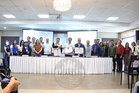
I WAS happy to hear that Metropolitan Manila Development Authority (MMDA) Chairman Atty. Romando “Don” Artes was recently in Barcelona, Spain to learn about Barcelona’s approach to mobility and other urban challenges.
Barcelona is one of the most livable cities in the world, so there is a lot to learn from it. Metropolitan Manila and Metropolitan Barcelona have roughly the same land area, but Metro Manila has four times the population of Metro Barcelona.
Here are nine of Barcelona’s best practices that are worthy of emulation.
Barcelona focuses on moving people rather than vehicles. Barcelona has been implementing an urban mobility plan for the past five decades that prioritizes people-oriented modes of travel (walking, cycling and public transport) over the mobility of private motor vehicles. The city recognized early on that favoring private motor vehicles on its roads would very soon leave everyone in gridlock. The only way to enhance mobility for everyone was to discourage private motor vehicle use (the least efficient and least sustainable mode of travel) while giving more road space to the most efficient, healthy and inclusive travel modes.
The objectives of Barcelona’s Mobility Plan are safe mobility, sustainable mobility, healthy mobility, equal mobility and smart mobility. In Barcelona, traffic management is not about keeping vehicles moving; it is about ensuring that every road user is safe and comfortable as he or she travels around the city. Infrastructure and vehicles are designed to be universally accessible, so that no one is excluded, regardless of physical ability.
Trees are found on every street and offer a dense, shaded canopy. Greenery and trees are part of essential infrastructure on every street, offering weather protection, temperature control and additional drainage for excess water. This makes every neighborhood not only attractive, but also cool and walkable even in the noonday sun. This is what Metro Manila needs in order to offset the urban heat island effect plus global warming.
Sidewalk space is generous and pedestrians are prioritized at traffic signals. Whether on avenues or small streets, pedestrian space is abundant and safe. At traffic signals, there is enough time for people to cross. On wide roads, there are pedestrian refuge islands. Benches are available for those who need to sit along their journey. This makes walking a safe and pleasurable experience.
Bicycle lanes are protected and provide a continuous network. You can travel on a bicycle through many parts of the city on a continuous safe pathway. Ankle-level barriers, interspersed along bike lanes, keep cars from mixing in the same space. These pathways are used by senior citizens and persons with disability on mobility devices such as wheelchairs. At intersections, bike lanes are painted red or bright orange, indicating that bicycles have priority and motor vehicles should stop. Bike racks are available at popular destinations, and bike rental schemes serve local residents and tourists.
Car-free streets provide ample public open space that attracts tourists and commercial activity. One of the most famous pedestrian streets in the world is La Rambla of Barcelona, which hosts hundreds of thousands of tourists daily. Lined with trees on both sides, La Rambla runs for over a kilometer with numerous commercial establishments and historic landmarks along the way. It is one example of the more than 100 kilometers of pedestrianized streets (covering about 145 hectares) in Barcelona, providing citizens and visitors with ample public space.
Barcelona’s road design and traffic management enables buses to move faster than cars. The city’s bus network achieves this efficiency with dedicated bus lanes, traffic signals that give buses priority at intersections, and station designs that ensure smooth transfers and fast boarding and alighting.
Buses and trains under common management and a single transport agency deliver a high-quality experience for the commuter. Different modes of transport are well-integrated under unified management that permits convenient interchanges, cost-free transfers within a single zone, and cashless payments using a common fare card or electronic wallet. Buses and trains are regarded as complementary services; one mode does not see the other as its competition.
Superblocks control vehicle access so that neighborhoods have more space for walking, greenery, play and social activity. A superblock is a square-shaped cluster of several residential city blocks where vehicle through traffic is restricted, thereby enabling the interior street space within the superblock cluster to be transformed into neighborhood public space or community facilities — playgrounds, gardens, recreation and exercise areas, social services and meeting halls. The result is a more cohesive, active, healthy and interconnected local community.
Barcelona’s Protecting Schools Program applies people-friendly street design and lower speed limits to keep students safe. The purpose of the program is to make streets around schools safer and healthier (with fewer motor vehicles), giving parents and students safe spaces around schools to play, wait and meet. School zones have mandatory low speed limits of 10-30 kph, plus traffic calming infrastructure (speed tables, traffic humps and narrowing lanes). The design is tailored to each school. Other possible elements are: removal of parking; restricting vehicle access in front of the school; and marking the road in front of the school with orange pavement. In some cases, the road in front of the school is transformed into a car-free plaza with shade trees, greenery and park benches.
Barcelona is one of the most livable places on the planet, in large part, because it promotes and prioritizes the space-efficient modes of travel — walking, cycling and public transportation — given its limited road space, while discouraging the inefficient and unhealthy use of private motor vehicles. Meanwhile, Metro Manila, with similarly limited road space and much higher population density, is doing just the opposite, becoming more unlivable in the process. Let’s hope Chairman Don’s visit to Barcelona delivers the right lessons. Our urban future depends on it.
Robert Y. Siy is a development economist, city and regional planner, and public transport advocate.