
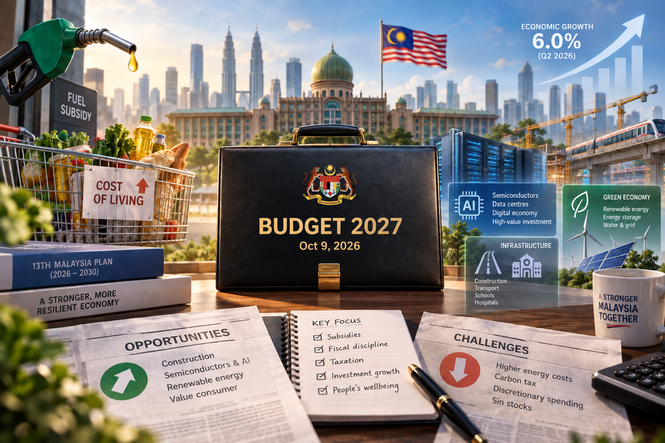
EVERY government budget carries a question from the people: how will this help us with the cost of living?
Budget 2027, to be tabled on Oct 9, arrives with a question more pointed than usual, following a year underlined by geopolitics impacting global oil price rises and fluctuations, and locally, with tightening subsidy reforms.
However, for the market, this is not just a one-day event. The parliamentary schedule spans 37 sitting days through to Dec 8, with policy and committee debates running continuously through October and November.
For investors, this creates a crucial six-week trading window. Historically, October is a peak liquidity period—accounting for 11.05% of the entire year’s trading volume in 2025—making this the most critical market window of the fourth quarter.
According to Moomoo Malaysia, the nation enters this cycle from a position of strength, driven by several high value investments into the country. The economy grew 6% in the second quarter of 2026, lifting the first-half growth to 5.7% – comfortably ahead of last year’s pace, and stronger than expected going into 2027.
That momentum gives the government room to manoeuvre. Current market consensus estimates put Budget 2027’s total expenditure at around RM438.9 billion (comprising roughly RM353.1 billion in operating and RM85.8 billion in development expenditure). This aligns tightly with the 13th Malaysia Plan (13MP: 2026–2030), which maps out an average development expenditure of RM86 billion annually. A key focus will be whether the government can narrow its fiscal deficit towards 3.3% of GDP, down from the official 3.5% target in 2026.
The Finance Ministry, in its Pre-Budget Statement released in August, sets out some expectations that aim to raise the ceiling for growth, and the floor for living standards, but as cost of living, subsidies, and infrastructure spending remain in many people’s minds, and many will continue to wonder about its impact.
Fortunately, the pre-budget statement is candid about this: the prolonged conflict in West Asia pushed crude oil above US$100 a barrel, and as escalations are likely to continue, it could stay that way well into 2027 – impacting the expected RM15.5 billion in annual savings from targeted subsidies throughout this year.
Moomoo Malaysia in a statement yesterday said the resilience is driven by the aforementioned high-value investments through digital industrialisation such as semiconductors, AI, data centres, digital services and energy. As a result, approved investments climbed from RM267.8 billion in 2022 to RM431.1 billion in 2025. The Pre-Budget Statement notes this shift as building resilience against future geopolitical, climate and commodity disruptions, alongside strengthening the social protection system, including EPF adequacy.
What to watch: Key policy variables
Beyond the headline spending figure, two key policy variables will dictate market sentiment and foreign capital flows:
> Subsidies and fiscal discipline: The tension between global energy costs and domestic subsidies is the single biggest variable this October. Effective Sept 1, the BUDI95 basic subsidy quota was restored to 300 litres per month at RM1.99 per litre, benefiting over 16 million people. With the 2026 fuel subsidy bill potentially reaching RM40 billion, the government’s ability to maintain fiscal discipline while protecting households will be closely watched.
> Taxation and revenue: The market broadly expects no major new taxes. Instead, the focus will likely remain on optimising the existing tax framework, including SST and the Capital Gains Tax on unlisted shares. The Sept 1 increase in the mandatory e-Invoicing threshold from RM1 million to RM3 million in annual revenue also provides relief for SMEs, while the proposed carbon tax, initially targeting the steel and energy sectors, will remain an area to watch.
Sectors to watch: Winners and losers
Every budget moves markets unevenly. Based on these fiscal signals, here is how sectors are positioned for Budget 2027:
> The beneficiaries: Development expenditure (RM85–90 billion consensus) directly benefits construction and building materials, particularly those securing contracts for hospitals, schools, and transport. Beyond traditional concrete, look to grid and water infrastructure, renewable energy, and energy storage as structural winners. Semiconductors and AI-linked names will continue to ride the data centre and National AI Action Plan wave. Lastly, targeted cash aids like BUDI95 will support value and affordable consumer stocks by protecting baseline household purchasing power.
> Sectors under pressure: The rollout of the carbon tax introduces immediate compliance costs for steel and high-carbon energy producers. Discretionary consumer stocks may face headwinds from the cascading effects of an expanded or adjusted SST framework, as middle-class spending power gets squeezed. Additionally, “sin stocks” across tobacco and alcohol face their usual pre-Budget jitters over potential excise duty hikes.
For investors, MoomooMalaysia said the practical takeaway is that Budget Day rewards diversification across this mix rather than a single-sector bet. Having access to both Bursa-listed beneficiaries and the global names feeding into the same AI and semiconductor cycle is what lets a portfolio capture the budget story from more than one angle. That same discipline extends beyond sector selection: it’s not just the headline figure, but it’s also whether the money actually goes where it’s said to – a check that applies whether you’re managing billions or building your first portfolio.
This commentary by Moomoo Malaysia has not been reviewed by the SC.