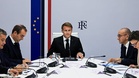
President Emmanuel Macron has declined Interior Minister Laurent Nunez's offer to resign after a weekend of widespread rioting, according to the Elysee presidential office.
Macron said Nunez should remain to ensure a chain of command is kept within the police and security forces, and has also asked Nunez to set up new approaches to deal with looters, the Elysee added.
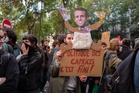
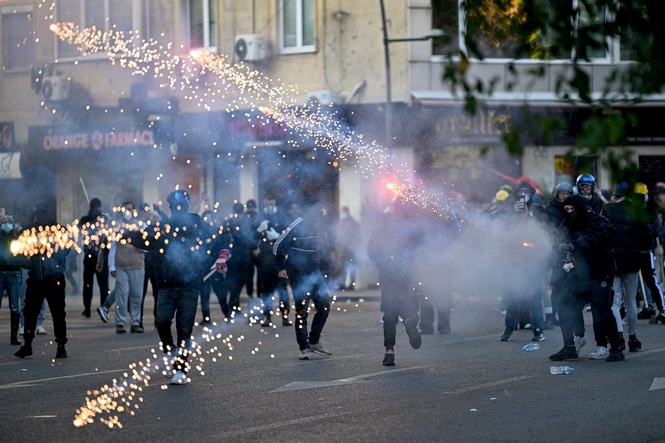
It comes after hundreds of people were arrested and buildings set on fire across France on Saturday as protests over the cost of living crisis spread. In Paris, police fired tear gas into crowds on Saturday, while there were also violent incidents reported in Marseille, Rennes, Toulouse and Angers.
Meanwhile, more clashes also broke out in Paris and Marseille on Sunday, where riot police intervened to prevent attempts to ransack businesses.
Macron held an emergency meeting with top government officials on Sunday afternoon, before addressing the nation at 8pm.
The turmoil marks the latest test for Emmanuel Macron’s presidency as France contends with both foreign and domestic troubles.
The protests began in September, launched by students angry at the conditions at their high schools after the summer holidays.
However, they have since grown, fuelled by a wider group of protesters incensed about the cost of living.
Here’s everything you need to know about the movement.
Where the protests began
Demonstrations first erupted in September in a high school in Creteil, southeast of Paris, over a lack of staff.
From there, class strikes, blockades and demonstrations spread to other Paris suburbs and then nationwide, even in smaller towns. Hundreds of schools had to close because of damage or attacks on staff.

High schoolers said they had grievances over schools that are under-resourced, with dilapidated facilities and insufficient staff, notably in lower-income neighbourhoods. French media showed videos of scampering rats, collapsed ceilings, leaks, broken furniture and other woes in dilapidated schools.
Some students also complained that during summer heat waves, they roast in classrooms without air-conditioning, while in winter they freeze. They say school days, which often run from 8am-6pm, are too exhausting and the university entrance system is complex and unfair. Some university students also joined the protests.
There have been broader concerns in France that the country's education system is losing ground to other countries and failing in its mission to enable children from disadvantaged backgrounds to move up the social ladder. Scores in reading comprehension and mathematics have plunged, according to the latest PISA report, which evaluates students worldwide.
Why protests exploded on Saturday
Demonstrations were boosted by other groups on Saturday, protesting the high cost of living and what they say is the deterioration of the social welfare system.
The General Confederation of Labour (CGT), which is one of the country’s largest unions, backed the protests, issuing a call for lower prices and higher pensions and wages.
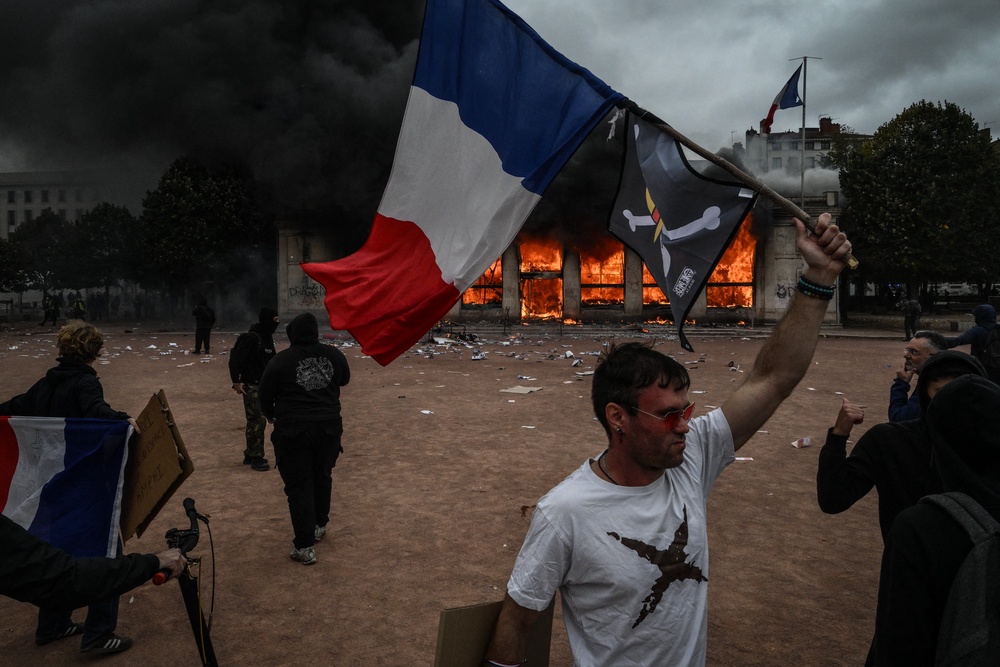
Tens of thousands of people took to the streets. Protesters in Marseille stormed the town hall, painting an ‘A’ for anarchy on a wall, while in Paris, police fired tear gas and a water cannon and rioters threw stones and fireworks.
In Lyon, protesters set fire to the city’s tourism office.
French authorities said there were more than 500,000 protesters across the country, with more than 800 arrests in Paris alone.
Macron has called for calm, saying “we all feel anger and shame” after “unprecedented violence” nationwide. He vowed to “make examples if need be” of the rioters, warning for “those who want to spark violence and create unrest in our country, we will not yield”.
Police response to students has drawn ire
Riot police have liberally used tear gas and wielded their batons to disperse crowds during the student protests.
A police tear gas grenade shattered a 14-year-old’s jaw and many of his teeth. A 15-year-old lost a hand in an incident involving a police stun grenade. Other adolescents have also suffered life-changing injuries blamed on police weaponry during protests.

Police and school staff have been targeted with powerful fireworks and other injury-causing projectiles. The interior ministry says acid has been hurled in some cases, and that people intent on destruction and looting have grafted themselves onto the high schoolers’ movement.
Presidential candidates are seizing the moment
Candidates campaigning to succeed Mr Macron in a coming presidential election in April and May have seized on the demonstrations as a political issue. Mr Macron is constitutionally barred from seeking a third consecutive term.
Far-left candidate Jean-Luc Mélenchon has positioned himself firmly on the side of the students and has decried police actions. His party invited high school activists on stage at a rally, and then proposed lowering the voting age to 16 and scrapping selective admissions at universities.

Meanwhile, far-right leader Marine Le Pen has called for broader police powers against rioters. Conservative former Prime Minister Edouard Philippe, one of Le Pen’s main challengers for the presidency, has condemned those who “break things, burn things or assault people.”
Other European countries have seen unrest
Taking grievances to the streets is hardly unusual in the country that spawned the French Revolution of 1789. To name just a few, there were mass student protests in 1968, weeks of suburban unrest in 2005, yellow vest protests in 2018-2019, and demonstrations in 2023 against raising the retirement age.
But some other countries have also seen some student unrest.
In neighbouring Belgium, some schools closed in Liege, a day after violence in the city and arrests there.
Several Italian cities also saw student protests last week, though on a smaller scale than in France and focused on a broader set of domestic grievances. On Saturday there was a protest in Milan where rioters clashed with police, looted stores and set property on fire, emptying Piazza del Duomo and a luxury shopping arcade when the area would usually be teeming with shoppers.
The march against wars and rising living costs began peacefully. But masked protesters threw stones, paving blocks and other objects at riot police and set fire to barricades made from bar tables. Images of the aftermath showed a severely damaged carabinieri car.
Police used water cannons and tear gas to disperse the crowds. At least two police officers were injured and about 50 demonstrators, including many minors, were detained, the LaPresse news agency reported.
Read MoreFrance protests live: Macron says ‘we feel anger and shame’ after 2,000 arrests
Massachusetts GOP lieutenant governor candidate suspends campaign after arrest in car crash
Ukraine war live: Kyiv launches massive 1,000-drone attack and sets oil sites ablaze
Blaze at St Petersburg oil sites as Kyiv launches more than 1,000 drones at Russia
Twenty-four Romanian men deported from Ireland on charter flight from Dublin
As France burns, Macron looks like a man who has lost control