.jpg)
What the Chew Jetty Fire Should Tell Us Before We Move On
By Mihar Dias September 2026
At 1.08 in the morning, someone picked up a phone and made a call that mattered. By the time the fire trucks reached George Town's oldest clan jetty, roughly two minutes had passed — a response time most cities would kill for. Thirty firefighters, seventeen volunteers, the Civil Defence Force, the police, all converging in the dark on a settlement built out of teak and memory, standing on stilts over the sea. By dawn, five premises were gone. No one died. A petrol station and a neighbourhood full of homes were spared. https://mcigroup.my/top-news/fire-razes-five-business-premises-at-penangs-iconic-chew-jetty/
On paper, this is a good news story about competence under pressure.
I don't think it should be read that way, and I suspect most people who love Chew Jetty won't read it that way either.
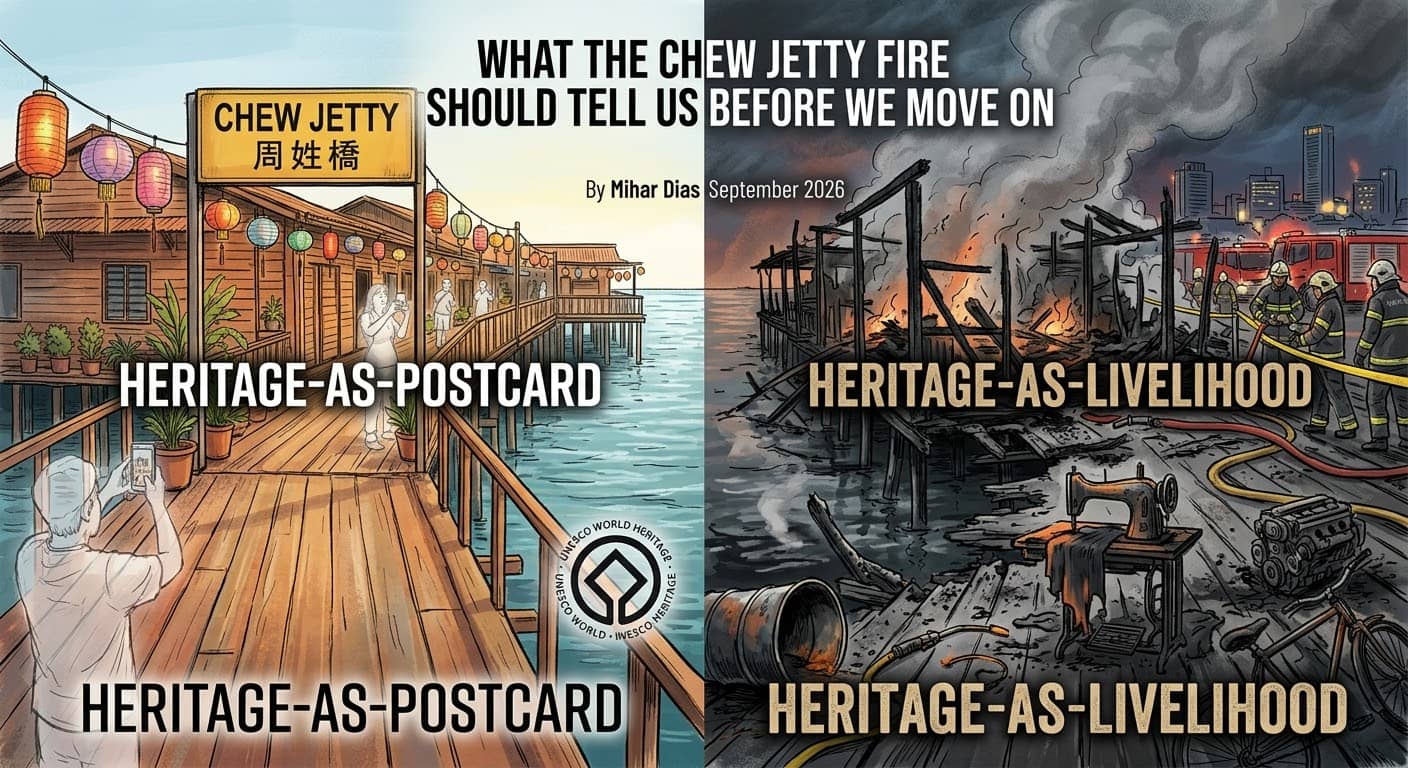
Start with the obvious irony that nobody in the coverage seems to have dwelt on. The businesses lost were not incense shops or trinket stalls catering to the tourist trade that Chew Jetty has increasingly become known for. They were a car workshop. A welding shop. A timber factory. A T-shirt printing operation that had served customers for thirty years, with — as its owner Toh Aik Aun pointed out — hundreds of pieces of other people's clothing burned along with it. A car painting shop running since 1997, with a Swift, a C-Class and a BMW caught inside when the flames came. https://mcigroup.my/top-news/fire-razes-five-business-premises-at-penangs-iconic-chew-jetty/
This was not heritage-as-postcard. This was heritage-as-livelihood: welding torches, paint thinner, sawdust, and combustion engines, all packed onto wooden stilts above water, inside a UNESCO World Heritage Site that half the world associates with lantern-lit alleys and grandmother's laksa recipes.
That mismatch is the story. A car workshop and a timber factory are, by any reasonable fire-safety standard, exactly the kind of operations you don't want sharing a timber substructure with families who have lived there since the nineteenth century. This is not a criticism of the traders — many of them have operated in that spot for decades, long before "heritage tourism" was a line item in anyone's economic plan, and they have as much right to make a living there as anyone. It is a question for the rest of us, the ones who declared Chew Jetty a UNESCO site in 2008 and have spent the years since congratulating ourselves on the plaque, without asking hard enough what still burns underneath it.
Penang has been here before, in spirit if not in exact form. Every few years a fire moves through one of George Town's old quarters and reminds everyone that "heritage" is not a synonym for "safe." Wooden structures built a century before anyone imagined a fire code do not become fire-resistant because UNESCO likes the way they look. And clan jetties, precisely because of what makes them so photogenic — the closeness of the houses, the shared walkways, the water beneath instead of a fire lane — are structurally almost designed to turn a single workshop fire into a five-premises fire within the span of two hours.
So credit where it's due: the firefighters saved the petrol station, and they saved the residential blocks next door, and nobody is dead. That is not a small thing, and Rosli Ibrahim's team deserves to hear that said plainly. But "no one died this time" is not a heritage-management strategy. It's a description of luck holding, once again.
What should follow now, and almost certainly won't unless someone insists on it, is an unglamorous audit: which premises on Chew Jetty and its sister jetties are running machinery, flames, solvents or combustibles; whether the electrical wiring feeding them has ever been inspected since the buildings were declared "iconic"; whether there is a fire hydrant or a water source on the jetty itself rather than two minutes away by road. UNESCO status brought Chew Jetty tourists, Instagram fame, and a certain amount of civic pride. It has not, on the evidence of last night, brought it a fire code suited to what actually happens on those stilts after the tour groups go home.
The residents and traders of Chew Jetty are exactly the kind of ordinary Malaysians most Malaysians say they want to protect when they wax lyrical about heritage — precisely because they still work there, still live there, still weld and paint and print T-shirts there, rather than having been priced out into some heritage-conservation fantasy where the buildings survive and the people don't. If we mean any of that, the response to this fire cannot be a press release and a repaired jetty. It has to be a serious look at what we are asking a nineteenth-century settlement to safely contain in the twenty-first.
The investigation into the cause is still ongoing. The investigation into why this was allowed to be foreseeable should start now, before the next distress call comes in at some other hour of some other morning, and the arithmetic of luck runs the other way.
Mihar Dias (mihardias@gmail.com) is a content creator under the Newswav Creator programme, where you get to express yourself, be a citizen journalist, and at the same time monetize your content & reach millions of users on Newswav. Log in to creator.newswav.com and become a Newswav Creator now!
The User Content (as defined on Newswav Terms of Use) above including the views expressed and media (pictures, videos, citations etc) were submitted & posted by the author. Newswav is solely an aggregation platform that hosts the User Content. If you have any questions about the content, copyright or other issues of the work, please contact creator@newswav.com.