

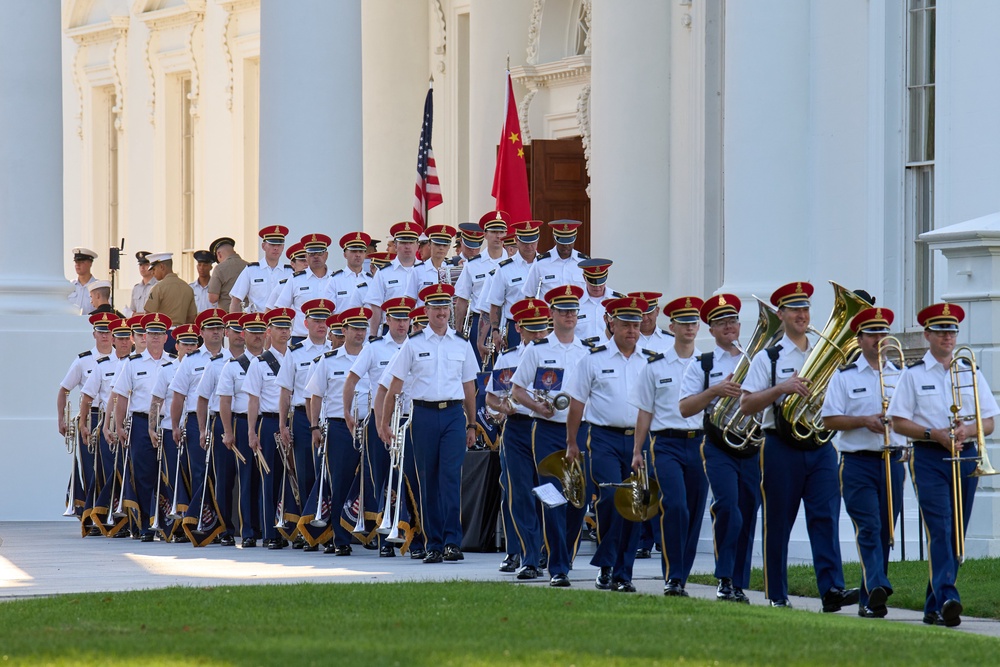
Later this week when Xi Jinping arrives in the US for high-stakes talks, Donald Trump will be there at Joint Base Andrews airbase to welcome him personally, a rare departure from protocol for the US president.
Analysts say the gesture is an indication of how seriously Trump is taking this visit, and of the dramatic transformation in China’s stature on the world stage since Xi’s last visit to Washington over a decade ago, when he had to wait for his chance to meet then-president Barack Obama at a nuclear security summit.
Trump’s ongoing war with Iran – an important trading partner for China in the Middle East – is set to loom large over Xi’s visit from Thursday, but the real crux of the talks will be how to maintain the uneasy economic relationship between the US and China themselves.
China goes into the talks in a strong position, thanks in large part to the Middle East conflict. Analysts say Xi will be in no rush to make concessions to the US president constrained by the costly war that has hurt Americans' wallets and is impacting his ratings ahead of midterm elections.
“Trump has repeatedly downplayed the scale and significance of China's support for Iran. Neither he nor (treasury secretary Scott) Bessent, has indicated that the US is preparing, or inclined, to target major Chinese financial institutions,” Ali Wyne, a senior research and advocacy adviser on US-China at the Crisis Group International, tells The Independent.
China and the US will, instead, aim to drive modest outcomes to show the world – and financial markets – that both leaders are keen to preserve the truce that has held since their tariff war reached its peak last year, Wyne says.
“But the backdrop will be significant for at least two reasons. First, it will offer a split screen between a resurgent power that is building its diplomatic sway and an incumbent power that is undercutting many of its longstanding alliances and partnerships.
“Second, it will underscore a profound shift in the bilateral balance relative to March 2016, when Xi last visited Washington: he will arrive as the leader of a country that Trump concedes is a near-peer,” he says.

Washington sees Xi as uniquely able to exert pressure on Iran to bring an end to the war that has dragged Trump's approval rating to the lowest of his political career. However, Xi has shown little inclination to do so.
Reuters earlier this month reported that Beijing is selling billions of dollars' worth of goods to Iran through a sanctions-evasion scheme. China's foreign ministry says it is not aware of such a scheme.
Sam Goodman, senior director of policy at the China Strategic Risks Institute (CSRI), says: “It seems at the moment very much that the Chinese have the upper hand here and that the Americans are clearly very reluctant to take any measures against China regarding Iran that might upset Beijing.”
That is more evidence, analysts say, that Trump is eager to keep relations with Xi steady as he focuses his energies elsewhere – an arrangement that also suits the Chinese leader.
While the Iran war will feature prominently in the talks, the main focus of the 24 September meeting is on whether the leaders will signal an extension to a trade truce struck last year that averted a major shock to the global economy.
With a tariff agreement between the two sides due to expire in November, getting plans in place to extend the truce and adding in some targeted tariff reductions is a more likely outcome than a broad new trade deal.
Other important issues are also at stake, including US defence and military cooperation with Taiwan – a major issue for China, if not for Washington – Beijing’s tensions with Japan, rare Earth export controls and the US accusing China of extracting capabilities from frontier American AI systems.
Trump’s meeting with China comes at a time when Bessent has warned every country doing business with Iran that the US will launch a new round of sanctions.
The top trade official did not mention China in his veiled threats but Beijing remains Iran’s biggest trading partner and its leading oil buyer.
China receives more than 80 per cent of Iranian oil shipments but usually through indirect channels – around 1.47m barrels a day as last recorded in March this year. In response to Bessent, Chinese foreign ministry spokesperson, Lin Jian, said China-Iran cooperation “should not be disrupted or undermined”.
Edgard Kagan, senior adviser and Freeman Chair in China studies at the Center for Strategic and International Studies, has described China’s position on Iran as “a holding response” and said Beijing will try to do the least to comply without openly confronting the US.
“They’ve tended to be careful not crossing explicit red lines, but they haven’t addressed the spirit of what the US has sought,” Kagan told the AP last month, referring to ship-to-ship oil transfers that obscure the origin of Iranian crude oil to evade American sanctions.
“I think the real question is, is there room to push (the Chinese) to reduce what they’re doing with Iran, to put more pressure on the Iranian regime in a way that doesn’t lead them to say, ‘This is unreasonable, and we’re not going to comply,’” he said.
Trump visited China in May, as well as in his first term, for talks with Xi, who rolled out the red carpet for his American counterpart. Xi was last in the US for a full state visit in September 2015.
Read MoreOver 1.6 million people under evacuation order as Typhoon Dujuan batters Japan
Death toll from Nepal flash floods may near 10,000
What is China building this giant ship for? Satellite images offer a clue
Taiwanese minister makes rare visit to China despite rising tensions
Hyrox athlete apologises and forfeits victory after defecating during race
Rumours swirl about Xi Jinping’s health after he returns quickly from India