
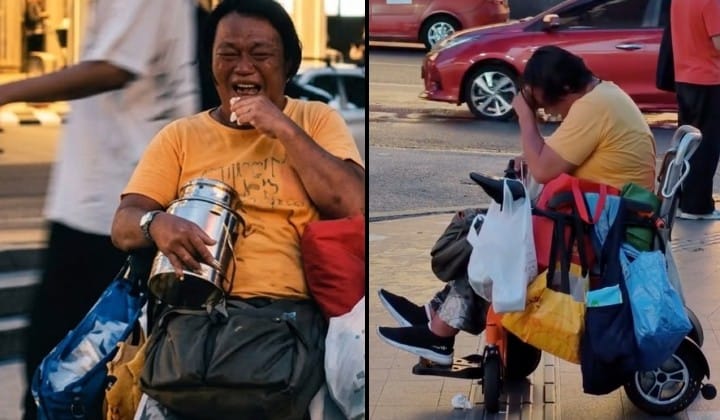
Every single afternoon, the concrete jungle of Bukit Bintang throbs with the unyielding rhythm of consumerism. Tourists from across the globe take selfies under the neon lights, and affluent locals stroll out of luxury boutiques carrying bags that cost more than a minimum-wage annual salary. It is a glittering monument to Malaysia’s modern prosperity. Yet, just a few feet away from the shelter of upscale shopping complexes, a raw, heartbreaking scene shattered the digital consciousness of the nation.
A video surfaced across social media platforms like Facebook and Threads, capturing an elderly woman in a wheelchair, wearing her distinctive "Malayan Tiger" national jersey, entirely overwhelmed by tears. She wasn't shouting or holding out a hand for handouts; she was sitting under the merciless heat, clutching her forehead, weeping in deep distress. For thousands of passersby rushing into Pavilion Kuala Lumpur, she was just another invisible fixture of urban poverty. But to those who paused online, a shocking reality hit home: this woman is Koh Lee Peng. Between 2001 and 2005, she did not just participate for her country she dominated, bringing home seven gold medals and three silver medals for Malaysia at the ASEAN Para Games.
The image of a former national champion crying while hawking tissue packets on the sidewalks of Kuala Lumpur's premier shopping district did not just spark sympathy; it ignited an explosive, polarized debate across the Malaysian digital landscape. It forced an entire country to look into a mirror and ask an incredibly uncomfortable question: How does a woman who once stood proudly on international podiums while Negaraku played end up weeping on a street corner, selling RM2 tissue packets to survive?
Anatomy of a Public Breakdown: Beyond the Surface Pity
When a video like Koh’s goes viral, the knee-jack reaction of the internet is swift, fierce, and heavily reliant on outrage. Within twenty-four hours, fingers were aggressively pointed at the government, the Ministry of Youth and Sports (KBS), and a supposedly ungrateful society that discards its sporting heroes once the flashbulbs stop popping. Comment sections turned into a digital war zone. However, as independent journalists dug deeper into the reality behind those viral tears, a far more complex, heartbreaking, and institutional crisis began to unravel.
According to an investigative report by The Rakyat Post, Koh’s emotional collapse on that specific day was not a simple plea for financial charity. It was the breaking point of an accumulation of trauma. Weeks prior, on April 16, Koh was the victim of a ruthless hit-and-run accident. A car struck her wheelchair while she was navigating her way to an MRT station, throwing her violently to the ground. The driver sped away without an apology, let alone an offer of medical compensation. The accident completely destroyed her electric wheelchair her only lifeline to mobility and independence.
Compounding the trauma of the accident was a relentless week of heavy tropical downpours that kept foot traffic away, severely crippling her daily earnings. Furthermore, as revealed by Deputy Youth and Sports Minister Mordi Bimol during a welfare visit to her residence, Koh had been subjected to severe mental stress after being publicly harassed, insulted, and falsely labeled by unfeeling netizens and passersby as a lazy beggar or part of a syndicate exploiting the public. She wore her national jersey and her hard-earned medals around her neck not as a marketing gimmick, but as a shield of honor. As she poignantly shared, she wore them so people would know she was a legitimate athlete who once gave everything for her nation, not a scam artist.
The Dignity Paradox: Choice, Independence, and Institutional Limitations
The structural analysis of Koh Lee Peng’s reality challenges the conventional narrative of the "abandoned athlete." Over the years, government agencies and the National Athletes Welfare Foundation (YAKEB) have stepped forward to offer various forms of conventional aid. As reported by AsiaOne, YAKEB has provided her with medical assistance, coordinated psychiatric care at Kuala Lumpur Hospital, and even rushed to replace her ruined wheelchair with a brand-new electric model following her recent hit-and-run. She also receives a monthly stipend from the Social Welfare Department (JKM) and temporary financial allowances from sports foundations.
So, why is she still on the streets? This is where the profound disconnect between top-down institutional assistance and the lived reality of disabled individuals becomes apparent. Former government officials have previously noted in Parliament that Koh was offered stable employment opportunities, including an entrepreneurial business kiosk at a transit station and coaching paths. Yet, Koh actively chose to turn them down. To understand her refusal is to understand the fiercely independent psychology of a Paralympian.
Before turning to the streets in 2019, Koh held a standard office job. However, she was forced to resign due to egregious structural accessibility issues specifically, working in a commercial building with broken or nonexistent elevators that left a wheelchair user completely stranded. For an elite athlete who spent her youth moving freely through water, the claustrophobia of being trapped indoors or restricted to a stationary booth was a form of psychological confinement. Koh explicitly stated that sitting inside an enclosed space all day would destroy her happiness; her years of grueling athletic training instilled in her a profound need for physical autonomy, movement, and self-reliance. Selling tissue paper and handmade crafts on the streets is an honest living where she answers to no one but herself.
Yet, this independence comes at a terrifying cost. Koh is part of an informal communal network of roughly seventeen disabled individuals who live and support each other collectively. Their shared expenses encompassing rent, specialized medical bills, and food range between RM35,000 and RM45,000 every single month. When institutional aid is structured around rigid, individualistic welfare models, it completely fails to support these unique, self-organized communities of disabled citizens who are trying to survive outside of a broken system.
The Broader Crisis: The Fragile Safety Nets for Malaysia’s Retired Sports Heroes
Sociological analysis suggests that the uproar surrounding Koh Lee Peng is indicative of a much deeper, systemic rot within the ecosystem of Malaysian sports management. While able-bodied, mainstream sports heroes are showered with lucrative corporate sponsorships, lifetime pensions, luxury apartments, and massive cash incentives upon winning major tournaments, para-athletes are historically treated as secondary thoughts. The disparity in post-retirement security between mainstream athletes and para-athletes remains a yawning chasm.
An athlete's professional lifecycle is incredibly brief. They spend their prime developmental years from childhood until their late twenties submitting their bodies to intense physical punishment to bring glory to the Malaysian flag. During these formative decades, they do not build corporate resumes, they do not acquire corporate skills, and they rarely accumulate traditional academic qualifications. When retirement inevitably arrives due to age or injury, they are cast out into a highly competitive, unforgiving job market with a massive gap in their employment history.
For a disabled retired athlete, this transition is double the hardship. Malaysia's public infrastructure remains deeply hostile to wheelchair users, from broken sidewalks to inaccessible public transit systems. When the state treats athlete welfare as a temporary series of ad-hoc financial handouts rather than establishing a comprehensive, permanent post-retirement career transition framework, it leaves former champions highly vulnerable. Welfare is a band-aid; what these retired heroes require is systemic integration such as specialized training to become certified coaches, sports administrators, or access to genuinely accessible corporate environments that honor their unparalleled discipline.
Cultural Hypocrisy and the Perils of "Outrage Culture"
The public discourse surrounding Koh’s viral breakdown highlights a profound cultural hypocrisy within Malaysian society. As noted in media commentary on The Independent Singapore, the digital space oscillates violently between extreme pity and cruel skepticism. When the video first dropped, the immediate reaction was collective performative grief thousands of netizens sharing the clip accompanied by weeping emojis, demanding immediate government accountability.
Yet, when details emerged that Koh prefers the dignity of work over blind charity, the narrative shifted. Some netizens pivoted to cynical skepticism, accusing her of exploiting her past sports career for "emotional selling" or dismissing her struggle because she had rejected previous government job offers. This reveals a highly toxic societal attitude: we demand that our poor and disabled citizens conform strictly to our preconceived notions of a "grateful victim." If a marginalized individual demands autonomy, exhibits a complicated personality, or chooses a survival path that makes us uncomfortable such as selling tissues in a luxury district we quickly withdraw our empathy.
We love our athletes when they are standing on podiums under the roar of a stadium, draped in the national flag, bringing us a collective sense of national pride. But the moment they step off that podium and navigate the messy, unglamorous realities of disability and poverty, society treats them as an eyesore that should be tucked away safely out of sight.
What do you think? I’d love to hear your opinion in the comments section.
Koh Lee Peng's tears on the pavement of Bukit Bintang are a symptom of a nation that has yet to reconcile its massive economic ambitions with its social conscience. We can build the tallest skyscrapers in Southeast Asia and boast about our rising GDP, but the true measure of a developed society lies entirely in how it treats its most vulnerable and specifically, those who once sacrificed their health to elevate the country's name on the global stage.
The state assistance provided by YAKEB and the Ministry of Youth and Sports is an essential safety net, but it is clear that the current frameworks are entirely insufficient for the nuances of human dignity. True welfare cannot be a one-size-fits-all model that forces an independent spirit into a sedentary box. It requires listening to the unique voices of athletes like Koh, ensuring infrastructure is genuinely accessible, protecting them from predatory drivers on our roads, and safeguarding their mental well-being from the toxic whims of social media commentary.
Until we bridge the gap between institutional policy and human empathy, the ghosts of our sporting triumphs will continue to haunt our luxury commercial districts, selling tissue packets in the rain, wrapped in the very flags we once cheered for.
AM World (tameer.work88@gmail.com) is a content creator under the Newswav Creator programme, where you get to express yourself, be a citizen journalist, and at the same time monetize your content & reach millions of users on Newswav. Log in to creator.newswav.com and become a Newswav Creator now!
The User Content (as defined on Newswav Terms of Use) above including the views expressed and media (pictures, videos, citations etc) were submitted & posted by the author. Newswav is solely an aggregation platform that hosts the User Content. If you have any questions about the content, copyright or other issues of the work, please contact creator@newswav.com.