ACROSS Southeast Asia, climate change is placing pressure on institutions responsible for maintaining peace.
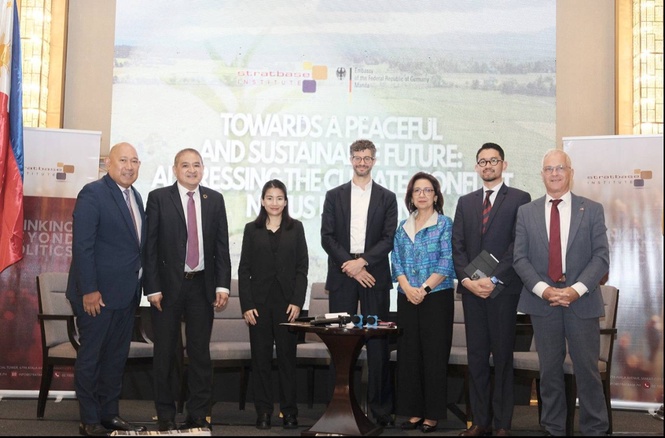
That was the central message of the panel, “Assessing the Security Implications of Climate Risks,” during the conference “Toward a Peaceful and Sustainable Future: Addressing the Climate-Conflict Nexus in Asean” on Aug. 24, 2026. As the moderator, I framed the discussion around an urgent question: how can Asean respond when environmental pressures begin to undermine social cohesion, economic stability and regional peace?
Organized by the Stratbase Institute and the Embassy of the Federal Republic of Germany in the Philippines, the conference gathered policymakers, diplomats, academics and civil society representatives to examine climate change as a growing security concern.
Lukas Rüttinger, senior advisor for environmental and climate security at Adelphi, emphasized that the issue has moved beyond the margins of policy discussions. He said that climate security “is no longer a niche or future concern. It is really reshaping security and stability around the world, but also in Asean.” He added that climate security “needs a framing that speaks to the institutional landscape in the region, but also how member states understand their security and what they are willing to engage on.”
For the Philippines, the answer begins with recognizing climate change as a threat multiplier. The opening statement delivered by Department of Environment and Natural Resources Undersecretary Analiza Rebuelta-Teh described how climate impacts can deepen existing grievances. “In Mindanao, decades of conflict were rooted in land dispossession and contestation over vital wetlands and watersheds,” she noted. Climate-induced droughts and erratic rainfall have aggravated food and water insecurity, contributing to localized disputes over arable land and natural resources.
The Bangsamoro offers an important lesson: environmental governance can also be peace-building. Decentralizing control over inland waters, forests and resource revenues can make resource management more responsive to communities and better connected to local peace processes.
The same principle applies beyond conflict-affected areas. In Cotabato and other agricultural corridors, climate stress has contributed to protests over failed irrigation and disrupted transport routes — developments that can affect national food supply chains and increase pressure on public institutions.
Undersecretary Teh emphasized that community-based forest management, secure land tenure, transparent land-use planning and equitable benefit-sharing can prevent grievances from escalating by giving communities a meaningful stake in the protection and sustainable use of natural resources. “Securing livelihoods is securing the state,” she said, as climate change “is no longer just an environmental issue. It is a core national security imperative.”
On the community level
She noted that the Philippine National Security Policy 2023–2028 identifies climate change and ecological degradation as primary nontraditional threats. By integrating ecological balance and climate resilience into the security agenda, the country’s defense focus can include resource stability, food, water and energy, while requiring security forces to contribute to conservation and biodiversity protection.
Australian National University Assistant Professor Aristyo Darmawan said that for Indonesia, climate-related risks are inseparable from human security, sovereignty and regional stability. “Climate change is also a maritime security issue,” he argued. As fish stocks shift and coral reefs deteriorate, coastal communities may face greater competition over declining resources. These pressures’ extension across maritime boundaries makes cooperation on fisheries, marine ecosystems, climate data and early warning systems important.
Darmawan stressed that regional commitments must produce tangible benefits for communities: “Most of the conversations on the environment are indeed at the international and regional levels. But how they translate to the local level is key to implementation.”
S. Rajaratnam School of International Studies International Relations Professor Dr. Mely Caballero-Anthony argued that climate security must become institutionalized within Asean. It should not be viewed as an infringement on national sovereignty, she explained, but as “an important perspective for proactive governance and anticipation for future risk.”
Rüttinger pointed to Asean’s existing security architecture and sectoral bodies as potential entry points. Greater coordination among institutions working on disaster management, peace and security, environmental protection and climate adaptation could address risks that do not fit neatly within a single agency’s mandate.
The panel’s message was clear: climate security must be preventive, inclusive and cooperative. Ecosystem restoration, adaptation finance, community participation, reliable data and early warning systems should be treated as investments in peace.
The Philippines’ Asean leadership provides a timely opportunity to advance this agenda. By promoting regional risk mapping, data-sharing and stronger coordination among Asean institutions, the country can help move the conversation from recognition to implementation.
Climate change will continue to test the region’s institutions and relationships. As Undersecretary Teh concluded, “When we protect our environment, we address climate change, we protect our food, our water, our borders and our peace.”
The author is the founder and chief strategic advisor of the Young Environmental Forum and a subject-matter expert at the Co-operative College of the Philippines. He completed a climate change and development course at the University of East Anglia (UK) and an executive program on sustainability leadership at Yale University (USA). Email him at ludwig.federigan@gmail.com.