.jpg)
When GAMA of Penang Brought Back a Language I Never Expected to Teach In
By Mihar Dias August 2026
A single photograph has a remarkable ability to unlock doors in the mind that have remained closed for decades.
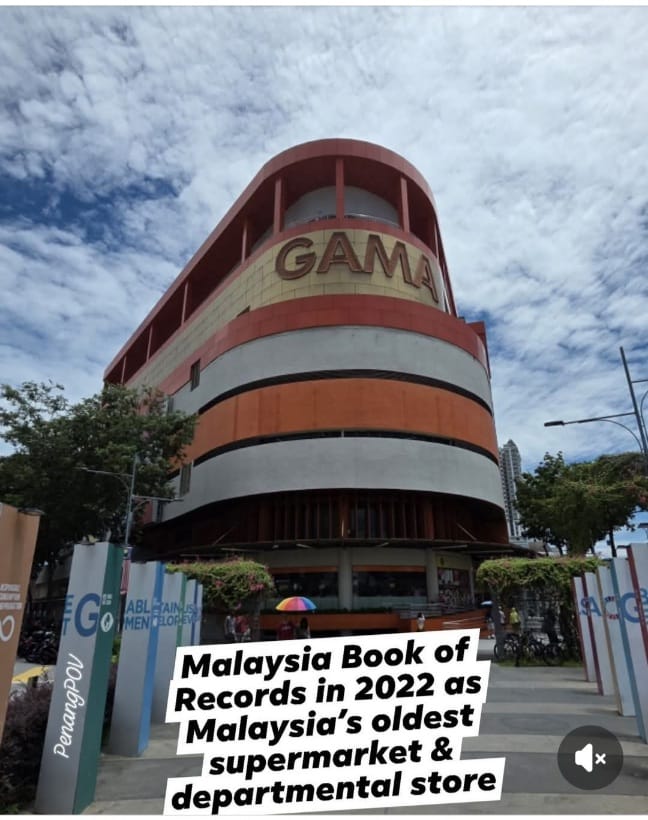
The other day, someone shared an old photograph of the GAMA Supermarket standing proudly at the busy Simpang Enam junction in Penang. Instantly I was transported back to another era when that part of the island pulsed with commerce, conversation and, of course, nasi kandar.
Long before shopping malls became cathedrals of consumerism, GAMA was a destination. Families came not merely to shop but to spend the day. Children tugged at their parents' hands, husbands waited patiently while wives compared prices, and everyone somehow found time to end the outing with a steaming plate of nasi kandar from one of the nearby stalls.
Simpang Enam had its own rhythm. Cars squeezed through impossible traffic, buses groaned to a halt, cyclists appeared from every direction and the aroma of curry drifted through the humid Penang air. It was organised chaos, and nobody wanted it any other way.
My memories of GAMA, however, are not of shopping.
They are of teaching.
Many years ago I was invited as a customer service consultant to conduct training for GAMA's retail assistants. They were enthusiastic young men and women—what we would now call eager beavers. They wanted to learn. They listened attentively. They smiled constantly.
There was only one small problem.
Most of them understood very little English.
That was manageable, I thought. I switched to Bahasa Malaysia.
Blank faces.
It slowly dawned on me that the language spoken comfortably by almost everyone in that training room was Hokkien, the unofficial lingua franca of Penang.
Suddenly all my carefully prepared notes, examples and role-playing exercises seemed almost useless.
Necessity, as always, became the mother of invention.
I found a delightful young instructor from Universiti Sains Malaysia who agreed to become my interpreter. I would explain a principle of customer service in English. Before the puzzled expressions had time to deepen, she would instantly translate every sentence into fluent Penang Hokkien.
Almost magically, the room came alive.
Heads nodded.
Questions flowed.
Laughter erupted at the appropriate moments.
The participants were no longer memorising customer service techniques. They were understanding them.
It was one of the earliest lessons in my consulting career that communication is never about the language we speak. It is about the language people understand.
Too often we mistake fluency for communication. We believe that if our grammar is perfect and our PowerPoint slides polished, our message has been delivered.
Not necessarily.
Real communication happens only when another human being receives the message in a form that is meaningful to them.
That experience in Penang changed the way I conducted training everywhere else. Whether I was speaking to factory workers, salespeople, managers or corporate executives, I learnt to adjust my language before expecting them to adjust theirs.
It also taught me something else.
Penang has always possessed a remarkable confidence in its own identity. Hokkien was never officially declared the language of business, yet it connected markets, neighbourhoods and generations with astonishing efficiency. It transcended race and occupation. Shopkeepers, hawkers, mechanics, customers and delivery men all understood enough to get business done.
Perhaps that was Penang's greatest strength—not merely its famous food, heritage buildings or bustling markets—but its ability to communicate across cultures without making a fuss about it.
Today many of those old landmarks have changed. Shopping habits have migrated online. Young retail assistants are just as likely to converse in English, Bahasa Malaysia or Mandarin as they are in Hokkien. Artificial intelligence now translates languages in seconds, something unimaginable when I stood nervously before that GAMA audience wondering how I was going to complete the day's programme.
Yet I sometimes wonder whether technology has made us better listeners.
Translation has become easier.
Understanding one another has not.
That faded photograph of GAMA reminded me that customer service has never been about scripted greetings or memorised slogans. It begins with something far simpler—the willingness to meet people where they are, in the language they are comfortable with, and with respect for who they are.
Perhaps that is why Penang remains unforgettable.
It was the only place where I discovered that the shortest distance between a trainer and his audience was not English, nor Bahasa Malaysia.
It was Hokkien.
And somewhere just outside the training room, the irresistible aroma of nasi kandar was waiting to reward us after a day's work.
Mihar Dias (mihardias@gmail.com) is a content creator under the Newswav Creator programme, where you get to express yourself, be a citizen journalist, and at the same time monetize your content & reach millions of users on Newswav. Log in to creator.newswav.com and become a Newswav Creator now!
The User Content (as defined on Newswav Terms of Use) above including the views expressed and media (pictures, videos, citations etc) were submitted & posted by the author. Newswav is solely an aggregation platform that hosts the User Content. If you have any questions about the content, copyright or other issues of the work, please contact creator@newswav.com.