
When Malaysia Speaks, Does the World Listen?
By Mihar Dias October 2026
There is a certain paradox in Malaysia telling the United Nations that the global majority must find its voice — while our own voice at the podium seems to be searching for one.
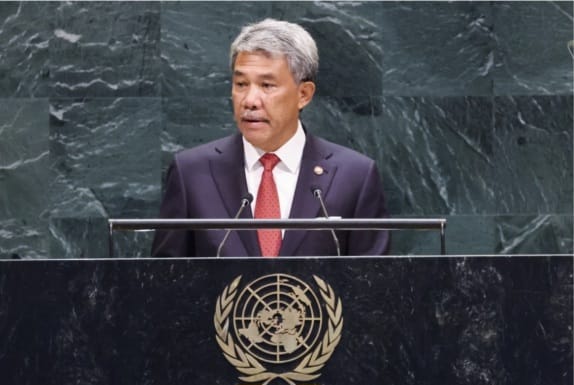
I watched Foreign Minister Mohamad Hasan address the UN General Assembly in New York. https://www.malaymail.com/news/malaysia/2026/09/27/middle-powers-like-malaysia-can-shape-global-decisions-when-major-powers-cant-agree-mohamad-hasan-says-at-un-general-assembly/236660
And I found myself doing something a listener should never have to do at an international summit: concentrating very hard to stay interested.
To be fair, the problem was not his English. Nor was it his Malaysian accent. We have survived considerably worse English from our politicians — occasionally from people who seemed to be discovering the language at the same time as the rest of us.
Mohamad Hasan was perfectly understandable.
The problem was delivery. He was reading a speech.There is a world of difference between reading words and delivering a message.
For years, I taught young diplomats at IDFR and executives in the private sector precisely this lesson. If you want to influence people, you cannot simply throw perfectly constructed sentences at them and hope something sticks.
You have to communicate.You pause.You vary your pace.You emphasise the important word.
You look up. You let a sentence breathe.
Most importantly, you make the audience believe that you believe what you are saying.
This was the United Nations, not a school assembly and the message was actually important.
Malaysia was talking about middle powers having a role in shaping global decisions rather than merely accepting decisions made by the great powers.
"We are the global majority."
Now that should have been a thunderclap.
Instead, it arrived sounding rather like another paragraph waiting to be completed.
He spoke about Malaysia having the confidence to speak for its region rather than allowing itself to be spoken for.
Again, an important proposition.
But where was the urgency?
Where was the conviction?
Where was the diplomatic equivalent of grabbing the world's lapels and saying:
Listen. We are here. We matter. And you ignore us at your own peril.
That is what the podium is for.
And this is not merely about Mohamad Hasan.
It is a recurring Malaysian problem.
We produce politicians who can negotiate in corridors, shake hands at banquets and read beautifully prepared statements.
But when they reach the international stage, too many sound as though somebody has handed them a script and instructed them:
“Please read until applause.”
Unfortunately, diplomacy doesn't work that way.
Neither does theatre.
I have spent years teaching people how to stand before an audience and make words matter. Even a ten-year-old reading aloud has to understand that reading for yourself is different from reading for somebody else.
You don't merely pronounce the words.
You interpret them.
You make the listener understand which words matter.
You make them feel why they matter.
The UN is, after all, the world's largest stage.
And Malaysia has something worth saying.
We are a middle power. We are part of ASEAN. We sit in a region where competing great powers are increasingly interested in our neighbourhood.
And there is another significant power that sometimes appears remarkably capable of ignoring Malaysia until Malaysia becomes useful to it.
That makes our ability to communicate even more important.
If we want the global majority to listen to us, we cannot sound as though we are merely reading minutes from a meeting.
For years I had the privilege of teaching young diplomats the art of delivery.
Watching our Foreign Minister at the UN, I found myself wishing our politicians had been given the same privilege.
Because sometimes the problem isn't the message.
Sometimes the problem is that the messenger hasn't learned how to make the world hear it.
And at the United Nations, Malaysia cannot afford to whisper.
Especially when we are telling everybody else to find their voice.
Mihar Dias (mihardias@gmail.com) is a content creator under the Newswav Creator programme, where you get to express yourself, be a citizen journalist, and at the same time monetize your content & reach millions of users on Newswav. Log in to creator.newswav.com and become a Newswav Creator now!
The User Content (as defined on Newswav Terms of Use) above including the views expressed and media (pictures, videos, citations etc) were submitted & posted by the author. Newswav is solely an aggregation platform that hosts the User Content. If you have any questions about the content, copyright or other issues of the work, please contact creator@newswav.com.
