
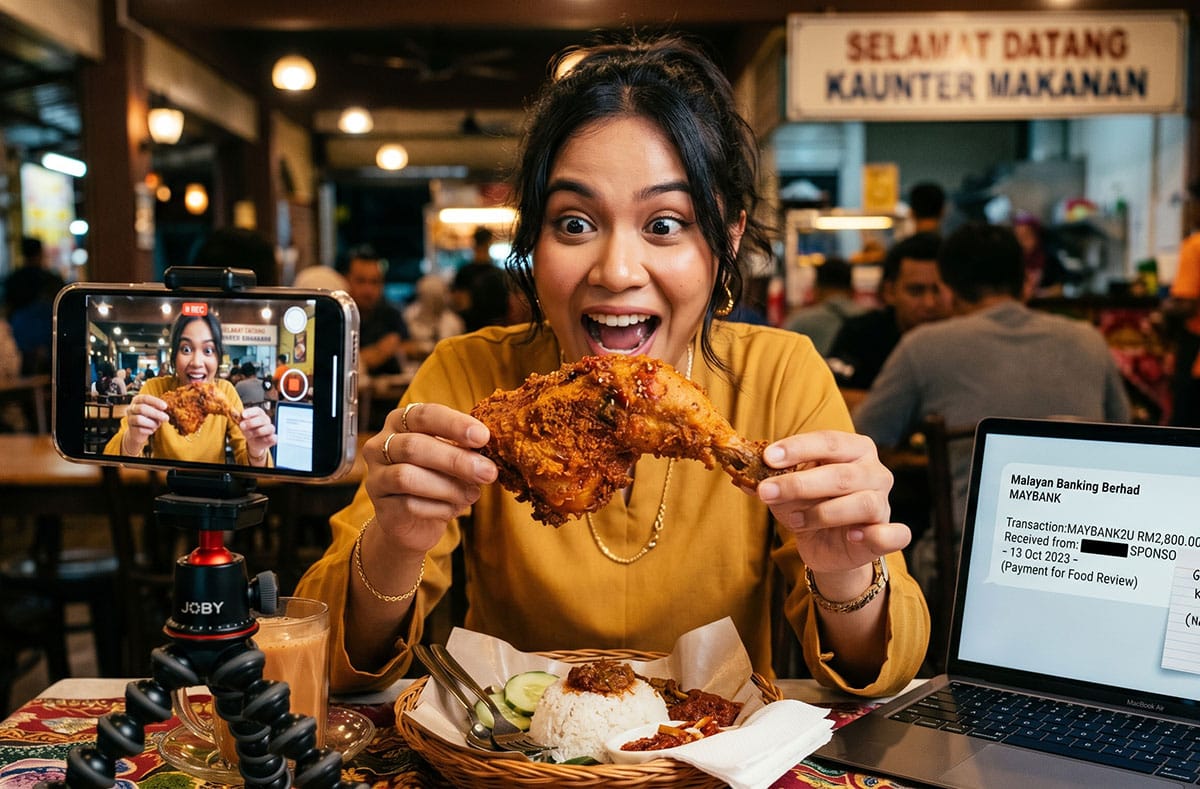
When every dish is "sedap" and every restaurant is "wajib cuba," you have to wonder who is actually eating and who is just performing.
You have seen the video. A influencer picks up a piece of fried chicken, takes one dramatic bite, eyes go wide, and delivers the verdict: "Wah, sedap gila. Padu lah. You all must come try."
No description of the texture. No mention of whether it was too salty. No comparison to anything. Just "sedap" with maximum enthusiasm and a location tag.
And somehow, thousands of people share it.
The Golden Age of the Malaysian Food Review
Let us be fair first. Food content in Malaysia has genuinely opened doors that never existed before. A nasi lemak stall in a hidden corner of Subang Jaya that would have remained a neighbourhood secret for decades can now have a queue stretching around the block after one well-placed video. A family-run kopitiam in Ipoh that could not afford a single advertisement can go viral overnight because someone with a phone and a following decided to show up and eat.
That is genuinely powerful, and I have experienced it firsthand. I followed an influencer's recommendation once, walked into a restaurant I would never have discovered on my own, and the food was not only good but surprisingly affordable. The review was accurate, the experience matched the hype, and I left as a converted regular.
Food influencers, at their best, are the most democratic form of food discovery Malaysia has ever had. No Michelin inspector needed. No expensive food magazine spread required. Just a real person, a real meal, and an honest camera.
The problem is that not all cameras are equally honest.
The "Everything Is Sedap" School of Reviewing
Here is something I have noticed after years of watching Malaysian food content, and after doing my own fair share of food reviews as a lifestyle blogger: you can tell within the first 30 seconds of a video whether a review is genuine or paid.
The giveaway is not the production quality or the follower count. It is the language.
A genuine reviewer describes. They tell you the char kuey teow was wok hei-forward but slightly underseasoned. They mention the portion size relative to the price. They compare it to similar places they have tried. They pause, chew slowly, think, and give you something you can actually use when deciding whether to make the drive.
A paid reviewer performs. Everything is "sedap." Everything is "wajib cuba." Every single dish, from the appetiser to the dessert, gets the same wide-eyed reaction regardless of what it actually tastes like. There is no texture. No nuance. No honest moment where they pause and say "this one, not bad but could be better lah."
When every review sounds the same, none of them mean anything.
The Unwritten Rule Some Influencers Live By
Here is the part nobody says out loud but everybody in the content space knows: there is a segment of influencers who genuinely believe that accepting a free meal comes with an unspoken obligation to deliver a positive review. Full stop. No asterisks.
In their world, free food equals good review. That is the transaction. The restaurant fed them, so the influencer feeds the restaurant's reputation back. Whether the food earned it or not is beside the point.
I have been approached countless times over the years to review restaurants and cafes around KL. My approach has always been the same: if it is good, I say it is good. If it is not, I say it is not, while being constructive about it. Not a single restaurant has ever asked me to fabricate a positive review, and I genuinely respect them for that. Most business owners actually want honest feedback, even when it stings, because honest feedback helps them improve.
But there are influencers out there operating under a completely different code. Some have reportedly gone further, dining at establishments and making it clear, directly or indirectly, that a positive review is conditional on the meal being complimentary. No free meal, no good review. This kind of arrangement, while hopefully rare in Malaysia, poisons the well for every honest reviewer out there.
Meet Jason: What Honest Looks Like
In the middle of all this noise, there is a content creator named Jason who has built a following doing something radical by Malaysian influencer standards - telling the truth.
Not good? He says it is not good. Overpriced? He says it is overpriced. Overhyped? He will be the first to stand in front of a queue and tell you the queue is not worth it.
Predictably, this has made him unpopular in certain circles. Some fellow influencers have criticised him for not being "supportive" of the food businesses he reviews, as though an honest assessment of a mediocre plate of food is somehow an act of aggression against a small business owner.
But the public? The public loves him. Because in a sea of "sedap" and "wajib cuba," a voice that actually tells you the truth stands out like kopi ais on a hot afternoon. People trust him precisely because he is willing to say what the paid reviewers will not.
That trust is not built overnight. And it cannot be faked with a free meal.
What This Costs Everyone
When paid positive reviews flood a platform, the entire ecosystem suffers. Consumers make decisions based on inaccurate information and end up disappointed. Honest reviewers get drowned out by louder, shinier, more sponsored content. And restaurants that do genuinely good work get lost in a noise of equally glowing reviews for places that do not deserve them.
There is also a longer term cost to the influencers themselves. Audiences are not as naive as some content creators seem to think. Malaysians have been burned enough times by following a "wajib cuba" recommendation only to find mediocre food and inflated prices. The skepticism is growing. And once an audience stops trusting your palate, no amount of dramatic bite reactions will win it back.
The Malaysian Communications and Multimedia Commission (MCMC) has guidelines on paid content disclosure that require influencers to clearly label sponsored posts. In practice, enforcement is patchy and many paid reviews still circulate without any disclosure at all. A hashtag buried at the bottom of a caption is not transparency. It is a technicality.
My Take
I think the majority of food influencers in Malaysia are genuinely trying to do something useful. They love food, they love sharing, and they want to help people discover good places to eat. That motivation is real and it shows.
But the culture of free meals in exchange for guaranteed positive reviews has created a credibility problem that honest influencers end up paying for. When audiences cannot tell the difference between a genuine recommendation and a paid one, they start trusting none of them. That is bad for consumers, bad for good restaurants, and ultimately bad for the influencers who actually care about their integrity.
My advice to anyone consuming food content in Malaysia: watch how they describe the food, not how enthusiastically they react to it. Anyone can perform excitement. Not everyone can tell you why something actually tastes good, what makes it different, or whether it is worth your time and money.
And if every single dish they try is "sedap" without exception? That tells you everything you need to know.
What is your take on this?
Kamarul Azwan (k.azwan@gmail.com) is a content creator under the Newswav Creator programme, where you get to express yourself, be a citizen journalist, and at the same time monetize your content & reach millions of users on Newswav. Log in to creator.newswav.com and become a Newswav Creator now!
The User Content (as defined on Newswav Terms of Use) above including the views expressed and media (pictures, videos, citations etc) were submitted & posted by the author. Newswav is solely an aggregation platform that hosts the User Content. If you have any questions about the content, copyright or other issues of the work, please contact creator@newswav.com.