.jpg)
By Mihar Dias April 2026
There’s a touch of irony to it—almost poetic, if it weren’t so painfully real—when the man who once filled rooms with song now finds himself struggling to finance the continuation of his own final refrain.
Among his friends, Zakaria Kader is “Pak Ya.” Among colleagues, he was “the crooner”—a man who could slip from uniformed authority into velvet-voiced charm without missing a beat. And among those who remember better days, he carried yet another title: the local Tom Jones, because somewhere between duty and discipline, he found time to serenade life itself.
Now, life has reduced him to a ledger.
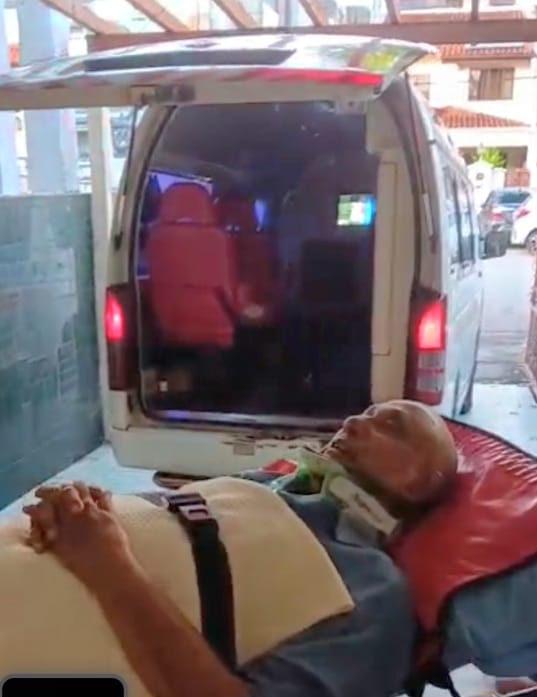
RM210 a day for a live-in nurse. That’s RM6,300 a month—before we even factor in the ambulance rides, priced like short-haul flights, except there are no peanuts and certainly no applause. Add another RM800 to RM1,000 for those necessary journeys to hospitals in Putrajaya or HUKM, because sitting upright in a car is no longer an option.
All in, about RM7,300 a month just to stay alive with dignity.
Pak Ya’s pension? RM5,000.
Which leaves a monthly shortfall of RM2,300—give or take the cost of rice, cooking oil, and whatever inflation decides to do next week.
This is where the story stops being about one man and starts becoming a national habit.
Because in Malaysia, we are exceptionally good at two things:
• Praising people for their service after they can no longer serve.
• Passing the hat around when the system quietly misses a beat.
We visited Pak Ya recently. There he was—once the man who could light up a room with a song, now confined to a bed after a fall just before Ramadan. A fractured neck, a spinal injury. The kind of cruel twist that turns a voice into silence, independence into dependence, and savings into arithmetic.
And arithmetic, as it turns out, is merciless.
Even with a pension that sounds respectable on paper, the equation simply doesn’t balance. Care costs more than dignity can comfortably afford. Survival becomes a subscription model—renewed monthly, with no guarantee of continuity.
His friends—loyal as ever—did what Malaysians do best. They passed the hat. RM20,000 raised. Enough to buy time, not solutions. A brief encore, not a full performance.
And now we are back to the same uncomfortable question:
What next?
Because charity, for all its nobility, has an expiry date. Friends grow tired. Networks shrink. WhatsApp groups fall silent. The same names cannot keep appearing on donation lists without eventually becoming a quiet discomfort no one wants to acknowledge.
Yet here is the deeper unease: Pak Ya is not an outlier. He is a preview.
He represents a generation that served—in uniform, in silence, in sincerity—under the assumption that when their curtain call came, the system would at least keep the lights on.
But the system, like many things in Malaysia, performs brilliantly in speeches and somewhat less convincingly in real life.
We have built a society where surviving old age increasingly depends on three things: your children, your savings, or your luck.
Pak Ya, it seems, is currently relying on the fourth: his friends—and the fading echoes of a life once well-lived.
There is something profoundly unsettling about knowing that a man who once gave joy through song must now negotiate, month by month, the cost of staying alive.
It forces us to confront a question we would rather not hear:
If this can happen to him, what about the rest of us?
What happens when the music stops?
When pensions fall out of tune with reality?
When medical care becomes a privilege instead of a right?
We can, of course, continue doing what we do best—organise another round of donations, circulate his bank details, and hope that kindness fills the silence left by policy.
And perhaps it will. For a while.
But kindness, unlike systems, is unpredictable.
And dignity should not depend on whether your old friends still remember your songs.
Pak Ya, the crooner, once gave people moments to remember.
Now he reminds us—quietly, poignantly—that the real tragedy is not death, but the cost of staying alive long enough to sing one last verse.
Bank Account Details
Bank: RHB Islamic
Account No: 16418800061467
Phone: 019-2621000
Mihar Dias (mihardias@gmail.com) is a content creator under the Newswav Creator programme, where you get to express yourself, be a citizen journalist, and at the same time monetize your content & reach millions of users on Newswav. Log in to creator.newswav.com and become a Newswav Creator now!
The User Content (as defined on Newswav Terms of Use) above including the views expressed and media (pictures, videos, citations etc) were submitted & posted by the author. Newswav is solely an aggregation platform that hosts the User Content. If you have any questions about the content, copyright or other issues of the work, please contact creator@newswav.com.