
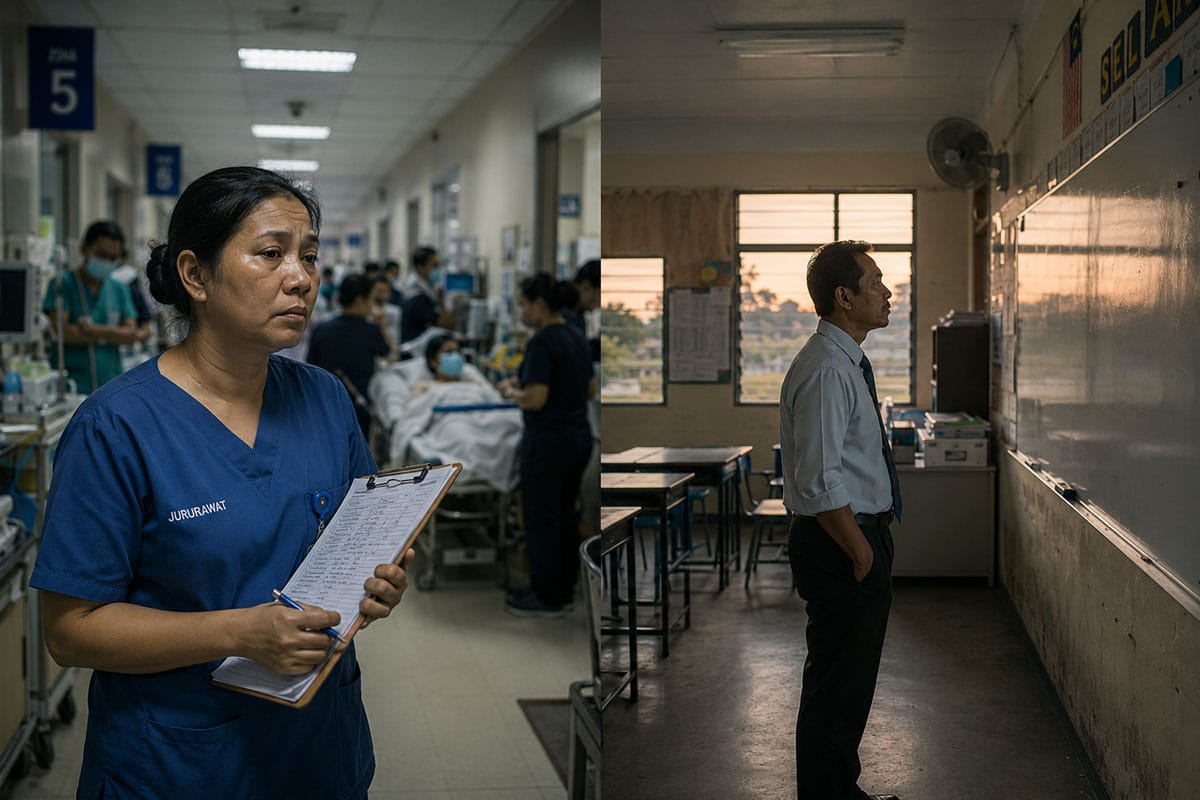
Every ministry in Malaysia just got told to cut spending, and the official verdict is that it will be "unavoidable but manageable."
The real question is: manageable for who?
That is the question the rest of us are quietly asking.
Why the Cuts Are Happening in the First Place
This did not come out of nowhere. The real culprit is the ongoing Middle East conflict and what it has done to global oil prices.
Malaysia is currently grappling with one of the worst energy supply crises in recent memory, with global crude oil prices exceeding US$115 per barrel as the Middle East conflict escalated sharply this year. For a country that has committed to keeping RON95 petrol at RM1.99 per litre, that commitment comes at a staggering price. The fuel subsidy bill for April 2026 alone shot up to an estimated RM7 billion, compared to just RM700 million the previous month.
Malaysia's total subsidy bill is now expected to balloon to RM58.4 billion for the full year, far exceeding the RM15 billion originally allocated under the approved 2026 budget. When the numbers go that far off course, something has to give. And what gave was the operating budgets of every ministry in the country.
A Treasury directive identified a total of RM10 billion in potential savings across ministries, departments, and agencies, including RM3.06 billion from the Health Ministry and RM2.39 billion from the Ministry of Higher Education alone. That is over five billion ringgit from just two ministries. Two of the most important ones.
What "Non-Critical" Really Means
The government has been consistent with one message: the cuts will only affect non-critical spending. Events postponed. Overseas travel reduced. Utility costs trimmed. Non-essential hiring delayed.
Core spending for healthcare, education, and basic public services will continue as approved under Budget 2026 allocations, the Ministry of Finance stressed.
On paper, that sounds reassuring. And to be fair, the government deserves some credit for being specific about what gets cut. Postponing conferences and reducing first-class flights to overseas seminars is genuinely sensible savings that most Malaysians would applaud.
But here is where the reassurance starts to get fuzzy. When PM Anwar told top Education Ministry officials "you can appeal as much as you want but the cuts will still happen," he also said that out of the ministry's RM20 billion allocation, it is impossible that nothing can be saved. That is technically true. It is also the kind of statement that tells you the cuts are real, significant, and not entirely up for negotiation, regardless of how the official press releases frame it.
The Teacher in the Classroom Nobody Is Talking About
Let us talk about what budget cuts in education actually feel like on the ground, because it rarely looks like what the press conferences describe.
It looks like a school that cannot hire a replacement teacher because the position has been frozen. A classroom that does not get repainted. Supplementary learning materials that do not get purchased this year. School trips that quietly disappear from the calendar. Co-curricular programmes that get scaled back because there is no budget for the coordinator's allowance.
None of these things make headlines. None of them get mentioned in the minister's speech. But every single one of them is felt by the children sitting in those classrooms every single day.
My biggest concern as a parent is not actually the buildings or the equipment. It is the teachers. The PM confirmed that building new classrooms to accommodate student intake would continue as planned, which is good. But what about the people inside those classrooms? A teacher who has had their allowances trimmed, their training opportunities cancelled, and their workload increased because the colleague next door's position was not filled, is not a teacher who is going to show up Monday morning fired up to inspire eight-year-olds.
Motivated teachers are not a line item you can cut and then restore with a memo. Morale takes years to build and can collapse in a single budget cycle.
The Public Hospital Queue That Was Already Long
Now let us talk about healthcare, because this one hits close to home for millions of Malaysians.
The proposed RM3.06 billion cut to the Health Ministry comprises 6.6% of its RM46.5 billion budget for 2026, which would leave the ministry with RM43.4 billion, actually less than its RM45.3 billion budget last year. In other words, even before these new cuts, the Health Ministry was already stretched. This just stretches it further.
Health Minister Datuk Seri Dr Dzulkefly Ahmad clarified that patient treatment, emergency care, and medicine supply will be safeguarded despite the reprioritisation under discussion. Again, reassuring on the surface. But healthcare in Malaysia is a system that was already under significant pressure before any of this happened.
If you have ever taken an elderly parent or family member to a government hospital, you already know the reality. The waiting times are long. The specialist queues stretch for weeks or months. The doctors and nurses are doing their best but they are clearly overworked and understaffed. The facilities in some hospitals outside Kuala Lumpur are decades old.
For those of us who rely entirely on public healthcare because private hospital bills are simply not an option, "core services will not be affected" is a statement we want to believe. But it sits uneasily against the reality of a system that was already running on lean margins before they started looking for places to cut RM3 billion.
A Perfect Storm Nobody Planned For
Step back and look at the full picture that ordinary Malaysians are navigating right now, and it starts to feel like a lot to absorb all at once.
Retrenchments are up 47% year-on-year. Thousands of workers lost their jobs in January alone. Companies are slowing down, delaying payments, and tightening budgets. Solo entrepreneurs and freelancers are chasing invoices while their own bills keep coming. And now, the same government that is asking Malaysians to be financially resilient is also cutting the public services that lower-income Malaysians depend on most.
This is not a criticism for the sake of it. The global energy crisis is real, the subsidy burden is genuinely unsustainable, and the government does not have the luxury of spending money it does not have. These are hard decisions made under genuinely difficult circumstances.
But it is worth being honest about who absorbs the impact when hard decisions get made. It is rarely the people at the top of the income ladder. The families who can afford private tuition barely notice when school programmes get scaled back. The people with private hospital insurance barely notice when public hospital budgets get trimmed.
The people who notice are the ones who had no other option to begin with.
My Take
I have an eight-year-old in school and an elderly family member who depends on public healthcare. So this budget cut conversation is not abstract for me. It is personal.
What I want to say to the government, respectfully, is this: please do not let the phrase "non-critical" become a convenient blanket that covers things that are very critical to the people at the bottom. A teacher's training allowance is non-critical on a spreadsheet. It is very critical to the quality of education my child receives. A hospital's maintenance budget is non-critical on a spreadsheet. It is very critical to the patient waiting six months for a specialist appointment.
Anwar said ministries cannot think in silos and must grasp the magnitude of the crisis Malaysia is facing. Fair enough. But Malaysians at the ground level are also asking the people in those ministries to grasp the magnitude of what their daily lives actually look like. The crisis is real. So is the impact on the people who have the least room to absorb it.
Manageable is a word that works better when you have options. For a lot of Malaysians right now, the options are getting fewer.
Kamarul Azwan (k.azwan@gmail.com) is a content creator under the Newswav Creator programme, where you get to express yourself, be a citizen journalist, and at the same time monetize your content & reach millions of users on Newswav. Log in to creator.newswav.com and become a Newswav Creator now!
The User Content (as defined on Newswav Terms of Use) above including the views expressed and media (pictures, videos, citations etc) were submitted & posted by the author. Newswav is solely an aggregation platform that hosts the User Content. If you have any questions about the content, copyright or other issues of the work, please contact creator@newswav.com.