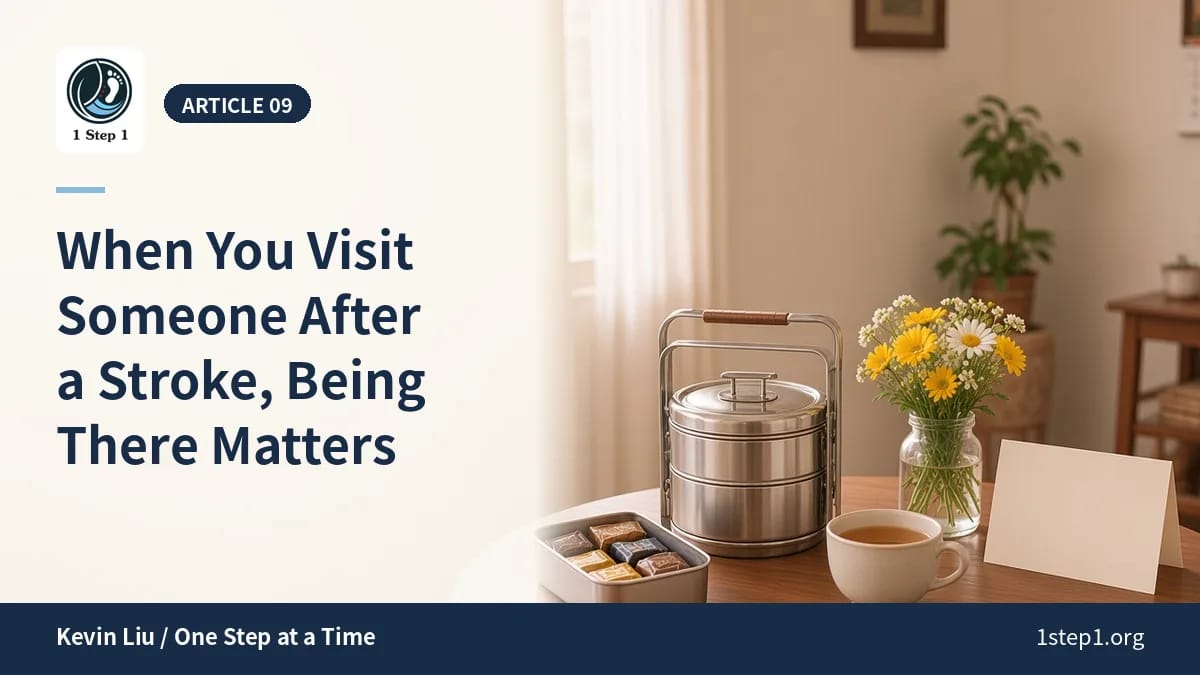
What helps most when you visit someone after a stroke? From my own hospital bed, my answer is simple: that you came. You don’t need the right words. Being there says it for you.
Your visit matters more than what you say
After my stroke, I couldn’t speak at first. I could only answer with my eyes. So my visitors did the talking. I remember them standing by my bed, looking at me with concern, telling me to stay strong. I couldn’t reply, but I still remember them there.
As time went on, I managed to say a few words. My friends’ encouragement helped me get my confidence back, and I could feel how much they cared. Looking back, that support meant more to me than the physical side of getting better. That’s only my own feeling, but it’s a strong one.
31 visitors in five weeks
I spent five weeks in the ICU and in hospital. In that time, 31 relatives and friends came to see me. I can’t list all their names here, but I will always remember their kindness. It was their presence, and their belief in me, that gave me the strength to get through such a hard time.
What I noticed from my bed
Life in the ward had its own rhythm. After dinner, relatives and friends would drop by, and by 8 p.m. the visitors would leave.
During the day, whenever I had free time, I slept a lot, because I couldn’t talk or use my phone. Strangely, all that sleep sometimes made my mind clearer. I would lie there and wonder who might come to see me that day.
Most days, I saw around ten people.
My wife and my mother, every day
The two people who came most were my wife and my mother. They came every single day, without fail.
My mother usually came between 11 a.m. and 2 p.m. She couldn’t drive, so she took a taxi to the hospital every day. She never ate lunch before coming, so I asked her to bring something, and we shared the meal. Sometimes my wife joined her.
In the evenings, from 5 p.m. to 8 p.m., it was my wife’s turn. We would either eat dinner together or I would eat on my own. She would stay with me for a while, or we would chat with any visitors who came to see me.
Between the two of them, someone was by my side day and night. Their presence gave me more comfort and strength than I can put into words.
Saying thank you in silence
Because I couldn’t speak, I said thank you in my head. I would think of each person who might come that day and say to them, in my mind, “Thank you for visiting me.”
I thanked the doctors and nurses the same way, for treating me and taking care of me. And the kind cleaning ladies on the ward. I gave them chocolates to show my thanks, and in my mind I thanked them too, because they had become my friends.
One by one, every day, I thanked each person silently.
So if you’re wondering whether to visit someone who can’t say much yet, here is what I learned from my side of the bed. I could not always tell people. But I was thanking them anyway.
FAQs
Should I visit if they can’t talk much yet?
In my case, I’m glad people came. At first I couldn’t speak and could only answer with my eyes, yet I still remember who stood by my bed and how they looked at me. Check with the family first, and follow the ward’s visiting rules. Your being there can say what words can’t.
Is it okay to just sit quietly?
From my bed, quiet visits still counted. I couldn’t talk or use my phone, so simply having someone there meant a lot to me. You don’t need to fill the silence or find the perfect words. Sitting with them, or keeping the family company, is a way of showing you care.
How long should a visit be?
There’s no single answer, and it isn’t mine to set. Follow the family’s wishes and the ward’s visiting rules. In my ward, visitors would leave by 8 p.m. For me, what stayed with me wasn’t how long anyone stayed. It was that they came at all.
Related reading
When Words Are Difficult, Make Room for the Answer — When you can’t find words, this is how I made room for the answer. https://1step1.org/insights/article-08-when-words-are-difficult-make-room-for-the-answer
Needing Help Does Not Erase Who You Are — On accepting help from family and visitors. https://1step1.org/insights/article-07-needing-help-does-not-erase-who-you-are
When Recovery Progress Slows: What to Review Next — For the quiet days when nothing seems to move. https://1step1.org/insights/article-06-when-recovery-progress-slows
If you’d like to read more of my story, you can Read Chapter 1 free (https://1step1.org/sample).
When you’re ready, the Step by Step Academy walks through it step by step: https://1step1.org/academy
Full article on 1step1.org: https://1step1.org/insights/article-09-visiting-someone-after-a-stroke-being-there-matters
If you’d like my new articles by email, you can subscribe here: https://1step1.org/insights
Kevin Liu
kevin.1step1.org
One Step at a Time
https://kevin.1step1.org/
https://1step1.org/
Kevin Liu (kevliu11@gmail.com) is a content creator under the Newswav Creator programme, where you get to express yourself, be a citizen journalist, and at the same time monetize your content & reach millions of users on Newswav. Log in to creator.newswav.com and become a Newswav Creator now!
The User Content (as defined on Newswav Terms of Use) above including the views expressed and media (pictures, videos, citations etc) were submitted & posted by the author. Newswav is solely an aggregation platform that hosts the User Content. If you have any questions about the content, copyright or other issues of the work, please contact creator@newswav.com.