
Author: Dr.Jay Reuben Savarimuthu, Consultant Emergency Physician and Head of Department. KPMC Kajang; Committee of Malaysia Sepsis Alliance (MySepsis)
Co-authors:
1.Dr Khaizurin Tajul Arifin, Department of Biochemistry, Faculty of Medicine, Universiti Kebangsaan Malaysia; Committee of Malaysian Sepsis Alliance (MySepsis);
2. Professor Dr Tan Toh Leong, Consultant Emergency Physician, Department of Emergency Medicine, Faculty of Medicine, UKM; Founder and President, Malaysian Sepsis Alliance (MySepsis)
Imagine waking up one day and feeling that your heart is no longer beating the way it should. This is exactly what happened to Mr R, who had been fit and active all his life. That morning, he suddenly felt weak, tired, and unusually pale. Mr R had an uncomfortable sensation in the centre of his chest—something he could not clearly describe but knew was not normal. As he was about to collapse, his colleagues quickly rushed him to the Emergency Department (ED). His heart was racing at a rate of 170 beats per minute(bpm). At that moment, Mr R could not immediately tell what was happening inside his heart. So, what exactly is going on with Mr R?
When the heart loses its rhythm
At rest, your heart beats at a rate of 60 to 100 bpm, in a coordinated and organised way, pumping blood to the entire body. There are times when the heart can lose its rhythm, beat irregularly and extremely fast. This was how Mr R first discovered that he had an irregular heartbeat—a condition known as Atrial Fibrillation (AF). Mr R is certainly not alone. An estimated 52.55 million people worldwide were living with AF in 2021 (Global Impact of Atrial Fibrillation), AF is a rapid, uncoordinated heart activity twitching at a rate between 120 bpm and 170 bpm. If the rate goes above 150 bpm, this condition is called AF with rapid ventricular response (RVR) and could cause the patient to collapse.
When the heart beats extremely fast, it becomes inefficient at pumping blood to the other vital organs throughout the body, hence mimicking other illnesses, sometimes making it difficult to be identified until a pulse check is done, an electrocardiogram (ECG) is performed, or attached to a monitor to measure heart rate.
What does a person feel
At first, patients may not have any symptoms, as AF can be a silent disease (Silent AF). Usually, a person won't be able to perceive their heartbeat. As the heart races abruptly and rapidly, patients will complain about palpitations. When AF occurs, patients may often notice an irregular heartbeat, while others describe it as though their hearts are skipping beats.
Often, sensations can be localised to the chest and cause discomfort to the patient. Some patients are aware and will be able to demonstrate the beat by tapping their fingers or hands (AF: Diagnosis & Treatment). The pattern of tapping has no uniformity and is irregular. Patients can also develop shortness of breath, chest pain, cool hands and feet, lightheadedness or tiredness. Especially in elderly patients, symptoms can be bizarre and non-specific. Sometimes AF can be transient and may not be detected upon arrival at the hospital. At times, the very first detection of AF is during a stroke.
How dangerous is AF?
AF is the most common abnormal heart rhythm. Incidence of AF in patients with no history of abnormal heart rhythm is 3% to 6%. A devastating complication of AF is a stroke. Patients with AF can easily form blood clots that can dislodge and travel to the brain and cause a stroke. Atrial fibrillation increases stroke risks by 5 times and is responsible for 15% of all strokes worldwide (AF, Stroke Risk, and Warfarin Therapy). Traditionally, a stroke is seen in the elderly population. With AF, strokes can be seen in the young, and this is a rising health concern as it causes disability and death.
Can sleep trigger AF?
Not known to many, AF can even be triggered during sleep. This condition is known as Vagal AF. Traditionally, AF affects the older population with hypertension, diabetes or with abnormal heart structure and is triggered by certain conditions such as physical activity, stress, or infection. However, Vagal AF typically affects younger patients (Vagal AF), males with a normal heart structure and is triggered by periods of relaxation, during sleep or even after a meal. Patients often associate heart issues with activity. Since vagal AF occurs at rest, patients may not seek treatment until it's too late. Devices like Holter and loop recorder can be attached to the patient to record the patient's heart activity during sleep.
Obstructive Sleep Apnoea(OSA) is the most common sleep breathing disorder. In OSA, patients may stop breathing momentarily and develop excessive sleepiness during the day. OSA patients often present with snoring at night due to the collapse of structures related to the passage of air into the patient’s lungs while asleep. When the passage of air is obstructed, patients can be deprived of oxygen over a period of time, and this will lead to the formation of an abnormal heart rhythm in the heart. There is a bidirectional relationship between AF and OSA (Obstructive Sleep Apnea and AF), whereby both of these diseases share similar risk factors and can exacerbate each other. Many patients with AF may not know they have OSA, and this can lead to serious consequences if it's not addressed.
Smartwatch – a game-changer in AF detection.
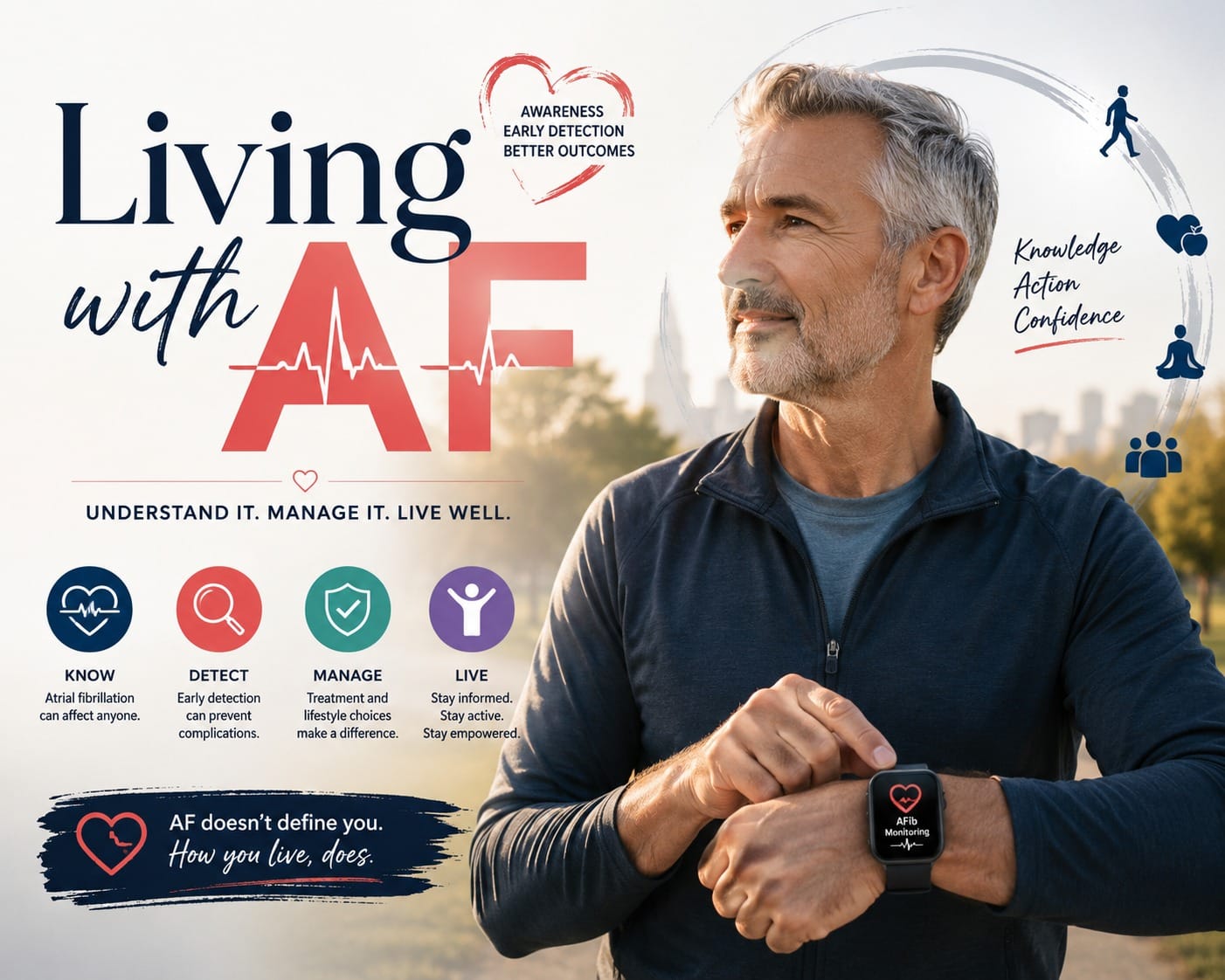
Traditionally, the gold standard test to diagnose is the ECG. Devices such as a Holter and a loop recorder are used to detect hidden episodic abnormal heart rhythms. Due to the advancement in technology, especially in the field of artificial intelligence, smartwatches have made AF detection easy. Technology may seem to be a universal choice in today’s world. However, the elderly population may face difficulties understanding health notifications and alerts. If the alert is unclear, this may be caused to be anxious and worry unnecessarily. In some cases, they may panic and seek medical attention without need (Natural History of Subclinical Atrial Fibrillation Detected by Implanted Loop Recorders). Data from smartwatches can sometimes be inaccurate and requires professional healthcare personnel to interpret.
Living with AF
Patients with AF can still enjoy life just like the rest. Mr R realised that having AF is not a death sentence. At times, AF can resolve spontaneously or with treatment. Treatment given to MrR was individualised to his age, presence of other risk factors, kidney function and bleeding risk. First and foremost, the heart rate was controlled with medications. The target heart rate should be below 110, and a stricter target may be required to achieve symptom control. Medications such as anticoagulants to prevent blood clot formation in the heart should be started, ideally after performing an echocardiography to evaluate the heart valves (Lifestyle Changes in AF Management and Intervention). An echo was performed on MrR, and a condition called mitral stenosis was detected.
Lifestyle changes such as exercise, weight management, smoking cessation and alcohol abstinence will help control AF, improve quality of life and minimise complications.

陈沱良医生DrSeb (drsebchannel@gmail.com) is a content creator under the Newswav Creator programme, where you get to express yourself, be a citizen journalist, and at the same time monetize your content & reach millions of users on Newswav. Log in to creator.newswav.com and become a Newswav Creator now!
The User Content (as defined on Newswav Terms of Use) above including the views expressed and media (pictures, videos, citations etc) were submitted & posted by the author. Newswav is solely an aggregation platform that hosts the User Content. If you have any questions about the content, copyright or other issues of the work, please contact creator@newswav.com.
