
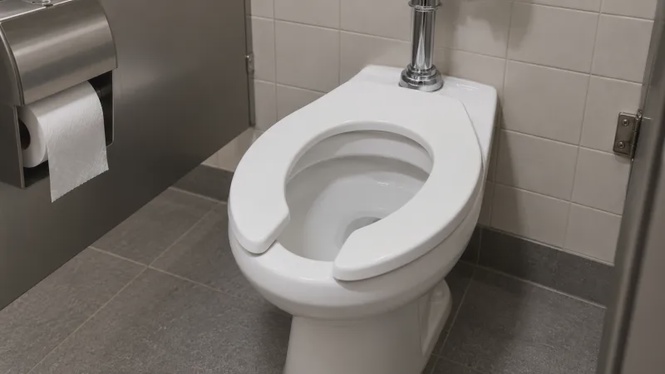
Step into a department store, an airport, an office building, or a public restroom overseas, and you may have noticed something odd about the toilet seat: instead of a full oval like the one at home, the front edge is missing a section, as if someone had snapped off a piece. It has not been broken, and manufacturers are not cutting corners on plastic. That gap has an official name, the open-front toilet seat, and the design exists specifically to address urine contamination, body contact, and the reality that public restrooms are used by a constant stream of strangers. In some places, it is not just a design choice but a written requirement for public plumbing fixtures.
What An Open Front Toilet Seat Actually Is
The American Society of Plumbing Engineers (ASPE), a professional body that publishes technical guidance on plumbing design, distinguishes between two basic toilet seat shapes: open-front and closed-front. An open-front seat leaves a deliberate gap at the front edge, and one of its main purposes is to cut down on the chances of the seat becoming contaminated, particularly from splashing during urination.
Why The Gap Sits Exactly At The Front
If the only goal were to use less material, the missing section could go anywhere. ASPE traces part of the original rationale to something more specific: giving women a way to wipe after using the toilet without having to touch the front of the seat, and reducing direct genital contact with that same edge. The front of the seat is also the part most exposed to splashing during urination, so removing it eliminates a spot that is simultaneously the most likely to get contaminated and the most likely to touch skin. The gap, in other words, is not decorative and cannot be explained away as a material-saving measure. It reflects a fairly direct piece of engineering logic: if one section of the fixture is prone to unnecessary contact and contamination, designers simply removed it.
Why Public Restrooms Differ From The One At Home
The reasoning comes down to how differently the two settings get used. A home bathroom typically serves a handful of family members. An airport, school, shopping mall, train station, or office building can see a rotating cast of strangers using the same fixture dozens or hundreds of times a day. Public plumbing design has to account for that volume, and hygiene, durability and ease of cleaning become bigger priorities as a result. ASPE notes that the United States' Uniform Plumbing Code (UPC) has specifically required open-front seats in public restrooms, driven by the same concerns over high-traffic use and user hygiene. That is the real difference behind what looks, at a glance, like nothing more than a missing sliver of plastic.
Where The Requirement Is Written Into Law
This is not an isolated design quirk invented by a handful of manufacturers. The International Code Council's 2024 International Plumbing Code (IPC), Section 425.3, specifies that toilets intended for public or employee use must have a "hinged open-front type" seat. The IPC functions as a model code, meaning individual states, cities and other jurisdictions can choose to adopt it and adapt it to local law. So while the requirement is not universal across every restroom in the United States, it carries enough weight to be written into a widely used model plumbing code and formally adopted in numerous jurisdictions.
New York City is one concrete example. The city's current Plumbing Code, Section 420.3, requires toilet seats to be made of smooth, non-absorbent material, and specifically mandates a hinged open-front design for toilets in public or employee restrooms. A shape that might otherwise register as "toilets look a little strange overseas" is, in several cities, a fixture built to a documented legal standard.
Does Taiwan Require The Same Design
Taiwan's public restrooms follow their own set of standards and habits. Data released by Taiwan's Ministry of Environment in 2025 counted roughly 45,000 registered public restrooms nationwide, with sit-down toilets making up about 53.6 percent of fixtures and squat toilets the remaining 46.4 percent. The rules that guide Taiwan's public restroom design, drawn largely from the Ministry of the Interior's National Land Management Agency and its handbook on hygienic facilities in public buildings, focus mainly on the mix of sit-down versus squat toilets, spacing, accessibility, and cleaning and maintenance. Unlike the United States' IPC, Taiwan does not broadly mandate open-front seats for ordinary public restrooms. So when this particular "gap in the front" design turns up in a mall or office building in Taiwan, it reflects one available option for public or commercial-grade fixtures rather than a nationwide requirement.
The Point Is Reducing Contact, Not Eliminating Germs
An open-front seat is not a claim that a toilet becomes germ-free. Regardless of which seat style is installed, public restrooms still need regular cleaning and upkeep. What the open-front design actually accomplishes is narrower: by removing the front section of the seat, it lowers the odds of contamination from urination and the odds of unnecessary skin contact in that one specific spot. That small, easy-to-miss gap says something bigger about how public and private bathrooms are designed for entirely different kinds of users.
YP