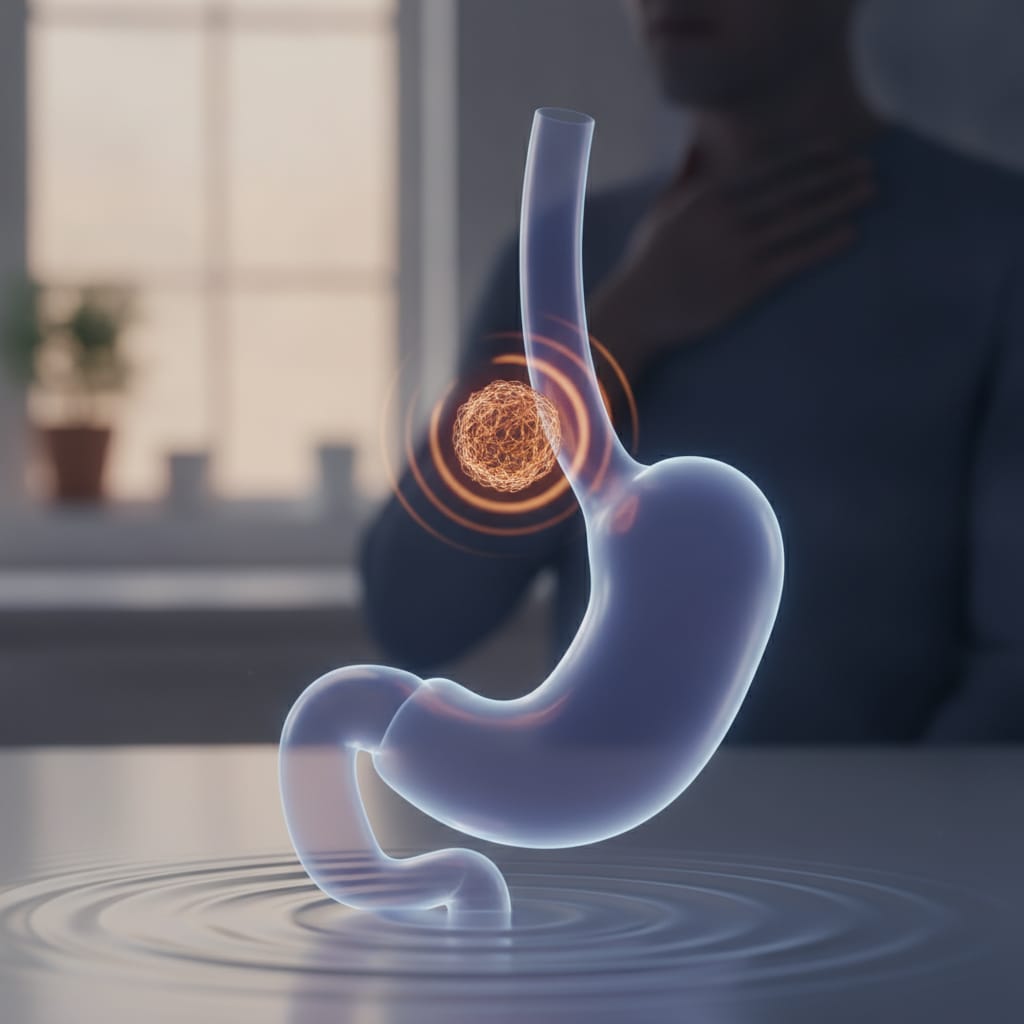
Have you ever swallowed a mouthful of food and thought:
“That didn’t go down properly.”
Perhaps a piece of bread seems to stick halfway down.
Or meat feels difficult to swallow.
Maybe you need to drink water to help food go down.
Some people describe it as a lump in the throat.
Others say it feels as though the food has stopped somewhere behind the breastbone.
Occasionally it happens once and never happens again.
But if it starts happening repeatedly, it is something I would not simply ignore.
As a pharmacist, I have had people mention swallowing difficulties almost as an afterthought.
“I’ve noticed food seems to get stuck sometimes, but it’s probably just because I’m getting older.”
That assumption isn’t always correct.
What exactly is swallowing?
Swallowing is actually a remarkably complicated process.
It involves muscles and nerves in your mouth, throat and food pipe — the oesophagus — working together to move food and drink safely into your stomach.
When everything is working normally, you barely notice the process.
But when something interferes with it, swallowing suddenly becomes something you are very aware of.
The medical term for difficulty swallowing is dysphagia. The NHS describes symptoms including coughing or choking when eating or drinking, food feeling stuck in the throat or chest, and bringing food back up. NHS — Dysphagia
Sometimes it is simply how you eat
Let’s start with the obvious.
Eating too quickly, taking large mouthfuls and not chewing food properly can make swallowing more difficult.
Dry foods such as bread or tough meat can be particularly troublesome.
If you occasionally find food difficult to swallow, slow down.
Take smaller mouthfuls.
Chew properly.
And don’t try to force a large piece down with a huge gulp of water.
Simple changes to eating habits can sometimes make meals much easier.
But there can be medical causes
There are many possible causes of swallowing problems.
Acid reflux can contribute to swallowing difficulties, while conditions affecting the nervous system or brain — including stroke and some neurological conditions — can also interfere with swallowing. NHS — Dysphagia
Sometimes the food pipe itself becomes narrowed or its muscles don’t work properly.
There is even a condition called achalasia, where the muscles of the oesophagus don’t move food down normally and the valve leading into the stomach doesn’t relax properly. NHS — Achalasia
The important point is that swallowing difficulty isn’t one single condition.
The cause matters.
What if food goes down the wrong way?
This is more important than simply feeling uncomfortable.
When swallowing doesn’t work properly, food or drink can occasionally enter the airway instead of travelling down the oesophagus.
This is called aspiration.
Repeated aspiration can lead to chest infections and pneumonia, as well as dehydration and poor nutrition if eating and drinking become difficult. University Hospitals Sussex NHS Foundation Trust — Dysphagia
Signs that swallowing may not be working properly include coughing or choking during meals, a wet or gurgly voice after eating or drinking, shortness of breath after meals and repeated chest infections. NHS — Dysphagia
These are not symptoms I would simply put down to getting older.
And what about tablets?
This is where the pharmacist in me becomes particularly interested.
Some people don’t actually struggle with food — they struggle with tablets.
A tablet can feel as though it is stuck, particularly if the mouth is dry or if someone is anxious about choking.
There are techniques that can make swallowing some tablets easier, including the “lean forward” technique for certain pills. NHS — Problems swallowing pills
But please don’t automatically crush a tablet or open a capsule.
Some medicines are specially formulated to release their contents slowly or protect them from the stomach.
Crushing or opening them can change how the medicine works.
Your pharmacist can check whether your particular medicine can safely be altered and whether a liquid, dispersible or another formulation is available. NHS — Problems swallowing pills
This is one of those occasions when five minutes with your pharmacist can save you a lot of unnecessary frustration.
When should you get it checked?
This is the important bit.
If you regularly have difficulty swallowing, don’t simply adapt your diet and carry on without finding out why.
The NHS advises seeking urgent medical advice for swallowing difficulties, particularly when there is coughing or choking with food or drink, a sensation that something is stuck, or repeated chest infections. NHS — Dysphagia
There is another reason doctors take persistent swallowing difficulty seriously.
NICE recommends an urgent suspected-cancer pathway referral for people with dysphagia because it can sometimes be a symptom of oesophageal cancer. NICE — Suspected cancer: recognition and referral
Now, before anyone panics, let me make this absolutely clear:
Difficulty swallowing does not mean you have cancer.
There are many other causes.
The reason it deserves investigation is simply that persistent dysphagia should not be assumed to be harmless without finding the cause.
Don’t wait if you cannot swallow
There is an important distinction between occasionally finding swallowing uncomfortable and being unable to swallow properly.
If you are unable to swallow, are drooling because you cannot swallow your saliva, or are having difficulty breathing, this needs urgent emergency assessment. NHS — Sore throat
If food genuinely becomes lodged and will not pass, don’t keep forcing more food or drink down.
Seek medical help.
The pharmacist’s takeaway
Swallowing is something we normally do thousands of times without giving it a second thought.
Until it stops being effortless.
An occasional problem after eating too quickly is one thing.
But if food regularly feels as though it is sticking, you are coughing or choking during meals, your voice becomes wet or gurgly after drinking, or you are losing weight because eating has become difficult, get it checked.
And when it comes to tablets, don’t struggle in silence.
Your pharmacist can often suggest a different formulation or explain a safer way of taking the medicine.
Sometimes the answer is as simple as slowing down and chewing properly.
Sometimes there is an underlying condition that needs investigating.
Either way, swallowing problems are not something I would simply write off as “just getting older.”
Until next time, eat slowly, chew well — and listen when your body tells you that something isn’t quite right.
Health Matters (zaynp100@yahoo.com) is a content creator under the Newswav Creator programme, where you get to express yourself, be a citizen journalist, and at the same time monetize your content & reach millions of users on Newswav. Log in to creator.newswav.com and become a Newswav Creator now!
The User Content (as defined on Newswav Terms of Use) above including the views expressed and media (pictures, videos, citations etc) were submitted & posted by the author. Newswav is solely an aggregation platform that hosts the User Content. If you have any questions about the content, copyright or other issues of the work, please contact creator@newswav.com.