
Main Author: Dr. Nurul Huda Ahmad. Lecturer & Emergency Medicine Consultant, Faculty of Medicine & Al-Sultan Abdullah Hospital, Universiti Teknologi MARA, Deputy Secretary of Malaysian Sepsis Alliance (MySepsis)
Co-authors:
Dr Khaizurin Tajul Arifin, Department of Biochemistry, Faculty of Medicine, Universiti Kebangsaan Malaysia; Committee of Malaysian Sepsis Alliance (MySepsis);
Professor Dr Tan Toh Leong, Consultant Emergency Physician, Department of Emergency Medicine, Faculty of Medicine, UKM; Founder and President, Malaysian Sepsis Alliance (MySepsis)
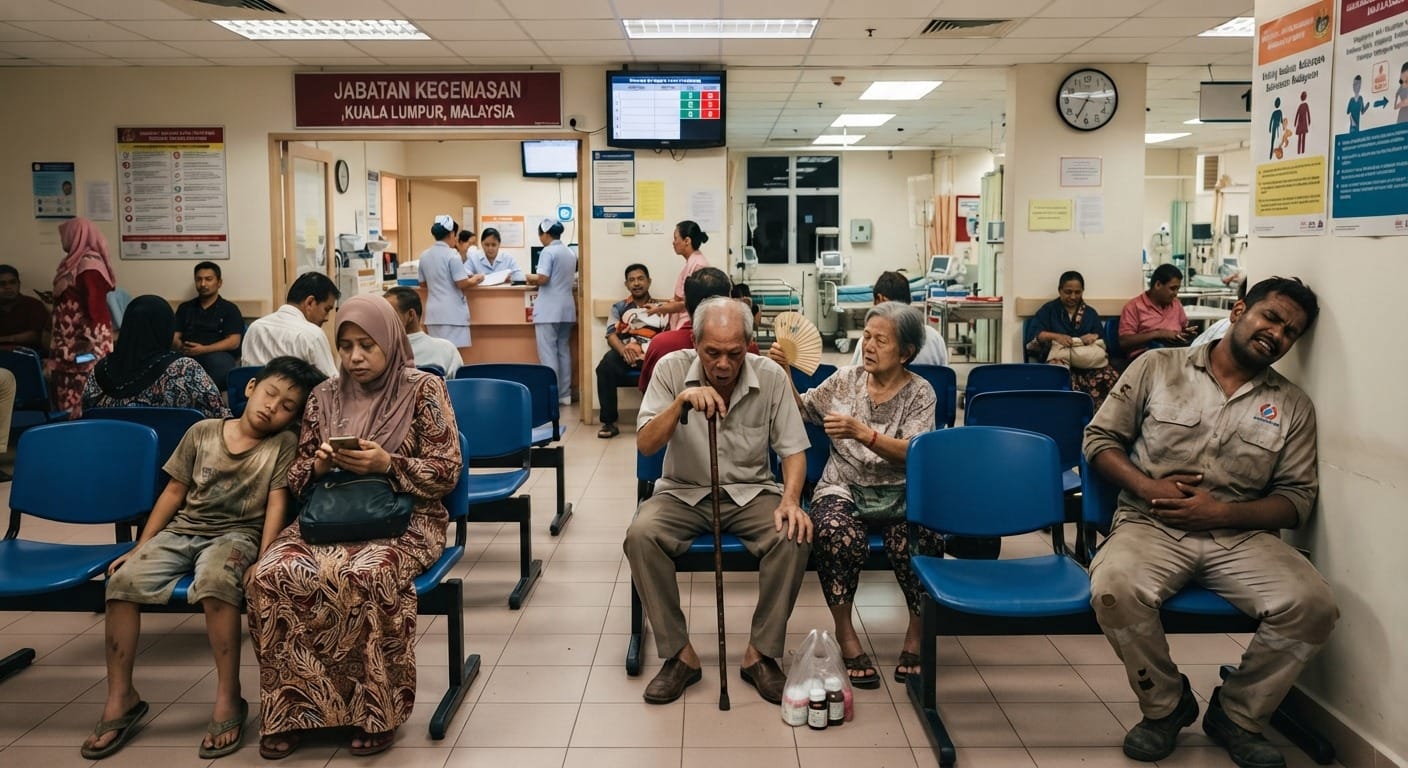
It is 10pm on a weekday. A child has been vomiting since the afternoon. An elderly parent has become increasingly breathless. A worker has developed severe abdominal pain after a long day at work. The nearby clinic is closed, the next available appointment at the specialist clinic is tomorrow, and the hospital emergency department is open. So, the family goes to the emergency department.
For many Malaysians, this is an increasingly familiar scenario. The emergency department has become the one part of the healthcare system that is reliably open, accessible and prepared to deal with uncertainty. But this raises an important question – has the emergency department become the safety net for a healthcare system that sometimes struggles to provide care elsewhere?
The emergency department is not simply a place for accidents
When people think of an emergency department, they may picture road traffic accidents, heart attacks, strokes or patients arriving by ambulance. These are certainly part of emergency medicine. But emergency departments are also designed to manage patients whose diagnoses are not immediately obvious.
Chest pain could be indigestion or a heart attack. A headache could be a migraine or a brain haemorrhage. Fever could be a viral infection or the beginning of sepsis. Abdominal pain could be gastritis or appendicitis. The patient does not necessarily know which one it is.
That uncertainty is precisely why emergency medicine exists. Emergency departments are designed to rapidly assess undifferentiated illness, identify patients at risk of deterioration and provide time-sensitive treatment. The World Health Organisation describes emergency care as an integrated platform for accessible, quality and time-sensitive care for acute illness and injury (Emergency and Critical Care).
This distinction matters. A patient does not have to know that they are having a heart attack before seeking emergency care. They only need to recognise that something is sufficiently concerning to require assessment.
So why are so many people coming?
The answer is more complicated than saying that people choose the emergency department because it is convenient. For many people, it is simply the most dependable option.
Emergency departments operate around the clock. They generally do not require an appointment. They can provide access to doctors, nurses, investigations and, when necessary, specialists. They can also determine whether a patient needs admission or can safely go home.
Compare this with the reality of healthcare outside the hospital. A working adult may finish work after a clinic has closed. A parent may not be able to obtain a same-day appointment for a sick child. An elderly person may have difficulty navigating several different services. A patient may simply be uncertain whether a symptom can safely wait until tomorrow.
These are not necessarily failures of individual patients. They are characteristics of how healthcare is organized.
A 2026 policy brief from the WHO European Observatory on Health Systems and Policies identified insufficient same-day and out-of-hours primary care capacity as one reason patients bypass primary care and seek urgent or emergency hospital services. It also identified workforce shortages and patient confidence in primary care as contributing factors (Challenges in Urgent and Emergency Care).
The issue, therefore, is not merely that patients are coming to the emergency department. It is that the alternatives may not always be available when patients need them.
What about the patient who is not having an emergency?
This is where the conversation often becomes unnecessarily judgemental.
Emergency departments do see patients whose conditions are not life-threatening. But determining this is part of the job. Patients are not expected to arrive with a diagnosis. They arrive with symptoms.
A person with chest discomfort may eventually be diagnosed with reflux. A patient with dizziness may turn out to have nothing dangerous. The fact that the final diagnosis is not an emergency does not necessarily mean the decision to seek medical assessment was unreasonable.
This is why triage is so important.
Patients are prioritised according to clinical urgency rather than simply the order in which they arrive. Someone with a life-threatening condition may be assessed before someone who has been waiting longer, even if the latter person understandably feels frustrated. From the patient’s perspective, everyone appears to be waiting.
From the emergency team’s perspective, patients are constantly being reassessed according to changing clinical priorities.
The bigger problem may actually be outside the emergency department
There is another part of this story that the public may not see. A patient may arrive at the emergency department appropriately, be assessed, undergo investigations and be found to require hospital admission. But what happens next?
If there is no available ward bed, the patient may remain in the emergency department. Meanwhile, ambulances continue to arrive. Walk-in patients continue to come through the doors. More patients require investigations, treatment and observation. Eventually, the emergency department becomes crowded.
This is why emergency department overcrowding cannot always be solved by simple asking the emergency department to work faster.
If admitted patients cannot move to inpatient wards, capacity in the emergency department becomes restricted. If primary care services cannot accommodate urgent patients, more people may arrive at the hospital. If ambulance services are stretched, access to emergency care is affected.
In other words, overcrowding can be a symptom of a problem affecting the entire healthcare system.
Malaysia has recognized the importance of patient flow. The Ministry of Health’s National Patient Flow Management System aims to improve movement of patients through hospitals and reduce congestion, including pressure on emergency departments (Hospital Planning).
The solution to an overcrowded emergency department may therefore not always be found inside the emergency department itself.
So where should patients go?
There is a practical question we should help the public answer: when should someone go to the emergency department and when might a GP or primary care service be more appropriate?
A simple rule can help.
If there is a possible immediate threat to life or major loss of function – such as severe difficulty breathing, significant chest pain, sudden weakness or difficulty speaking, loss of consciousness, severe bleeding, serious injury or rapidly worsening illness – the emergency department or 999 is appropriate.
If the person is stable but needs medical attention, a GP or primary care service may be a better first step for problems such as uncomplicated fever, cough, mild gastrointestinal illness, medication concerns or stable chronic conditions.
And if the person is genuinely unsure, it is okay to seek medical advice. The public should not be expected to diagnose themselves.
The purpose is not to keep people away from the emergency departments. It is to help people access the right care at the right time.
The answer is not to tell people to stop coming to emergency departments. Instead, the healthcare system should make it easier to choose the right level of care. This is consistent with the WHO’s approach – urgent and emergency care should be viewed as an interconnected system involving primary care, ambulances, hospitals and emergency departments (Progress on Emergency, Critical and Operative Care).
Perhaps we are asking the wrong question
The emergency department was never designed to be everyone’s clinic. But neither should it be criticised for becoming the place people turn to when other doors are difficult to open.
Emergency physicians see the consequences of a healthcare system’s strengths and weaknesses every day. They see the patient with a genuine life-threatening emergency. They also see the elderly patient who has nowhere else to go at midnight, the working parent who cannot obtain an appointment and the patient who simply does not know whether their symptoms are dangerous.
These are different problems arriving through the same door.
“Why do so many people feel that this is the safest door to knock on?”
If the emergency department has become the healthcare system’s safety net, strengthening the emergency department is important – but strengthening everything around it may be even more important.
The goal should not be to keep people away from the emergency departments. It should be to build a healthcare system in which people can confidently access the right care, place and at the right time, while ensuring that when someone truly is having an emergency, the system is ready for them.
References
- World Health Organization. Emergency care. WHO. https://www.who.int/health-topics/emergency-care
- WHO European Observatory on Health Systems and Policies. Dealing with the challenges in urgent and emergency care: What are the policy options? Policy Brief 74, 2026. https://eurohealthobservatory.who.int/publications/i/dealing-with-the-challenges-in-urgent-and-emergency-care-what-are-the-policy-options
- Ministry of Health Malaysia. A National Patient Flow Management System. Hospital Planning Unit. https://hq.moh.gov.my/perancangan/wp-content/uploads/2024/11/Edited241121_Norms-Guideline-Published-April-2024.pdf
- World Health Organization. Progress on emergency, critical and operative care. 24 May 2025. https://www.who.int/news/item/24-05-2025-progress-on-emergency--critical-and-operative-care

Dr. Nurul Huda Ahmad. Lecturer & Emergency Medicine Consultant, Faculty of Medicine & Al-Sultan Abdullah Hospital, Universiti Teknologi MARA.
陈沱良医生DrSeb (drsebchannel@gmail.com) is a content creator under the Newswav Creator programme, where you get to express yourself, be a citizen journalist, and at the same time monetize your content & reach millions of users on Newswav. Log in to creator.newswav.com and become a Newswav Creator now!
The User Content (as defined on Newswav Terms of Use) above including the views expressed and media (pictures, videos, citations etc) were submitted & posted by the author. Newswav is solely an aggregation platform that hosts the User Content. If you have any questions about the content, copyright or other issues of the work, please contact creator@newswav.com.