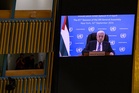
Japan’s prime minister Sanae Takaichi has called for the United Nations Charter to be amended to remove references to “enemy states” – a legacy of the Second World War that has resurfaced amid worsening tensions between Tokyo and Beijing.
Speaking at the UN General Assembly (UNGA) in New York on Tuesday, Ms Takaichi said the 81-year-old founding document needed to be reviewed as “reform of the United Nations is essential”.
This is Ms Takaichi’s first appearance before the UNGA.
She said: “Regarding the so-called ‘enemy states’ clauses, a United Nations General Assembly resolution was adopted in 2005 to delete references to ‘enemy states’ from the Charter of the United Nations, expressing the resolve of the heads of state and government of all member states.”
“In accordance with this resolution, these clauses must be deleted.”
What are the ‘enemy state’ clauses?
The provisions appear in Articles 53, 77 and 107 of the UN Charter. They refer to countries that fought against the allies in WWII, including Japan, Germany and Italy, and set out rules for dealing with “any state which during the Second World War has been an enemy of any signatory of the present Charter”.
They were included in the 1945 Charter to allow WWII allies to take action against the defeated Axis powers – including Japan, Germany and Italy.
Japan became a UN member in 1956, 11 years after its defeat.
In 1995 during the 50th anniversary session, the UNGA declared the clauses obsolete and expressed its intention to remove them. In 2005, during the 60th anniversary of the UN founding, world leaders again backed deleting the references.
But they remain in the Charter because formally amending it is a lengthy process requiring approval by two-thirds of the General Assembly and ratification by two-thirds of UN member states, including all of the five permanent members of the Security Council – which includes China and Russia besides Britain, France, and the US.
Why does Japan want the clauses removed?
During her speech at the UNGA, Ms Takaichi reiterated that Japan was a “peace-loving nation”.
“Japan takes pride and honour in its significant contributions to the efforts of the United Nations for the last 70 years.”
CCTV: On September 22 local time, Prime Minister of Japan Sanae Takaichi said at the UN General Assembly that Japan has consistently contributed to the peace and prosperity of the international community as a peace-loving nation, under its exclusively defense-oriented policy. It… pic.twitter.com/mhUMUCptBr
— Chinese Embassy in UK (@ChineseEmbinUK) September 23, 2026
“Since the end of the Second World War, Japan, as a peace-loving nation, has attached great importance to the rule of law in the settlement of any disputes. This is demonstrated by Japan’s consistent support for, and its contributions of judges to, various international judicial organs, such as the International Court of Justice (ICJ), the International Criminal Court (ICC) and the International Tribunal for the Law of the Sea (ITLOS).
“We established a unit for peace mediation within the government of Japan in March of this year. Japan will play a more proactive role in the peaceful settlement of disputes,” she said.
Tokyo argues that retaining language created for the immediate aftermath of WWII no longer reflects its current position in the international system.
Former UN official Hitoki Den, author of “Story of the UN: From the Notes of a Political Affairs Officer”, once called the “enemy states” label an “embarrassment”.
“While it is widely believed that the enemy state clauses have become obsolete, totally irrelevant in today’s global politics, their existence in the charter…. remains an embarrassment for the countries defined as former enemy states, as well as for the UN itself,” he wrote in The Japan Times years ago.
MFA spokesperson on Japanese PM’s call for deletion of “Enemy State Clauses”:
— CHINA MFA Spokesperson 中国外交部发言人 (@MFA_China) September 23, 2026
The Enemy State Clauses are a legal mechanism in the UN Charter. For 81 years, these clauses have served to prevent the resurgence of fascism and militarism and defend the postwar international order.… pic.twitter.com/1IJJ6zkgSd
The call to remove the “enemy state” clauses also comes alongside Japan’s broader push for a greater role in the UN.
Ms Takaichi argued on Tuesday that the Security Council’s current structure reflects the world of 1945 and called for more permanent and non-permanent members.
Jeff Kingston, a professor of modern Japanese politics and history at Temple University’s Tokyo campus, told The New York Times that Ms Takaichi “is playing to an international audience and seeking to highlight how this outdated clause is politicised by Japan’s adversaries”.
He believes that the Japanese leader wanted to remind the US “whose side Japan has been on for the past eight decades as a model international citizen”.
He says Ms Takaichi was also warning China and Russia that Japan will not accept their invoking Japan’s wartime status in current disputes.
Why is China objecting?
Ms Takaichi’s remarks have added to the tension between Beijing and Tokyo as it comes amid deteriorating relations over Taiwan.
Beijing has previously invoked Japan’s status as a defeated WWII power in opposing Ms Takaichi’s comments on Taiwan. It has cited the 1943 Cairo Declaration and the 1945 Potsdam Proclamation, which set out Allied terms for Japan’s surrender and called for territories seized by Japan to be returned.
China argues that these wartime agreements form part of the postwar settlement and place limits on Japan’s role in any Taiwan conflict.
Enshrining this wartime designation of Japan 🇯🇵 (and also Germany and Italy) as an "enemy state" in the founding document of the UN was a mistake of specificity, freezing and ossifying a particular moment into language that no longer reflects reality.
— Melissa Chen (@MsMelChen) September 23, 2026
Today these nations are… pic.twitter.com/8iVa0Zo6BV
Taiwan, on the other hand, disputes this interpretation, arguing that the Cairo Declaration and Potsdam Proclamation were wartime political statements rather than legally binding treaties.
China sees the “enemy state” clauses as part of the safeguards created after WWII to prevent a return to militarism by the defeated Axis powers.
Chinese foreign ministry spokesperson Guo Jiakun rejected Ms Takaichi’s description of Japan as a peaceful nation, saying: “Rather than what Japan says, the world cares more about what Japan does.”
He said the clauses remained a “vital institutional arrangement” designed to prevent “fascism and militarism from threatening international peace and security ever again”.
“The clauses provide important institutional safeguards for defending postwar international order and remain extremely relevant today.”
Mr Guo said: “The postwar ‘country for peace’ image that Japan seeks to establish can only be realised by repenting its history and making a clean break with militarism. The reality with the current Japanese administration, however, is a constant denial of the history of aggression, glorification of Japan’s wartime crimes, and a series of moves to rearm Japan, accelerate remilitarisation, seek to ditch the three non-nuclear principles, and revise the pacifist constitution.”
“The moves constitute a blatant challenge to the postwar international order, and a major factor threatening peace and stability in the region.
“We urge Japan to take history as a mirror, deeply repent, and earn the trust of its Asian neighbours and the international community through concrete actions,” he said.
Prime Minister Takaichi Sanae's speech before the UN general assembly asked that the UN Charter's enemy states clauses, a relic of WW2, be changed to remove Japan.
— Jeffrey J. Hall 🇯🇵🇺🇸 (@mrjeffu) September 23, 2026
It is unlikely this will happen any time soon because China is against such a change.pic.twitter.com/Ptr9wKWasm
China has also directly linked Ms Takaichi’s Taiwan comments to its concerns about Japan’s changing security posture.
In November last year, China’s ambassador to the UN, Fu Cong, sent a letter to UN secretary-general António Guterres over Ms Takaichi’s remarks on Taiwan.
He said, “Takaichi blatantly made provocative remarks on Taiwan”, adding that “this marks the first time since Japan’s defeat in 1945 that a Japanese leader has advocated in an official setting the notion that ‘a contingency for Taiwan is a contingency for Japan’ and linked it to the exercise of the right of collective self-defence.”
He said it was “the first time Japan has expressed ambitions to intervene militarily in the Taiwan question; and the first time Japan has issued a threat of force against China, openly challenging China’s core interests.”
It comes as Japan has expanded its defence partnerships across Indo-Pacific.

Lu Chao, a professor at the Liaoning Academy of Social Sciences, told The Global Times that Ms Takaichi’s call at the UN to remove the Charter’s “enemy state” clauses comes as Japan takes a tougher stance on security and increasingly describes China as a security challenge in its defence white papers.
In May this year, Russia criticised Japan’s (and Germany’s) military build-up, and Russian UN ambassador Vassily Nebenzia called their “remilitarisation” a “dangerous threat to global security” that was “undoing the results of World War Two”.
Japan’s UN ambassador Kazuyuki Yamazaki rejected the criticism, saying Japan’s defence expansion was a response to a worsening security environment.
He called it “ridiculous to criticise Japan’s defence posture as militaristic”, especially from a country “continuing its own military aggression” in Ukraine.
Read MoreAt least four killed as Pakistan launches airstrikes on Afghanistan
Almost 170 patients evacuated from hospital threatened by Indonesia wildfires
Two North Korean soldiers captured by Ukraine sent to South Korea, Zelensky says
US couple say last minute decision saved them from Nepal floods that killed 1,400
Two members of North Korean delegation seek asylum in Japan, report says
Japan’s Typhoon Dujuan leaves 10 dead as rescuers continue to search for four missing