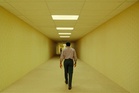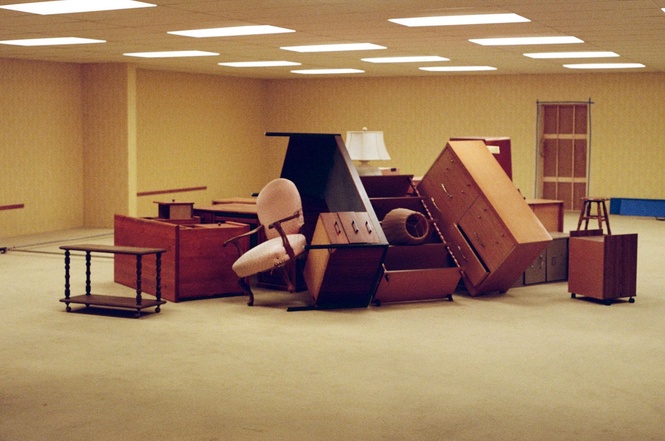
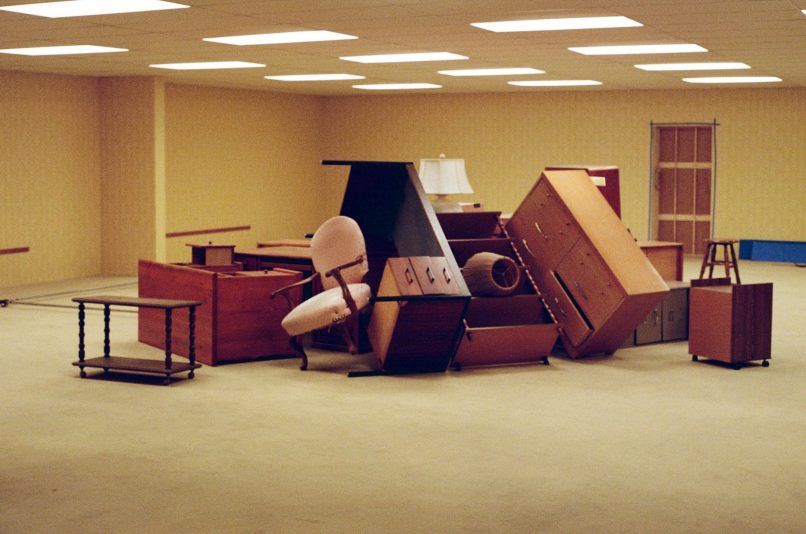
The fluorescent hum. The nothing that breathes. There’s an unnerving silence in the theatre when Clark is walking through the Backrooms in A24’s biggest hit. There are no flickering lights or jump scares, just an overbearing ominous sound that takes hold of your heart without you even realising it. It’s almost like the yellow maze extends into the theatre itself. That’s the sound of Kane Parsons directorial debut, Backrooms, which is now becoming a sub culture.
When we sit for the official early screening of Backrooms in India hosted by PVR Inox India, Prithvi Dot is playing an ambient DJ set on the console ahead of the film. Music before a Youtube / 4chan thread inspired horror film- what’s the relation one would wonder ? Yet, music is etched into the very walls of the Backrooms, albeit a very special kind of sound. By now you must be aware of the ‘liminal spaces’ and ‘liminal horror’ used by Parsons in his debut film. With the soundtrack, co-composed by the 20-year old director, he gives life to ‘liminal music’ and hauntology.
How Kane Parsons uses ‘liminal music’ , sound and silence in Backrooms
What Parsons and co-composer Edo van Breemen built for Backrooms is not a score in any conventional sense. It is constructed from room tones, ambient textures, and the hum of fluorescent lights the building blocks of a space that should feel familiar but doesn’t. The palette runs on analog synths, tape-warped pads, and sub-bass dread, sitting somewhere between Van Breemen’s clinical horror electronics and Parsons’ own glitchy liminal minimalism, and together the best moments merge both into something that sounds like fluorescent hum given a melody. This sound becomes the horror in Backrooms.
Parsons has cited the likes of Aphex Twin, Boards of Canada, and Burial as his influences. Those three names and their atmospheric, eerie almost otherworldy sounds are what the cultural theorists Mark Fisher and Simon Reynolds called hauntology: the art of making the past sound like it’s haunting the present. That eerie plane of music is where the sound of the Backrooms exists. All three treat absence as a compositional element. All three make the listener feel like they’ve wandered somewhere they shouldn’t be. All three are, in retrospect, the blueprint of Backrooms‘ music.
Boards of Canada’s music especially has frequently been described as hauntological, conjuring hazy images of cultural memories and lost futures. When Parsons chose to end the film’s credits with Boards of Canada’s ‘The Word Becomes Flesh,’ from the recently released album Inferno, it wasn’t just an easter egg for the followers of hauntology music but a well thought out conclusion to the eerie film. The two works share themes of liminality, nostalgia, analog media, and cryptic mystery. It’s a showcase of Parsons’ intellectual lineage, much like his use of ‘B1 – All that follows is true’, from The Caretaker, a music project by James Leyland Kirby, another track based on dementia, nostalgia and memory.
What is ‘liminal music’?
What is this ‘Liminal Music’ that Parsons seems to rely on so much throughout his storytelling? Essentially it is based on his concept of liminal horror, spaces and nostalgia. Liminal music provokes a sense of nostalgia for a time or place we haven’t even lived through. There’s also a certain eeriness to the music that isn’t exactly comforting. And that is precisely the point. The music delivers a sensation that cannot be described and has no particular call to action – just like the film, and yet manages to keep you on the edge of the seat. Liminal music typically uses techniques like time-stretching and reverb, slowing down and layering sounds to create an elongated, dreamlike effect, alongside tape hiss and vinyl crackle to simulate the passage of time. These production choices are the building blocks of hauntology. What’s new with Backrooms is the scale of the audience, and the unique audio-visual delivery. People are now searching the music that sounds like forgetting something important. They are doing so deliberately, repeatedly, and in enormous numbers.
How Backrooms have inspired a music sub-culture
As part of the promotions- A24 hosted first-ever live DJ set from inside the Backrooms, played by ambient music producer Instupendo, who’s viral track “Six Forty Seven,” has been paired with liminal space and Backrooms lore videos for years. That is what the Backrooms’ music or liminal music culture has created today, an entire generation of people who before or after watching the film, or even playing the associated video games have been seeking this music out as a lifestyle.
Playboi Carti and Travis Scott’s “BACKR00MS” was a track directly inspired by the 4chan creepypasta. While the rap was more traditional in essence, the production was a minimalist, hazy, and incredibly dark trap beat and the visuals of harsh fluorescent lighting, sterile walls, and a lo-fi, grainy camera aesthetic deliberately takes inspiration from the viral found-footage series popularized by Kane Parsons on YouTube. This haunting audio-visual production mimics the disorienting, endless, and dreamlike anxiety of being trapped in a liminal space.
On Spotify , playlists like “liminal,” “Liminal Ambient 2025,” and “Liminal Spaces / Backrooms / Uncanny Songs” have accumulated hundreds of thousands of saves, and people use them as background listening while reading, studying, or playing video games, I myself am guilty of the same. But this is not about people processing fear through music. It’s more about cueing up these ominous sounds the way one would put on whale sounds, or rainforest ambience, or lo-fi hip hop beats: to concentrate, to feel something, to find a kind of peace inside the unease.
And that’s a bit concerning.
We are in fact living in a cultural moment where the most popular aesthetic outside of the internet and in your personal living/ work places is the sensation of being lost in a place no one else knows about. Liminal music suspends us between nostalgia and unease, a feeling of being unanchored and somehow, in 2026, being unanchored is what we seem to want.
The age of anxiety: Why does Gen Z find comfort in feeling unanchored?
The question this raises is: why now? Why does creepy, unnerving music suddenly seem comforting and the answer is- anxiety. We as a chronically online generation are collectively overstimulated, and the backrooms represent the analogue anti-stimulation of that. A space of pure absence, with a score that matches it. The backrooms aesthetic, and its music especially, is haunted by life in a way that is culturally significant. The yellow-lit corridors, the commercial carpet, the humming overhead lights these are the textures of late-capitalist non-spaces. Shopping mall service corridors. Office building sub-basements, the backrooms is basically the infrastructure of everyday life, unmoored from that logical function and therefore it’s… comforting. The music mirrors this.
To listen to a backrooms playlist in 2026 is, in some sense, to grieve the life that has been replaced by glass and apps and frictionless surfaces. In an era of horror films that use orchestral stings and sound design as blunt instruments, Backrooms operates on a different nervous system of anonymity and aloofness. Parsons thinks of the music as environment and he is building a place to be lost in not just figuratively but sonically as well. The subculture that has grown up around backrooms music understands this, and the playlists are about inhabiting that third space the film describes, devoid of digital fallacies and instead based on an analogue emotion. They are for the listeners choosing to be lost, on purpose, in a place that does not exist, that sounds like everywhere they have ever been and nowhere they have ever stayed. Central to that liminal aesthetic is the complete absence of humans, a personal loneliness that people today seem to be relating to and now, pressing play on that feeling during their commutes, work and even free time.
Note : The information in this article is accurate as of the date of publication.